

The story: 初めての仕事
Read the text from top to bottom without stopping. Guess unknown words from the situation, then check the glosses. The narrator is a new employee writing about the day in polite style.
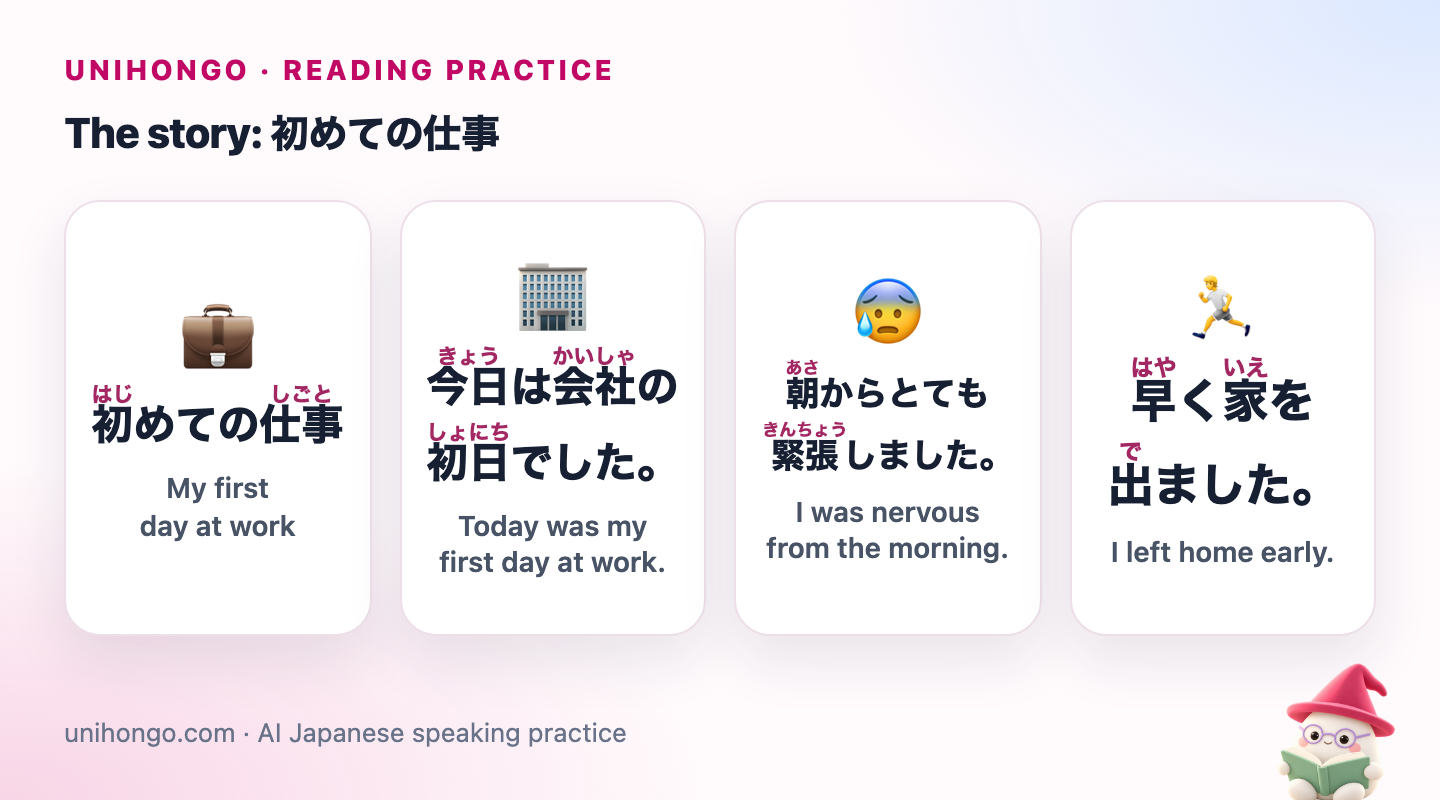
| Japanese | Romaji | Meaning |
|---|---|---|
| 初めての仕事 | Hajimete no shigoto | My first day at work |
| 今日は会社の初日でした。 | Kyō wa kaisha no shonichi deshita. | Today was my first day at work. |
| 朝からとても緊張しました。 | Asa kara totemo kinchō shimashita. | I was nervous from the morning. |
| 早く家を出ました。 | Hayaku ie o demashita. | I left home early. |
| 会社に着いた時、まだ八時でした。 | Kaisha ni tsuita toki, mada hachiji deshita. | When I got to the office, it was still only eight. |
| 受付で名前を言うと、田中さんが来てくれました。 | Uketsuke de namae o iu to, Tanaka-san ga kite kuremashita. | When I gave my name at reception, Ms Tanaka came to meet me. |
| 田中さんは私の先輩で、とても優しい人です。 | Tanaka-san wa watashi no senpai de, totemo yasashii hito desu. | Ms Tanaka is my senior colleague, and she is very kind. |
| 最初に、みんなの前で自己紹介をしました。 | Saisho ni, minna no mae de jiko shōkai o shimashita. | First, I introduced myself in front of everyone. |
| 声が小さかったので、もう一度言いました。 | Koe ga chiisakatta node, mō ichido iimashita. | My voice was too quiet, so I said it again. |
| 午前中は、パソコンの使い方を教えてもらいました。 | Gozenchū wa, pasokon no tsukaikata o oshiete moraimashita. | In the morning, I was shown how to use the computer. |
| 昼ごはんは先輩たちと近くの店で食べました。 | Hirugohan wa senpaitachi to chikaku no mise de tabemashita. | I had lunch with my senior colleagues at a place nearby. |
| 私はこんなに大きい会社で働いたことがありません。 | Watashi wa konna ni ōkii kaisha de hataraita koto ga arimasen. | I have never worked at such a big company before. |
| だから、分からないことがたくさんありました。 | Dakara, wakaranai koto ga takusan arimashita. | So there were lots of things I didn't understand. |
| でも、田中さんが「何でも聞いてね」と言ってくれました。 | Demo, Tanaka-san ga "Nandemo kiite ne" to itte kuremashita. | But Ms Tanaka told me, "Ask me anything." |
| 六時に仕事が終わって、疲れて家に帰りました。 | Rokuji ni shigoto ga owatte, tsukarete ie ni kaerimashita. | Work finished at six, and I went home tired. |
| 明日はもっと上手に話せると思います。 | Ashita wa motto jōzu ni hanaseru to omoimasu. | I think I'll be able to speak better tomorrow. |
Vocabulary notes
These are the words most likely to slow you down. Learn them as they appear in the story rather than as a separate list: the story gives each one a picture to hang on.
| Japanese | Romaji | Meaning |
|---|---|---|
| 初日 | shonichi | first day (of a job, an event or a sale) |
| 緊張する | kinchō suru | to be nervous, tense |
| 受付 | uketsuke | reception desk |
| 先輩 | senpai | senior colleague or student, someone who joined before you |
| 自己紹介 | jiko shōkai | self-introduction |
| 使い方 | tsukaikata | how to use (verb stem + 方) |
| 午前中 | gozenchū | during the morning, before noon |
| 働く | hataraku | to work |
| 疲れる | tsukareru | to get tired |
| 上手に話せる | jōzu ni hanaseru | to be able to speak well |
Two words deserve a closer look. 初日 is read shonichi, not hatsuhi: the second reading exists but means the first sunrise of the year. And 先輩 is not a job title. It simply means someone who started before you, so a 25-year-old can be the senpai of a 40-year-old new hire. You call them by name plus さん, not by the word senpai, in most offices.
Grammar notes: four N4 patterns in the text
Each pattern below appears in the story. The first row is the line from the text, the second is a new example so you can see the pattern in a different situation.
〜ので gives a reason in a soft, explanatory way. The reason comes first, the result second. Compared with 〜から, it sounds more polite and objective, which is why it fits a work diary.
| Japanese | Romaji | Meaning |
|---|---|---|
| 声が小さかったので、もう一度言いました。 | Koe ga chiisakatta node, mō ichido iimashita. | From the text: My voice was too quiet, so I said it again. |
| 雨が降っていたので、タクシーで行きました。 | Ame ga futte ita node, takushī de ikimashita. | It was raining, so I went by taxi. |
| こんなに大きい会社で働いたことがありません。 | Konna ni ōkii kaisha de hataraita koto ga arimasen. | From the text: I've never worked at such a big company. |
| 日本で働いたことがありますか。 | Nihon de hataraita koto ga arimasu ka. | Have you ever worked in Japan? |
| 田中さんが来てくれました。 | Tanaka-san ga kite kuremashita. | From the text: Ms Tanaka came (for me). |
| 友だちが駅まで送ってくれました。 | Tomodachi ga eki made okutte kuremashita. | A friend gave me a lift to the station. |
| もっと上手に話せると思います。 | Motto jōzu ni hanaseru to omoimasu. | From the text: I think I'll be able to speak better. |
| 来週は忙しくなると思います。 | Raishū wa isogashiku naru to omoimasu. | I think next week will get busy. |
〜たことがあります uses the plain past (た form) plus こと, a thing. Use it for experiences, not for things you did this morning: 今朝コーヒーを飲んだことがあります sounds strange. 〜てくれる means someone did something for me or my group; 〜てもらう, as in 教えてもらいました, looks at the same favour from the receiver's side: I got her to show me. Finally, 〜と思います always takes a plain form before it: 話せると思います, not 話せますと思います.
Polite phrases for a real first day
The story only reports what happened. On an actual first day in a Japanese workplace, a few set phrases do most of the work. They are polite or very polite, because you are new and speaking to people above you. Exact customs vary by company and industry, but these are safe almost everywhere.
お世話になります is the classic opening for a new relationship at work, and お先に失礼します is what you say when you leave before others. The reply you will hear is お疲れさまでした. Do not say ご苦労さま to seniors: it sounds as if you are thanking someone below you.
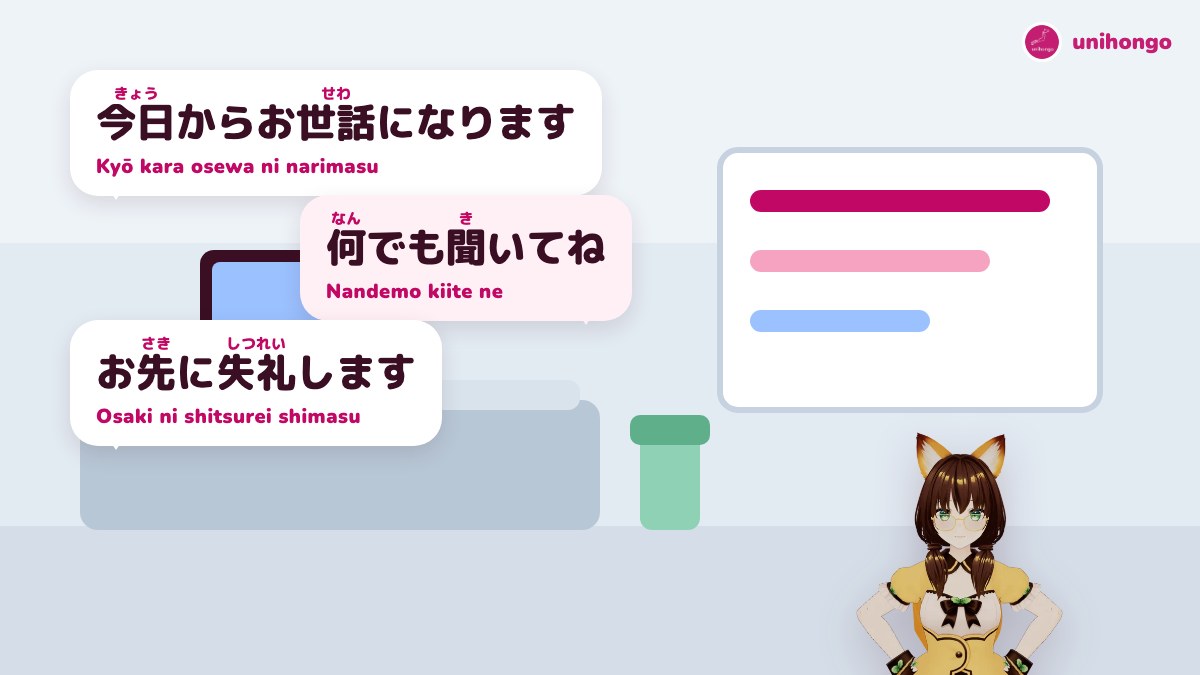
| Japanese | Romaji | Meaning |
|---|---|---|
| 今日からお世話になります、スミスです。 | Kyō kara osewa ni narimasu, Sumisu desu. | I'm Smith, and I'll be working with you from today. |
| どうぞよろしくお願いいたします。 | Dōzo yoroshiku onegai itashimasu. | I look forward to working with you. (very polite) |
| すみません、もう一度お願いします。 | Sumimasen, mō ichido onegai shimasu. | Sorry, could you say that once more? |
| これはどこに置けばいいですか。 | Kore wa doko ni okeba ii desu ka. | Where should I put this? |
| お先に失礼します。 | Osaki ni shitsurei shimasu. | Excuse me for leaving before you. |
| お疲れさまでした。 | Otsukaresama deshita. | Colleague: Thanks for your hard work today. |
Reading traps in this text
- 名前を言うと is not 'say the name and'. 〜と after a plain verb here means when or as soon as: when I gave my name, she came.
- 先輩で、とても優しい人です joins two descriptions with で, the て form of です. Read it as she is my senior and very kind, not as a place marker.
- 教えてもらいました does not mean I taught. The person who taught is hidden; the narrator received the teaching.
- 疲れて家に帰りました uses the て form for a state: being tired, I went home. It is not a sequence of two separate actions.
- 「何でも聞いてね」 is casual speech inside a polite text. Quotations keep the original speaker's register, so do not be surprised by the change.
Check your understanding
Answer in Japanese if you can, in English if not. The answers are in the next section.
- Why did the narrator say the self-introduction a second time?
- What did the narrator learn during the morning?
- How does the narrator feel about tomorrow?
Answers
| Japanese | Romaji | Meaning |
|---|---|---|
| 声が小さかったからです。 | Koe ga chiisakatta kara desu. | 1. Because their voice was too quiet. |
| パソコンの使い方を教えてもらいました。 | Pasokon no tsukaikata o oshiete moraimashita. | 2. They were shown how to use the computer. |
| 明日はもっと上手に話せると思っています。 | Ashita wa motto jōzu ni hanaseru to omotte imasu. | 3. They think they'll speak better tomorrow. |
Notice the switch in answer 3 from と思います to と思っています. When you report what someone else thinks, Japanese prefers the ている form, because it describes an ongoing state of mind seen from outside.
A read-aloud routine for this story
- Listen to yourself read the first five sentences slowly, pausing at every comma.
- Read the whole text once at a comfortable speed, keeping long vowels long: kinchō, shōkai, jōzu.
- Read it again and group words into chunks: 会社に着いた時 / まだ八時でした.
- Shadow your own recording or read along with a partner, one sentence each.
- Close the text and retell the day in three sentences, using ので once and と思います once.
Turn the story into a conversation
Reading builds the patterns; speaking makes them yours. Ask Mocchi on Unihongo to /explain the sentence 受付で名前を言うと、田中さんが来てくれました, and it will show why と means when here and who the くれました favour goes to. Mocchi keeps track of the points you ask about, so a later quiz can bring back the ones you found hard.
Then open AI Sensei, choose Hana-sensei and ask Hana-sensei to play Ms Tanaka on your first day. Introduce yourself, ask where to put your things, and say goodbye at six. The session report lists the corrections, so you can see whether your お世話になります came out naturally.