

The text: 京都旅行 (A trip to Kyoto)
Read the story once without the English. Try to answer: how did they travel, what happened on the second day, and what did the writer buy?
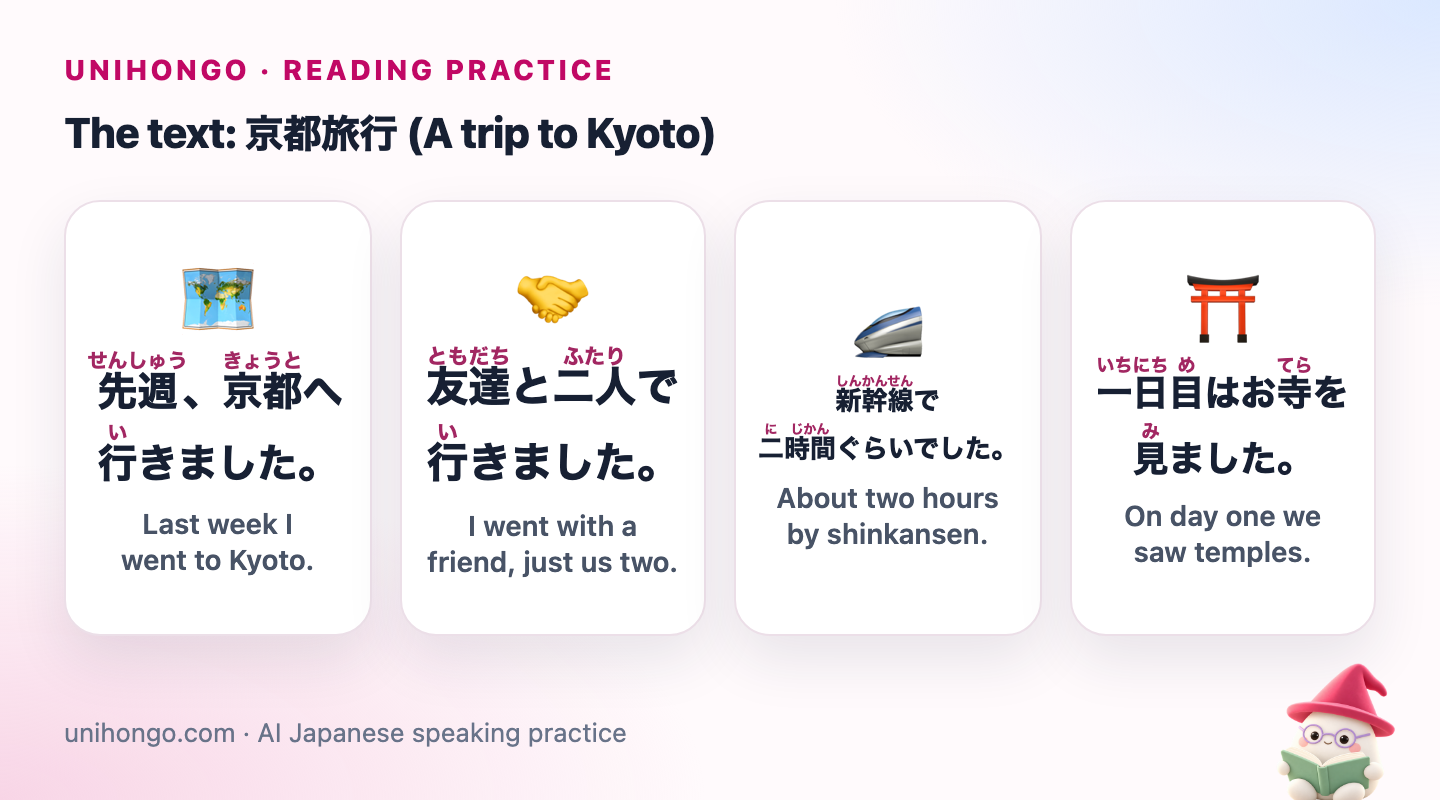
| Japanese | Romaji | Meaning |
|---|---|---|
| 先週、京都へ行きました。 | Senshū, Kyōto e ikimashita. | Last week I went to Kyoto. |
| 友達と二人で行きました。 | Tomodachi to futari de ikimashita. | I went with a friend, just us two. |
| 新幹線で二時間ぐらいでした。 | Shinkansen de nijikan gurai deshita. | About two hours by shinkansen. |
| 一日目はお寺を見ました。 | Ichinichime wa otera o mimashita. | On day one we saw temples. |
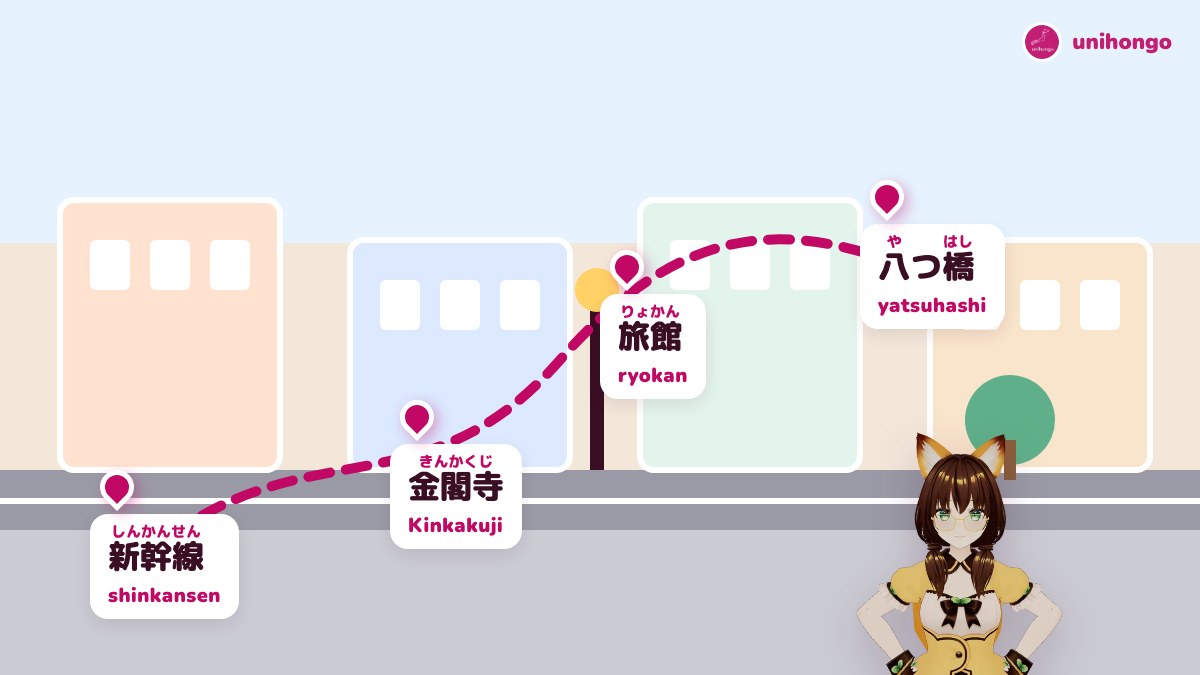
| 金閣寺はとてもきれいでした。 | Kinkakuji wa totemo kirei deshita. | Kinkaku-ji was very beautiful. |
| 人がたくさんいました。 | Hito ga takusan imashita. | There were a lot of people. |
| 夜は旅館に泊まりました。 | Yoru wa ryokan ni tomarimashita. | At night we stayed at a ryokan. |
| 晩ごはんはとてもおいしかったです。 | Bangohan wa totemo oishikatta desu. | Dinner was really delicious. |
| 二日目は雨でした。 | Futsukame wa ame deshita. | On the second day it rained. |
| でも、着物を着て、町を歩きました。 | Demo, kimono o kite, machi o arukimashita. | But we put on kimono and walked around town. |
| 写真をたくさん撮りました。 | Shashin o takusan torimashita. | We took lots of photos. |
| お土産に八つ橋を買いました。 | Omiyage ni yatsuhashi o kaimashita. | I bought yatsuhashi as a souvenir. |
| 京都は楽しかったです。 | Kyōto wa tanoshikatta desu. | Kyoto was a lot of fun. |
| また行きたいです。 | Mata ikitai desu. | I want to go again. |
The text mixes two ways of marking a destination: 京都へ行きました and, later, 旅館に泊まりました. With verbs of movement, へ and に are both fine; へ stresses the direction, に the arrival point. With 泊まります, to stay overnight, only に works.
Vocabulary notes: travel words
These are the words you will use to tell anyone about a trip in Japan. Verbs are in the past ました form, as in the text.
| Japanese | Romaji | Meaning |
|---|---|---|
| 先週 | senshū | last week |
| 二人で | futari de | the two of us, as a pair |
| 新幹線 | shinkansen | bullet train |
| お寺 | otera | Buddhist temple |
| きれい | kirei | beautiful, clean (a な-adjective) |
| 旅館 | ryokan | traditional Japanese inn |
| 泊まりました | tomarimashita | stayed overnight (N4 verb) |
| 着物を着て | kimono o kite | wearing a kimono, putting on a kimono |
| 撮りました | torimashita | took (a photo) |
| お土産 | omiyage | souvenir, a gift from a trip |
きれい ends in い but it is a な-adjective, so its past is きれいでした, not きれかったです. The same is true of 有名 (famous) and 元気 (well), though those do not end in い. きれい and きらい (dislike) are the two classic traps; learn them as exceptions.
Temples (お寺) are Buddhist; shrines (神社, jinja) are Shinto. Kyoto has many of both. Kinkaku-ji, the Golden Pavilion, is a temple.
Grammar notes: four patterns in the text
Each pattern comes with its line from the text and one new example.
| Japanese | Romaji | Meaning |
|---|---|---|
| 京都へ行きました。 | Kyōto e ikimashita. | Verb past: ました. (text) |
| きのう、映画を見ました。 | Kinō, eiga o mimashita. | I saw a film yesterday. (new example) |
| 二日目は雨でした。 | Futsukame wa ame deshita. | Noun past: でした. (text) |
| 先週は休みでした。 | Senshū wa yasumi deshita. | Last week was a holiday. (new example) |
| 京都は楽しかったです。 | Kyōto wa tanoshikatta desu. | い-adjective past: かったです. (text) |
| ホテルは高かったです。 | Hoteru wa takakatta desu. | The hotel was expensive. (new example) |
| 新幹線で行きました。 | Shinkansen de ikimashita. | で for means of transport. (text) |
| バスで空港へ行きました。 | Basu de kūkō e ikimashita. | I went to the airport by bus. (new example) |
| Word type | Present (polite) | Past (polite) | Past negative |
|---|---|---|---|
| Verb | 行きます | 行きました | 行きませんでした |
| Noun | 雨です | 雨でした | 雨じゃなかったです |
| な-adjective | きれいです | きれいでした | きれいじゃなかったです |
| い-adjective | 楽しいです | 楽しかったです | 楽しくなかったです |
The negative past forms in the table do not appear in the text, but you will need them as soon as you answer questions. じゃなかったです is common in speech; in more formal writing you will see ではありませんでした.
Comprehension questions
Answer in the past tense, in short Japanese sentences.
- How did the writer travel to Kyoto?
- What was the weather like on the second day?
- What did the writer buy as a souvenir?
| Japanese | Romaji | Meaning |
|---|---|---|
| 新幹線で行きました。 | Shinkansen de ikimashita. | Answer 1: By shinkansen. |
| 雨でした。 | Ame deshita. | Answer 2: It rained. |
| 八つ橋を買いました。 | Yatsuhashi o kaimashita. | Answer 3: Yatsuhashi. |
If you answered question 1 with 新幹線でした, the meaning gets through, but the full answer with the verb is clearer and closer to what the question asks: どうやって行きましたか, how did you go?
Telling someone about your trip
After any trip, people in Japan ask the same few questions, often at work on the first day back, when travellers may also hand out sweets as souvenirs (customs vary by workplace). Here is a short exchange using the text.
| Japanese | Romaji | Meaning |
|---|---|---|
| 週末、どこかへ行きましたか。 | Shūmatsu, dokoka e ikimashita ka. | Coworker: Did you go anywhere at the weekend? |
| はい、京都へ行きました。 | Hai, Kyōto e ikimashita. | You: Yes, I went to Kyoto. |
| いいですね。どうでしたか。 | Ii desu ne. Dō deshita ka. | Coworker: Nice. How was it? |
| 雨でしたが、楽しかったです。 | Ame deshita ga, tanoshikatta desu. | You: It rained, but it was fun. |
| これ、お土産です。どうぞ。 | Kore, omiyage desu. Dōzo. | You: This is a souvenir for you. Please. |
| わあ、八つ橋!ありがとうございます。 | Wā, yatsuhashi! Arigatō gozaimasu. | Coworker: Oh, yatsuhashi! Thank you. |
Common mistakes with the past tense
- Saying おいしいでした or 楽しいでした. い-adjectives take the past inside: おいしかったです, 楽しかったです.
- Saying きれかったです. きれい is a な-adjective, so its past is きれいでした.
- Using を with 泊まります: 旅館を泊まりました. The place where you stay takes に.
- Reading 二日目 as ninichime. It uses the date reading futsuka: futsukame.
- Mixing tenses inside one story without a reason. Keep events in the past; use the present only for facts that are still true, such as 京都は楽しいところです.
A read-aloud routine for this text
- Read the past endings alone first, as a chant: mashita, deshita, katta desu.
- Read the story slowly, as if telling it to a friend. Smile on 楽しかったです; it really does change your voice.
- Read again at natural speed. The small tsu in katta needs a short pause before the t: tanoshika-t-ta.
- Change three details (city, transport, souvenir) and tell the story again aloud.
- Tell the story of a real trip in eight sentences without notes.
Kyōto has a long ō, and so does dō in dō deshita ka. If you shorten it, Kyōto can sound like kyoto, which is not a word, and listeners may hesitate for a moment.
Retell the trip to a teacher
Before you speak, make sure every past form is solid. Paste any sentence you are unsure of into Mocchi, Unihongo's study assistant, with /explain, for example /explain 着物を着て、町を歩きました, to see how the て form joins two actions. Mocchi remembers which forms you get wrong, so if おいしいでした keeps creeping back, your next /review will test it.
Then retell the trip aloud. In AI Sensei, Sakura-sensei can play a coworker asking about your weekend: tell Sakura-sensei about Kyoto, or about a real trip of your own, and answer Sakura-sensei どうでしたか questions. The session report lists your corrections, which is the quickest way to see whether your past tense held up in speech.