

The text: 私の部屋 (My room)
Read once without the English, and try to picture the room as you go. Where is the desk? What is on it? What is under the bed, and who is on top of it?
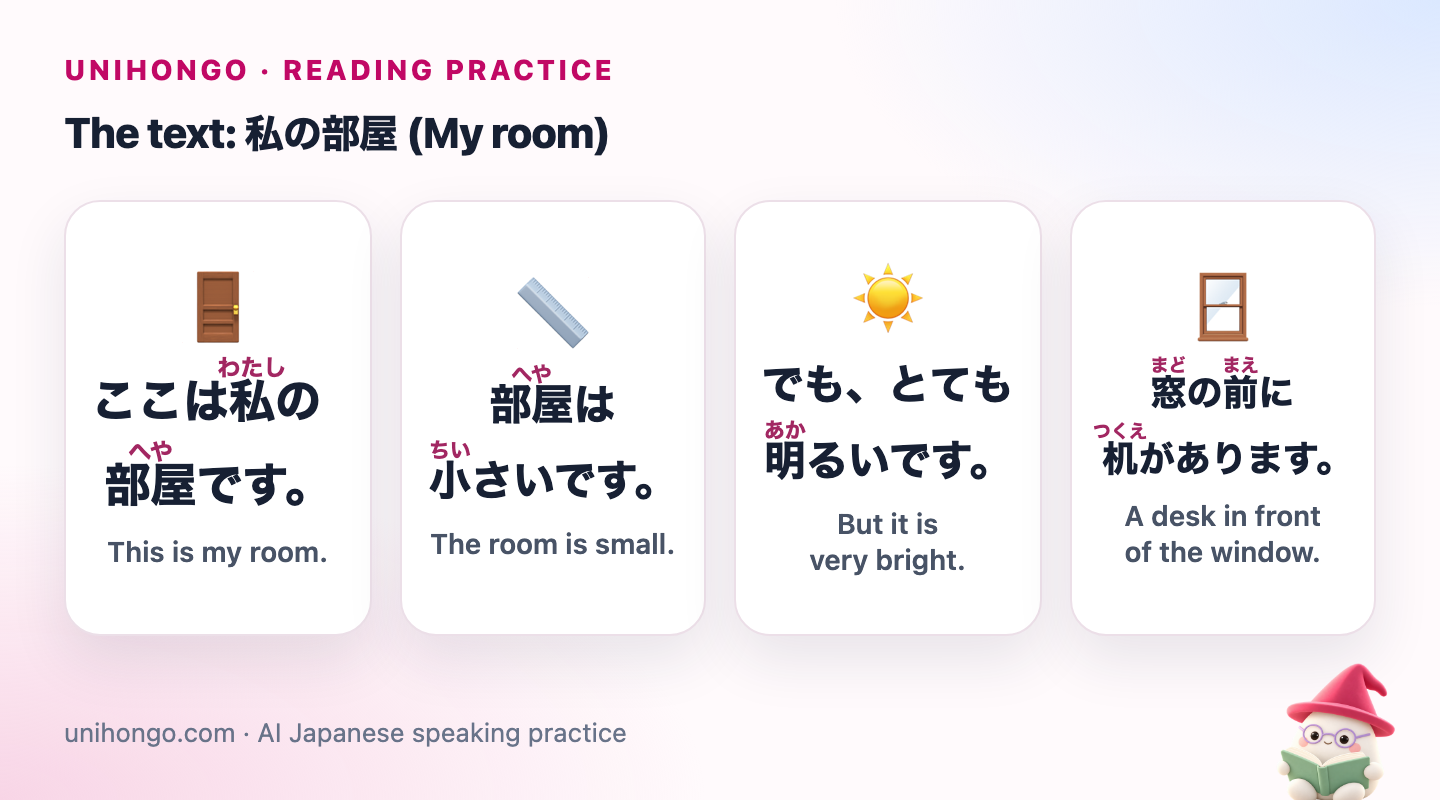
| Japanese | Romaji | Meaning |
|---|---|---|
| ここは私の部屋です。 | Koko wa watashi no heya desu. | This is my room. |
| 部屋は小さいです。 | Heya wa chiisai desu. | The room is small. |
| でも、とても明るいです。 | Demo, totemo akarui desu. | But it is very bright. |
| 窓の前に机があります。 | Mado no mae ni tsukue ga arimasu. | A desk in front of the window. |
| 机の上にパソコンと辞書があります。 | Tsukue no ue ni pasokon to jisho ga arimasu. | On the desk there's a computer and a dictionary. |
| 机の右に本棚があります。 | Tsukue no migi ni hondana ga arimasu. | To the right of the desk there's a bookshelf. |
| 本棚には日本の漫画がたくさんあります。 | Hondana ni wa Nihon no manga ga takusan arimasu. | There's a lot of Japanese manga on the bookshelf. |
| ベッドはドアの近くにあります。 | Beddo wa doa no chikaku ni arimasu. | The bed is near the door. |
| ベッドの下に箱があります。 | Beddo no shita ni hako ga arimasu. | There's a box under the bed. |
| 箱の中に古い写真があります。 | Hako no naka ni furui shashin ga arimasu. | Inside the box there are old photos. |
| ベッドの上にねこがいます。 | Beddo no ue ni neko ga imasu. | There's a cat on the bed. |
| 名前はミルクです。 | Namae wa Miruku desu. | Her name is Miruku (Milk). |
| テレビはありません。 | Terebi wa arimasen. | There's no TV. |
| 私はこの部屋が好きです。 | Watashi wa kono heya ga suki desu. | I like this room. |
Sentence 11 is the only one with います, because the cat is alive. Everything else in the room, from the desk to the photos, uses あります. The cat's name, ミルク, is written in katakana because it is the English word milk; many Japanese pet names are borrowed like this.
Vocabulary notes: things in a room
Learn these with a real object in front of you if you can. Point and say the word: it sticks far better than a list.
| Japanese | Romaji | Meaning |
|---|---|---|
| 部屋 | heya | room |
| 明るい | akarui | bright, light |
| 窓 | mado | window |
| 机 | tsukue | desk |
| パソコン | pasokon | computer, PC |
| 辞書 | jisho | dictionary |
| 本棚 | hondana | bookshelf |
| 箱 | hako | box |
| 写真 | shashin | photo |
| ねこ | neko | cat (kanji 猫) |
本棚 is read hondana, not hontana: the t sound of 棚 (tana) becomes d when it joins another word. This sound change, called rendaku, appears in many compound words, and at N5 it is enough to learn each word with its own reading.
Location words at a glance
All of these follow the same pattern: thing の location に. The table lists the ones in the text and the ones you will need next.
| Word | Reading | Meaning | In the text? |
|---|---|---|---|
| 上 | ue | on, on top of, above | Yes: 机の上, ベッドの上 |
| 下 | shita | under, below | Yes: ベッドの下 |
| 中 | naka | in, inside | Yes: 箱の中 |
| 前 | mae | in front of | Yes: 窓の前 |
| 後ろ | ushiro | behind | No |
| 右 / 左 | migi / hidari | right / left | Yes: 机の右 |
| 近く | chikaku | near | Yes: ドアの近く |
| となり | tonari | next to | No |
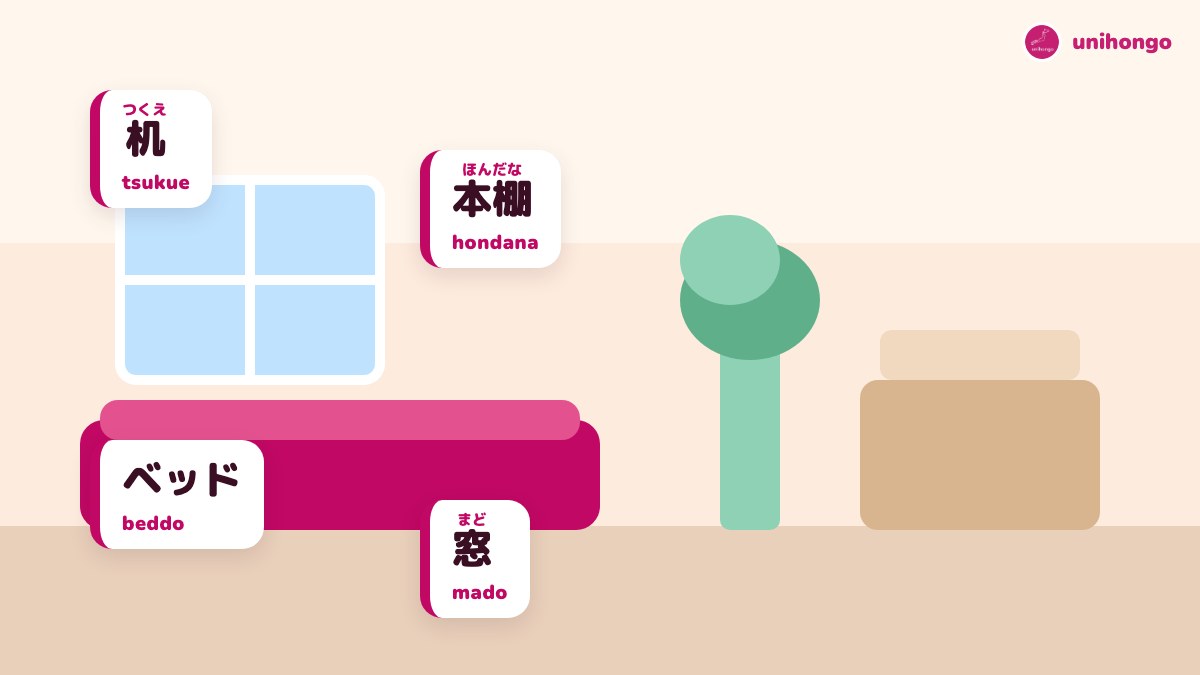
The scene below labels four of the objects so you can check your mental picture. Try to say where each one is before you read the labels.
Grammar notes: four patterns in the text
Each pattern is shown with the sentence from the text and one new example.
| Japanese | Romaji | Meaning |
|---|---|---|
| 窓の前に机があります。 | Mado no mae ni tsukue ga arimasu. | Place に thing が あります. (text) |
| 駅の前に銀行があります。 | Eki no mae ni ginkō ga arimasu. | There's a bank in front of the station. (new example) |
| ベッドはドアの近くにあります。 | Beddo wa doa no chikaku ni arimasu. | Thing は place に あります. (text) |
| トイレは二階にあります。 | Toire wa nikai ni arimasu. | The toilet is on the first floor. (new example) |
| ベッドの上にねこがいます。 | Beddo no ue ni neko ga imasu. | Living things use います. (text) |
| 公園に子どもがいます。 | Kōen ni kodomo ga imasu. | There are children in the park. (new example) |
| テレビはありません。 | Terebi wa arimasen. | Negative: ありません / いません. (text) |
| 部屋に犬はいません。 | Heya ni inu wa imasen. | There's no dog in the room. (new example) |
A note on 二階: in Japan, the ground floor is 一階, so 二階 is the floor above it. British English calls that the first floor and American English the second floor, which is why the gloss can look odd.
The most common mistake is the verb, not the particle: ねこがあります sounds like the cat is an object. If it can walk away, use います.
Comprehension questions
Answer with a short Japanese sentence that uses the location word.
- Where is the desk?
- What is under the bed?
- What is on the bed?
| Japanese | Romaji | Meaning |
|---|---|---|
| 窓の前にあります。 | Mado no mae ni arimasu. | Answer 1: In front of the window. |
| 箱があります。古い写真が入っています。 | Hako ga arimasu. Furui shashin ga haitte imasu. | Answer 2: A box. It has old photos in it. |
| ねこがいます。名前はミルクです。 | Neko ga imasu. Namae wa Miruku desu. | Answer 3: A cat called Miruku. |
Answer 2 adds 入っています, is inside, which is a useful N4 phrase for contents. The text itself uses 箱の中に…あります, which says the same thing in N5 grammar. Both are correct.
Common mistakes when describing a room
- Using あります for animals or people: ねこがあります. Anything alive and moving takes います.
- Putting the location word before の: 上の机 means the upper desk, not on the desk. Say 机の上.
- Using で instead of に with あります: 机の上でパソコンがあります. Existence takes に; で is for actions.
- Answering where-questions with が: パソコンが机の上にあります. When the question is パソコンはどこですか, answer with は: パソコンは机の上にあります.
- Mixing up 右 (migi, right) and 左 (hidari, left). Point with your hand as you read until they become automatic.
A read-aloud routine for this text
- Say the location words alone, touching real objects: tsukue no ue, beddo no shita, mado no mae.
- Read the text slowly, and with each sentence point to the place on your drawing.
- Read it again at natural speed. Keep arimasu and imasu clearly different; they are the heart of the text.
- Swap two objects in your drawing and read the text again, changing the sentences to match.
- Describe your own room aloud in eight sentences without notes.
Describe your room, then give a tour
Write your own eight-sentence room description and paste it into Mocchi, Unihongo's study assistant, with /correct. Mocchi checks あります against います, fixes the particles and explains each change; it also keeps a note of the location words you mix up so a later /review can test them. To read a second room description at the same level, type /read and ask for an N5 text about a kitchen or a classroom.
For speaking, show the room you described to Yamada-sensei in AI Sensei: ask Yamada-sensei to play a friend visiting your new flat, describe what is where, and answer Yamada-sensei's questions about where things are.