

The story: なくした傘
Read the whole text once. The narrator is an office worker in a big city, writing in polite style about something that happened last week.
Before you start, notice how the story is built: a short scene in the rain, a mistake on the train, the moment the narrator notices, two visits to the station and a resolution. Time words open most sentences, so if you get lost, look at the first two or three words of the line to find out when you are.
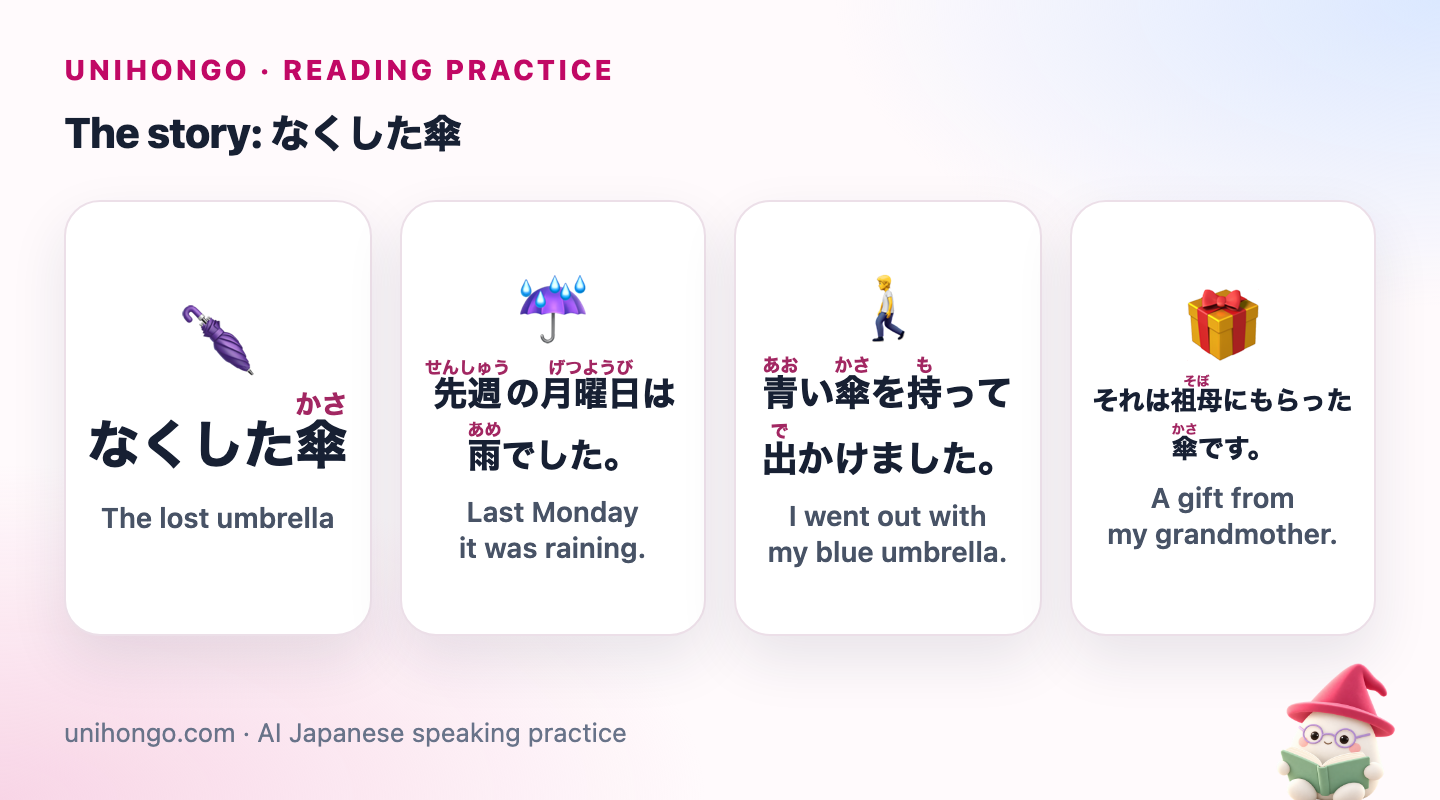
| Japanese | Romaji | Meaning |
|---|---|---|
| なくした傘 | Nakushita kasa | The lost umbrella |
| 先週の月曜日は雨でした。 | Senshū no getsuyōbi wa ame deshita. | Last Monday it was raining. |
| 青い傘を持って出かけました。 | Aoi kasa o motte dekakemashita. | I went out with my blue umbrella. |
| それは祖母にもらった傘です。 | Sore wa sobo ni moratta kasa desu. | A gift from my grandmother. |
| 電車の中で寝てしまったので、急いで降りました。 | Densha no naka de nete shimatta node, isoide orimashita. | I fell asleep on the train, so I got off in a hurry. |
| 駅を出た時、雨はもう止んでいました。 | Eki o deta toki, ame wa mō yande imashita. | When I left the station, the rain had already stopped. |
| 会社に着いてから、傘がないことに気がつきました。 | Kaisha ni tsuite kara, kasa ga nai koto ni ki ga tsukimashita. | After I got to the office, I noticed my umbrella was gone. |
| 電車の中に忘れたと思いました。 | Densha no naka ni wasureta to omoimashita. | I thought I must have left it on the train. |
| 傘をなくしたことは前にもありますが、今度はとても悲しかったです。 | Kasa o nakushita koto wa mae ni mo arimasu ga, kondo wa totemo kanashikatta desu. | I've lost umbrellas before, but this time I was really sad. |
| 仕事の後、駅の忘れ物センターに行きました。 | Shigoto no ato, eki no wasuremono sentā ni ikimashita. | After work, I went to the station's lost-property office. |
| 駅員さんに傘の色と乗った電車の時間を説明しました。 | Ekiin-san ni kasa no iro to notta densha no jikan o setsumei shimashita. | I told the staff the umbrella's colour and the time of my train. |
| 駅員さんは調べてくれましたが、その日は見つかりませんでした。 | Ekiin-san wa shirabete kuremashita ga, sono hi wa mitsukarimasen deshita. | The staff member checked for me, but it wasn't found that day. |
| 二日後、駅から電話がありました。 | Futsuka go, eki kara denwa ga arimashita. | Two days later, the station called me. |
| 終点の駅で私の傘が見つかったそうです。 | Shūten no eki de watashi no kasa ga mitsukatta sō desu. | They said my umbrella had been found at the end of the line. |
| 次の日、その駅まで取りに行きました。 | Tsugi no hi, sono eki made tori ni ikimashita. | The next day, I went to that station to collect it. |
| これからは、降りる前に必ず傘を確認しようと思います。 | Kore kara wa, oriru mae ni kanarazu kasa o kakunin shiyō to omoimasu. | From now on, I'll always check for my umbrella before getting off. |
Vocabulary notes
Station Japanese is very practical: once you know these words, you can read the signs on most platforms.
| Japanese | Romaji | Meaning |
|---|---|---|
| 祖母 | sobo | my grandmother (used about your own family) |
| 急いで | isoide | in a hurry |
| 止む | yamu | to stop (rain, snow, wind) |
| 気がつく | ki ga tsuku | to notice, to realise |
| 忘れ物 | wasuremono | something left behind, lost property |
| 駅員 | ekiin | station staff member |
| 調べる | shiraberu | to check, to look into |
| 見つかる | mitsukaru | to be found |
| 終点 | shūten | last stop, end of the line |
| 確認する | kakunin suru | to check, to confirm |
Notice the pair 見つける (to find something, transitive) and 見つかる (to be found, intransitive). The story uses 見つかる twice because the umbrella is the subject: 傘が見つかった. Japanese often prefers the intransitive verb when the focus is on the result rather than on who did it. Also note 祖母: you use it for your own grandmother, while someone else's is おばあさん.
Grammar notes: regret, experience, hearsay and plans
These four patterns carry the story. The first row of each pair is from the text; the second is a new example.
| Japanese | Romaji | Meaning |
|---|---|---|
| 電車の中で寝てしまいました。 | Densha no naka de nete shimaimashita. | From the text: I fell asleep on the train (oops). |
| ケーキを全部食べてしまいました。 | Kēki o zenbu tabete shimaimashita. | I ended up eating the whole cake. |
| 傘をなくしたことは前にもあります。 | Kasa o nakushita koto wa mae ni mo arimasu. | From the text: I've lost an umbrella before too. |
| 財布を落としたことがあります。 | Saifu o otoshita koto ga arimasu. | I've dropped my wallet before. |
| 私の傘が見つかったそうです。 | Watashi no kasa ga mitsukatta sō desu. | From the text: I heard my umbrella had been found. |
| 明日は雪が降るそうです。 | Ashita wa yuki ga furu sō desu. | I hear it's going to snow tomorrow. |
| 必ず傘を確認しようと思います。 | Kanarazu kasa o kakunin shiyō to omoimasu. | From the text: I intend to always check my umbrella. |
| 今年は毎日日本語を勉強しようと思います。 | Kotoshi wa mainichi nihongo o benkyō shiyō to omoimasu. | I'm planning to study Japanese every day this year. |
In the experience pattern the story writes ことは前にも instead of ことが. The particle は adds contrast: losing umbrellas has happened before, but this time was different. 〜ようと思います uses the volitional form (しよう, 行こう, 食べよう) and states your own intention. Compare it with 〜と思います after a plain verb, which is a guess or opinion: 雨が止むと思います, I think the rain will stop.
Asking about a lost item at the station
In real life the conversation at the station window is short and polite. Staff will ask about the time, the train, the car and the item. Car numbers are usually written inside the train and on the platform, and many people count from the front: 前から三両目, the third car from the front. Have your answers ready and speak in polite form.
If the item is not found at once, staff may take your phone number or give you a reference. Procedures differ between companies, and some have an online form, so it is worth asking どうすればいいですか, what should I do?
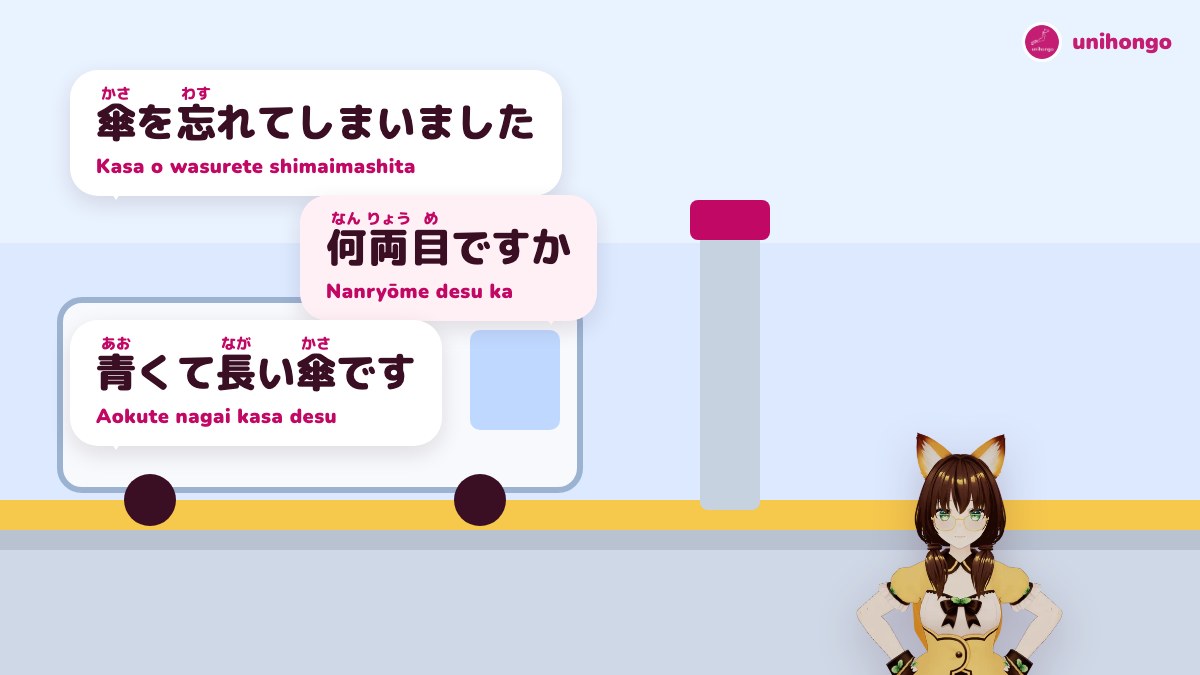
| Japanese | Romaji | Meaning |
|---|---|---|
| すみません、電車に傘を忘れてしまいました。 | Sumimasen, densha ni kasa o wasurete shimaimashita. | You: Excuse me, I left my umbrella on the train. |
| 何時ごろの電車ですか。 | Nanji goro no densha desu ka. | Staff: About what time was the train? |
| 八時十五分ごろの快速です。 | Hachiji jūgofun goro no kaisoku desu. | You: The rapid train at about 8:15. |
| 何両目に乗りましたか。 | Nanryōme ni norimashita ka. | Staff: Which car were you in? |
| 前から三両目です。 | Mae kara sanryōme desu. | You: The third car from the front. |
| どんな傘ですか。 | Donna kasa desu ka. | Staff: What kind of umbrella is it? |
| 青くて長い傘です。 | Aokute nagai kasa desu. | You: It's a long blue umbrella. |
| 見つかったら、連絡してもらえますか。 | Mitsukattara, renraku shite moraemasu ka. | You: Could you contact me if it turns up? |
Reading traps in this text
- 祖母にもらった傘 uses に to mark the giver with もらう: an umbrella I received from my grandmother, not one I gave to her.
- 止んでいました is ている in the past for a resulting state: the rain had already stopped. It does not mean it was in the middle of stopping.
- 傘がないことに気がつきました turns the whole clause 傘がない into the thing noticed. Read it as I noticed that there was no umbrella.
- 忘れたと思いました is a guess, not a fact. The narrator only thinks the umbrella is on the train; the call two days later confirms it.
- 取りに行きました is verb stem + に行く, go in order to do. 取りに行く, to go and collect, is very common for lost items, laundry and parcels.
Check your understanding
Try to answer before you look. Short Japanese answers are fine.
- Why did the narrator get off the train in a hurry?
- When did the narrator notice the umbrella was missing?
- Where was the umbrella finally found?
Answers
| Japanese | Romaji | Meaning |
|---|---|---|
| 電車の中で寝てしまったからです。 | Densha no naka de nete shimatta kara desu. | 1. Because they had fallen asleep on the train. |
| 会社に着いてから気がつきました。 | Kaisha ni tsuite kara ki ga tsukimashita. | 2. After arriving at the office. |
| 終点の駅で見つかりました。 | Shūten no eki de mitsukarimashita. | 3. At the station at the end of the line. |
Question 2 is the kind of detail the JLPT likes to test: the narrator left the station first, so the rain had already stopped and there was no reason to look for the umbrella. Small time words like 時 and 〜てから carry the answer.
A read-aloud routine
- Read sentences 1 to 5 slowly and mark where you breathe; aim for one breath per comma.
- Practise the tricky sounds: shūten has a long u, futsuka go has a quiet u in tsu, and kakunin shiyō ends on a long o.
- Read the whole story at a natural pace, then again a little faster.
- Read the station dialogue as two voices: a slightly hurried passenger and a calm staff member.
- Retell the story in four sentences without looking, using 〜てしまいました and 〜そうです once each.
From reading to the station window
Two steps make this story useful the next time you actually leave something on a train. First, ask Mocchi on Unihongo to quiz you on the station words: type /quiz 忘れ物 and station vocabulary from an N4 story, and it will mix readings, meanings and short fill-in sentences, then come back to the ones you miss in later reviews.
Second, rehearse the window conversation out loud. In AI Sensei, ask Ibuki-sensei to play a station attendant and describe a lost bag instead of an umbrella, so you have to change the details on the spot. Ask her to speak more slowly the first time and at normal speed the second.