

The letter: マリアへ
Yui lives in Japan. Her friend Maria studied in Japan last year and has gone home to Spain. Read the letter once without help.
Casual messages are easier to read aloud than to read silently, because their rhythm is the rhythm of speech. If a line looks strange, say it out loud: 降ってるよ and 聞いてたよ often make sense the moment you hear them. Read the letter first for the four pieces of news, then go back for the details.
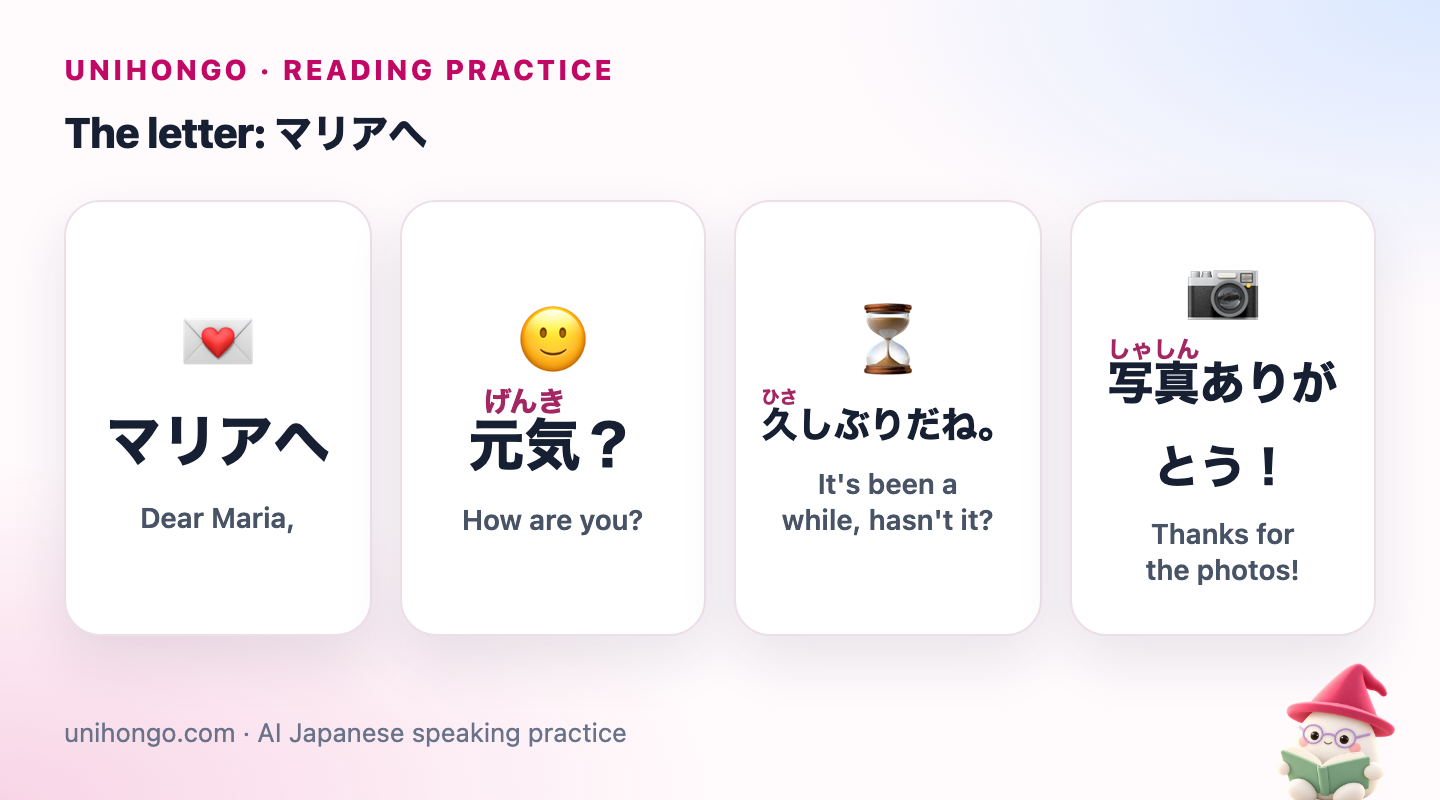
| Japanese | Romaji | Meaning |
|---|---|---|
| マリアへ | Maria e | Dear Maria, |
| 元気? | Genki? | How are you? |
| 久しぶりだね。 | Hisashiburi da ne. | It's been a while, hasn't it? |
| 写真ありがとう! | Shashin arigatō! | Thanks for the photos! |
| スペインの海、すごくきれいだった。 | Supein no umi, sugoku kirei datta. | The sea in Spain looked so beautiful. |
| こっちは最近、毎日雨が降ってるよ。 | Kotchi wa saikin, mainichi ame ga futteru yo. | Here it's been raining every day lately. |
| 先週、マリアが好きだったラーメン屋に行ったんだ。 | Senshū, Maria ga suki datta rāmen'ya ni itta n da. | Last week I went to that ramen shop you loved. |
| 店のおじさんが「マリアちゃんは元気?」って聞いてたよ。 | Mise no ojisan ga "Maria-chan wa genki?" tte kiiteta yo. | The owner asked, "How's Maria doing?" |
| 私、来月から新しい仕事を始めることになったんだ。 | Watashi, raigetsu kara atarashii shigoto o hajimeru koto ni natta n da. | Guess what, I'm starting a new job next month. |
| ちょっと緊張してるけど、楽しみ。 | Chotto kinchō shiteru kedo, tanoshimi. | I'm a bit nervous, but I'm looking forward to it. |
| でも、きっと大丈夫だと思う。 | Demo, kitto daijōbu da to omou. | But I'm sure it'll be fine. |
| マリアはスペインで日本語の勉強、続けてる? | Maria wa Supein de nihongo no benkyō, tsuzuketeru? | Are you keeping up your Japanese in Spain? |
| 私はスペインに行ったことがないから、いつか行ってみたいな。 | Watashi wa Supein ni itta koto ga nai kara, itsuka itte mitai na. | I've never been to Spain, so I'd love to go someday. |
| 夏休みに会えたらいいね。 | Natsuyasumi ni aetara ii ne. | It'd be great if we could meet in the summer holidays. |
| また連絡するね。 | Mata renraku suru ne. | I'll message you again. |
| 体に気をつけてね。 | Karada ni ki o tsukete ne. | Take care of yourself. |
| ゆいより | Yui yori | Love, Yui |
Vocabulary notes
Casual messages reuse a small set of friendly words. Once you know them, most chats become much easier to read.
| Japanese | Romaji | Meaning |
|---|---|---|
| 久しぶり | hisashiburi | long time no see, it's been a while |
| こっち | kotchi | here, my side (casual こちら) |
| 最近 | saikin | lately, recently |
| おじさん | ojisan | middle-aged man (friendly, not only uncle) |
| 楽しみ | tanoshimi | something you look forward to |
| きっと | kitto | surely, I bet |
| 続ける | tsuzukeru | to continue, to keep doing |
| いつか | itsuka | someday |
| 連絡する | renraku suru | to get in touch, to message |
| 気をつける | ki o tsukeru | to be careful, to take care |
〜へ and 〜より frame the letter: マリアへ, to Maria, and ゆいより, from Yui. They are standard in casual letters, cards and notes. マリアちゃん uses ちゃん, a friendly, affectionate suffix often used for children, girls and close friends; the shop owner uses it because he knew Maria as a regular. Do not add ちゃん to names on your own unless you are sure the relationship allows it.
Grammar notes: how casual Japanese works
The letter is N4 grammar in casual clothes. Each pair below shows a line from the letter and a new example.
| Japanese | Romaji | Meaning |
|---|---|---|
| 毎日雨が降ってるよ。 | Mainichi ame ga futteru yo. | From the letter: It's raining every day. |
| 今、ご飯を食べてる。 | Ima, gohan o tabeteru. | I'm eating right now. (casual) |
| ラーメン屋に行ったんだ。 | Rāmen'ya ni itta n da. | From the letter: I went to the ramen shop, you know. |
| 昨日、財布をなくしたんだ。 | Kinō, saifu o nakushita n da. | I lost my wallet yesterday, you see. |
| スペインに行ったことがないから、いつか行ってみたいな。 | Supein ni itta koto ga nai kara, itsuka itte mitai na. | From the letter: I've never been to Spain, so I'd love to go. |
| すしを食べたことがない。 | Sushi o tabeta koto ga nai. | I've never eaten sushi. (casual) |
| 夏休みに会えたらいいね。 | Natsuyasumi ni aetara ii ne. | From the letter: It'd be nice if we could meet in summer. |
| 明日晴れたらいいね。 | Ashita haretara ii ne. | It'd be nice if it's sunny tomorrow. |
〜てる is 〜ている with the い dropped, extremely common in speech and chat. 〜たことがない is the plain negative of 〜たことがあります. 〜たらいいね expresses a shared wish: if only, wouldn't it be nice. And 〜ことになった, in 始めることになった, says that something has been decided, often by circumstances or other people rather than by the speaker alone; it is a modest way to announce news.
The same message in polite Japanese
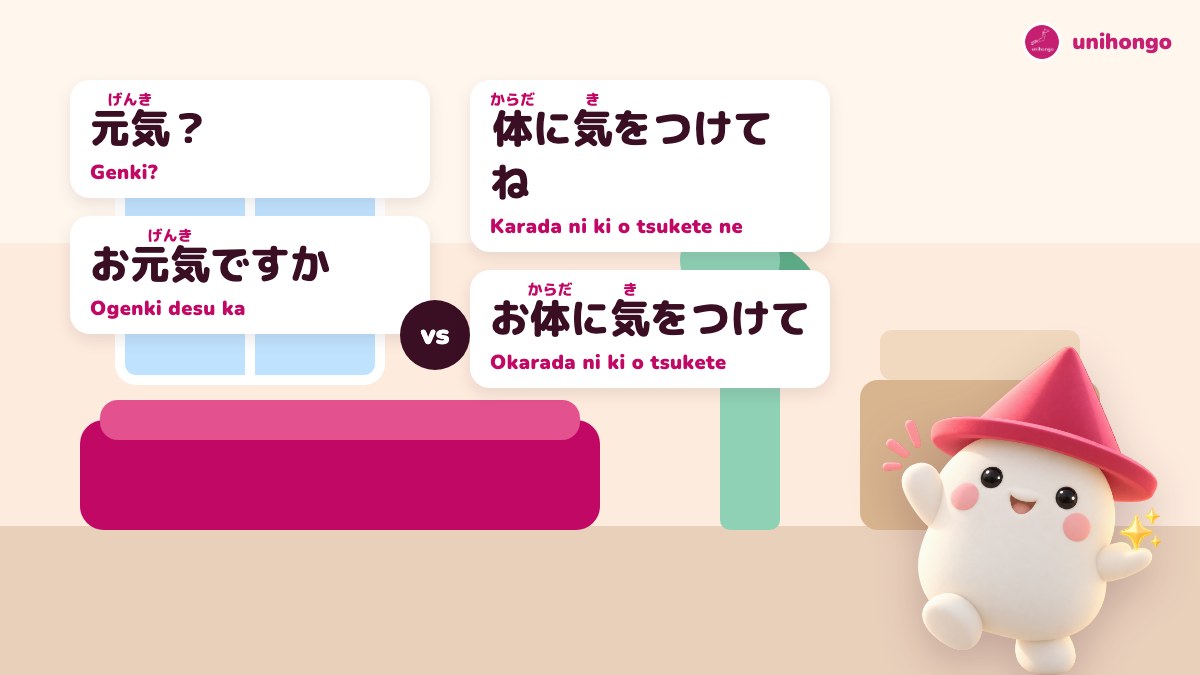
To feel the difference, compare a few lines with their polite equivalents, as you might write to a teacher or an older acquaintance. The polite version is longer, uses です and ます, keeps its particles and replaces ね-heavy endings with fuller sentences.
Neither version is better. Casual Japanese to a teacher would sound overfamiliar; polite Japanese to a close friend can sound cold or even hurt. Choosing the right register is part of reading and writing well.
| Japanese | Romaji | Meaning |
|---|---|---|
| お元気ですか。 | Ogenki desu ka. | Polite: How are you? |
| お久しぶりです。 | Ohisashiburi desu. | Polite: It has been a long time. |
| 写真をありがとうございました。 | Shashin o arigatō gozaimashita. | Polite: Thank you for the photos. |
| 来月から新しい仕事を始めることになりました。 | Raigetsu kara atarashii shigoto o hajimeru koto ni narimashita. | Polite: I will be starting a new job next month. |
| また連絡します。 | Mata renraku shimasu. | Polite: I will be in touch again. |
| お体に気をつけてください。 | Okarada ni ki o tsukete kudasai. | Polite: Please take care of yourself. |
Reading traps in this text
- マリアが好きだったラーメン屋 is a plain past clause describing the shop: the ramen shop Maria used to like. It is not the ramen shop that liked Maria.
- 「マリアちゃんは元気?」って聞いてた uses って, the casual form of the quoting particle と. 聞いてた is 聞いていた: he was asking.
- 私、来月から starts with a topic and a comma instead of は. Casual writing often uses the comma where speech would pause.
- 楽しみ alone is a complete casual sentence. A noun or な-adjective can end a casual sentence without だ, especially in messages.
- 行ってみたいな combines 〜てみたい, want to try, with な, a soft ending that sounds like thinking aloud.
Check your understanding
Answer the questions about the letter. The answers follow.
- What is the weather like where Yui lives?
- What news does Yui share about herself?
- Why does Yui want to go to Spain someday?
Answers
| Japanese | Romaji | Meaning |
|---|---|---|
| 最近、毎日雨が降っています。 | Saikin, mainichi ame ga futte imasu. | 1. It has been raining every day lately. |
| 来月から新しい仕事を始めます。 | Raigetsu kara atarashii shigoto o hajimemasu. | 2. She is starting a new job next month. |
| まだ行ったことがないからです。 | Mada itta koto ga nai kara desu. | 3. Because she has never been there. |
Notice that the answers are in polite form even though the letter is casual. Answering a question about a text is a new situation with its own register, which is exactly how JLPT answer choices are written.
Read it aloud like a voice message
- Read the first four lines with a rising, friendly tone on 元気? and a soft falling ね.
- Keep the contractions short: futteru, kiiteta, shiteru, tsuzuketeru; do not stretch them back into teiru.
- Read 〜んだ as one quick unit, n da, with no pause before it.
- Read the whole letter at a relaxed speed, as if talking to a friend on the phone.
- Then read the polite lines from the comparison section and notice how your voice becomes slower and steadier.
Write back to Yui
The best follow-up to reading a letter is answering it. Write Maria's reply in casual Japanese and send it to Mocchi on Unihongo with /correct; ask it to keep the casual tone and point out any line that sounds like a textbook. Because Mocchi remembers the mistakes you make, a later review can check whether you still drop the wrong particles.
Then say your news out loud. In AI Sensei, ask Haru-sensei to play Maria on a call and to switch to casual Japanese, and tell Haru-sensei about your week, your plans and when you might meet. Casual speech is hard to practise with a textbook, so ask him to point out any line that slipped back into です and ます.