

The text: 学校の一日 (A school day)
Read the whole text without the English. As you read, write down the subjects in the order they come.
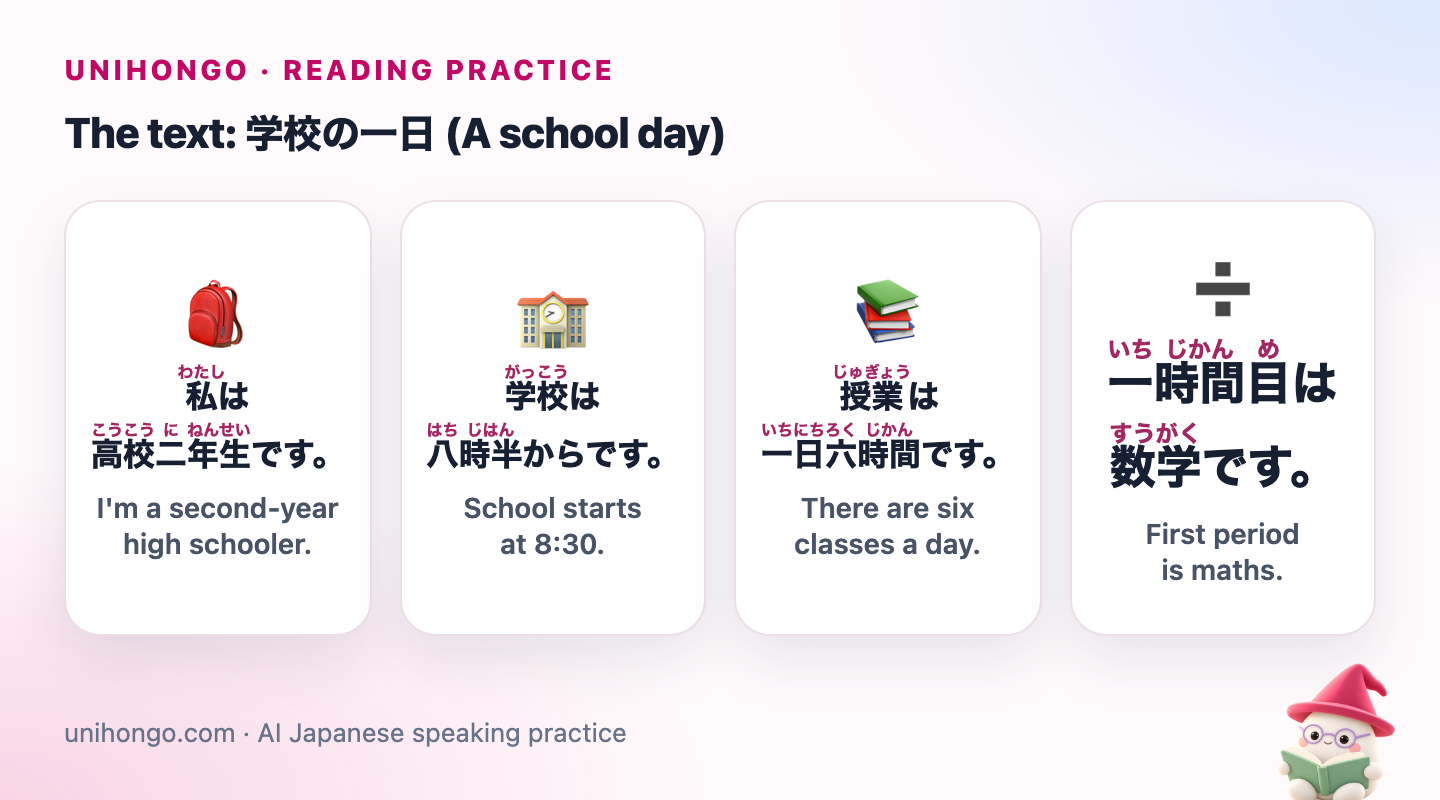
| Japanese | Romaji | Meaning |
|---|---|---|
| 私は高校二年生です。 | Watashi wa kōkō ninensei desu. | I'm a second-year high schooler. |
| 学校は八時半からです。 | Gakkō wa hachiji han kara desu. | School starts at 8:30. |
| 授業は一日六時間です。 | Jugyō wa ichinichi rokujikan desu. | There are six classes a day. |
| 一時間目は数学です。 | Ichijikanme wa sūgaku desu. | First period is maths. |
| 数学はちょっと難しいです。 | Sūgaku wa chotto muzukashii desu. | Maths is a little difficult. |
| 二時間目は英語です。 | Nijikanme wa eigo desu. | Second period is English. |
| 英語の先生はアメリカ人です。 | Eigo no sensei wa Amerikajin desu. | The English teacher is American. |
| 十二時半から昼休みです。 | Jūniji han kara hiruyasumi desu. | Lunch break is from 12:30. |
| 教室で友達と弁当を食べます。 | Kyōshitsu de tomodachi to bentō o tabemasu. | I eat a packed lunch with friends in the classroom. |
| 午後は体育と歴史です。 | Gogo wa taiiku to rekishi desu. | In the afternoon there's PE and history. |
| 授業は三時半に終わります。 | Jugyō wa sanji han ni owarimasu. | Classes finish at 3:30. |
| そのあと、図書館で宿題をします。 | Sono ato, toshokan de shukudai o shimasu. | After that, I do homework in the library. |
| 五時ごろ家に帰ります。 | Goji goro ie ni kaerimasu. | I go home at about five. |
| 学校は大変ですが、楽しいです。 | Gakkō wa taihen desu ga, tanoshii desu. | School is hard work, but it's fun. |
Sentence 3 is the tricky one: 六時間 here means six class periods, not six hours. The context, 授業, classes, tells you so. In sentence 4, 一時間目 confirms it: the first of those periods.
Vocabulary notes: school words
School subjects are a closed set, so they are easy to learn together. Here are the ones in the text plus a few you will need to describe your own timetable.
| Japanese | Romaji | Meaning |
|---|---|---|
| 授業 | jugyō | class, lesson |
| 数学 | sūgaku | maths |
| 英語 | eigo | English |
| 体育 | taiiku | PE, physical education |
| 歴史 | rekishi | history (N4 word) |
| 国語 | kokugo | Japanese (as a school subject) |
| 理科 | rika | science (not in the text) |
| 昼休み | hiruyasumi | lunch break |
| 教室 | kyōshitsu | classroom |
| 弁当 | bentō | packed lunch, bento |
| 図書館 | toshokan | library |
| 宿題 | shukudai | homework |
Japanese schools call the Japanese language subject 国語, the national language, not 日本語. 日本語 is what learners study. If you tell a Japanese student your favourite subject was 日本語, they will understand you mean your Japanese class as a foreign language.
Grammar notes: four patterns in the text
Each pattern comes with its line from the text and one new example.
| Japanese | Romaji | Meaning |
|---|---|---|
| 十二時半から昼休みです。 | Jūniji han kara hiruyasumi desu. | Time + から: from a time. (text) |
| 銀行は九時から三時までです。 | Ginkō wa kuji kara sanji made desu. | The bank is open from nine to three. (new example) |
| 一時間目は数学です。 | Ichijikanme wa sūgaku desu. | Number + 時間目: nth period. (text) |
| 三時間目は国語です。 | Sanjikanme wa kokugo desu. | Third period is Japanese. (new example) |
| 授業は三時半に終わります。 | Jugyō wa sanji han ni owarimasu. | Time + に + 終わります. (text) |
| 会議は四時に始まります。 | Kaigi wa yoji ni hajimarimasu. | The meeting starts at four. (new example) |
| 大変ですが、楽しいです。 | Taihen desu ga, tanoshii desu. | A ですが、B: A, but B. (text) |
| 高いですが、おいしいです。 | Takai desu ga, oishii desu. | It's expensive, but delicious. (new example) |
Four o'clock is 四時, yoji, not yonji, and nine o'clock is 九時, kuji, not kyūji. These two irregular readings cause most clock-time mistakes at N5, so read them aloud a few times.
The time with から and まで can come with です directly, as in 八時半からです, school is from half past eight. You do not need a verb for opening hours or schedules.
Comprehension questions
Answer in Japanese, then check.
- What subject is first period?
- Where and with whom does the writer eat lunch?
- What time do classes finish?
| Japanese | Romaji | Meaning |
|---|---|---|
| 数学です。 | Sūgaku desu. | Answer 1: Maths. |
| 教室で友達と食べます。 | Kyōshitsu de tomodachi to tabemasu. | Answer 2: In the classroom, with friends. |
| 三時半に終わります。 | Sanji han ni owarimasu. | Answer 3: At half past three. |
Question 2 asks two things at once, where and with whom, and the answer needs two particles: で for the place and と for the person. N5 reading questions often check exactly this kind of detail.
The school day as a timetable
Here is the writer's day laid out in order. Try saying each line aloud with the time first, as a Japanese student might describe their schedule.
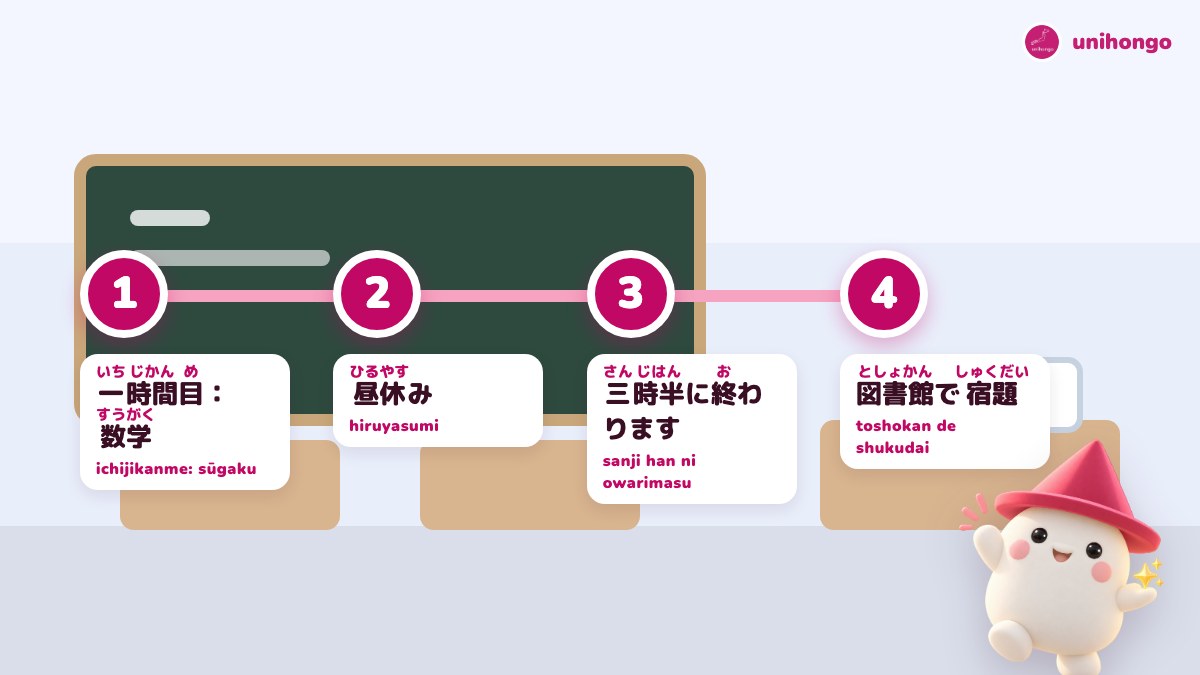
| Time | What happens | Japanese |
|---|---|---|
| 8:30 | School starts | 八時半から学校 |
| Periods 1-2 | Maths, then English | 数学、英語 |
| 12:30 | Lunch break | 昼休み |
| Afternoon | PE and history | 体育、歴史 |
| 3:30 | Classes end | 授業が終わります |
| Until about 5 | Homework in the library | 図書館で宿題 |
Japanese school days often continue after the last class. Many students clean their classroom together for a short time, a practice called そうじ, and then go to club activities, 部活 (bukatsu), such as sports teams, music or art clubs. Customs vary from school to school, but if a Japanese friend says they were at school until six, club activities are a likely reason. The writer of this text goes to the library instead, which is also common before exams.
Common mistakes with times and classes
- Reading 四時 as yonji or 九時 as kyūji. The correct readings are yoji and kuji.
- Reading 一時間目 as one hour. 目 makes it an ordinal: the first period.
- Using に with から: 八時半にから. Use one particle: 八時半から for from, 八時半に for at.
- Using で for 終わります: 三時半で終わります. The time a class ends takes に: 三時半に終わります.
- Saying 日本語 for the school subject Japanese at a Japanese school. Japanese students call it 国語.
A read-aloud routine for this text
- Read the times alone first: hachiji han, jūniji han, sanji han, goji.
- Read the text slowly. Keep the long vowels in kōkō, jugyō, sūgaku, kyōshitsu and bentō; this text has more of them than most.
- Read again at natural speed, pausing after から and before が.
- Replace the subjects and times with your own timetable and read it again.
- Describe your real day at school, work or home in eight sentences without notes.
Your own timetable, in Japanese
Ask Mocchi, Unihongo's study assistant, to /explain the sentence that tripped you up, for example 授業は一日六時間です, and it will show why 時間 means a class period here. Then type /read and ask for a similar N5 text about a university day or a workday; reading two versions side by side shows which words belong to school life and which you can reuse anywhere. Mocchi keeps a note of the readings you miss, like yoji and kuji, and brings them back in later reviews.
If you want to practise speaking, AI Sensei can turn the timetable into a conversation: ask Haru-sensei to play a Japanese exchange student who asks about your school day, and describe it from memory.