

The text: 雨の日 (A rainy day)
Read once without the English. Try to list the five things the writer does at home, in order.
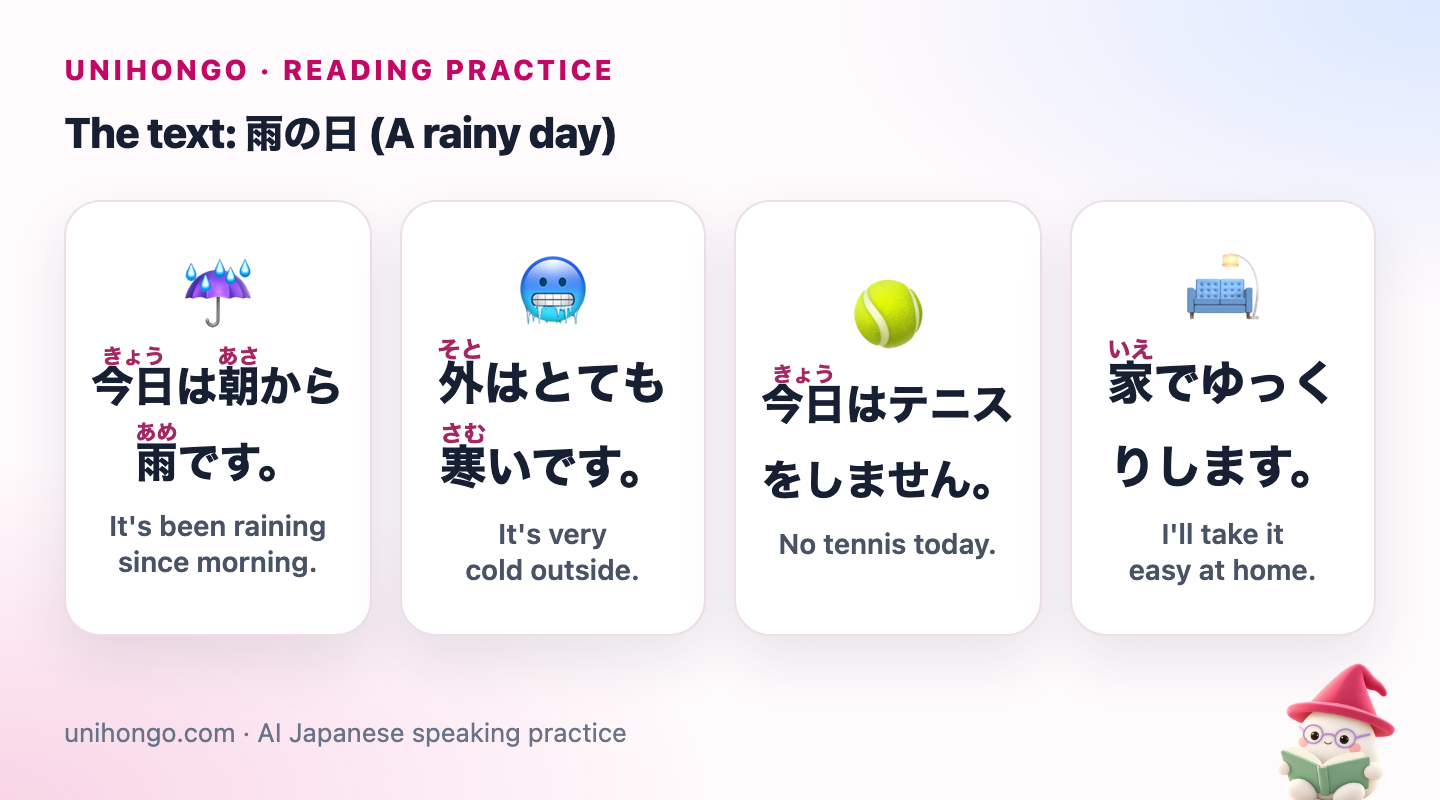
| Japanese | Romaji | Meaning |
|---|---|---|
| 今日は朝から雨です。 | Kyō wa asa kara ame desu. | It's been raining since morning. |
| 外はとても寒いです。 | Soto wa totemo samui desu. | It's very cold outside. |
| 今日はテニスをしません。 | Kyō wa tenisu o shimasen. | No tennis today. |
| 家でゆっくりします。 | Ie de yukkuri shimasu. | I'll take it easy at home. |
| まず、温かいお茶を入れます。 | Mazu, atatakai ocha o iremasu. | First, I make a cup of hot tea. |
| 雨の音を聞きます。 | Ame no oto o kikimasu. | I listen to the sound of the rain. |
| それから、本を読みます。 | Sore kara, hon o yomimasu. | Then I read a book. |
| 昼ごはんは、うどんを作ります。 | Hirugohan wa, udon o tsukurimasu. | For lunch, I make udon. |
| 午後は部屋をそうじします。 | Gogo wa heya o sōji shimasu. | In the afternoon, I clean my room. |
| 夕方、友達に電話をかけます。 | Yūgata, tomodachi ni denwa o kakemasu. | In the early evening, I call a friend. |
| 友達の町も雨です。 | Tomodachi no machi mo ame desu. | It's raining in my friend's town too. |
| 天気予報では、あしたは晴れです。 | Tenki yohō de wa, ashita wa hare desu. | The forecast says tomorrow will be sunny. |
| 雨の日も好きです。 | Ame no hi mo suki desu. | I like rainy days, too. |
Sentence 8 starts with 昼ごはんは, as for lunch, and then gives the dish with を. This topic-first pattern is very common when talking about meals: 晩ごはんは、カレーを食べます, for dinner, I'll have curry.
Vocabulary notes: weather and a day at home
The weather words are the core of this text. The verbs are given in the ます form.
| Japanese | Romaji | Meaning |
|---|---|---|
| 雨 | ame | rain |
| 晴れ | hare | sunny weather, clear skies |
| 曇り | kumori | cloudy weather (not in the text) |
| 天気予報 | tenki yohō | weather forecast |
| 寒い | samui | cold (weather, air) |
| 温かい | atatakai | warm (a drink, food, a hand) |
| 外 | soto | outside |
| 音 | oto | sound |
| そうじします | sōji shimasu | to clean (a room) |
| 電話をかけます | denwa o kakemasu | to make a phone call |
| 夕方 | yūgata | early evening, late afternoon |
寒い is for weather and air; for a cold drink or cold water you say 冷たい (tsumetai). In the same way, warm weather is 暖かい and a warm drink is 温かい. Both are read atatakai, and at N5 many learners just write あたたかい in kana, which is perfectly fine.
Grammar notes: four patterns in the text
Each pattern comes with its sentence from the text and one new example.
| Japanese | Romaji | Meaning |
|---|---|---|
| 今日は朝から雨です。 | Kyō wa asa kara ame desu. | Time + から: since, from. (text) |
| きのうから頭が痛いです。 | Kinō kara atama ga itai desu. | I've had a headache since yesterday. (new example) |
| 家でゆっくりします。 | Ie de yukkuri shimasu. | Place + で + action. (text) |
| 図書館で勉強します。 | Toshokan de benkyō shimasu. | I study at the library. (new example) |
| 今日はテニスをしません。 | Kyō wa tenisu o shimasen. | は for contrast with a negative. (text) |
| 今日は学校に行きません。 | Kyō wa gakkō ni ikimasen. | I'm not going to school today. (new example) |
| 友達の町も雨です。 | Tomodachi no machi mo ame desu. | N も: also, too. (text) |
| あしたも晴れです。 | Ashita mo hare desu. | Tomorrow will be sunny too. (new example) |
Compare で and に: 家でゆっくりします (do something at home) but 家にいます (be at home). で goes with actions, に with being somewhere or going somewhere. Mixing them up is one of the most common N5 errors, and this text gives you a clean example of で.
Comprehension questions
Answer in Japanese, then compare with the models.
- What is the weather like today?
- What does the writer have for lunch?
- What will the weather be like tomorrow?
| Japanese | Romaji | Meaning |
|---|---|---|
| 雨です。とても寒いです。 | Ame desu. Totemo samui desu. | Answer 1: Rainy and very cold. |
| うどんを作ります。 | Udon o tsukurimasu. | Answer 2: The writer makes udon. |
| 晴れです。 | Hare desu. | Answer 3: Sunny. |
For question 3, the information comes from the forecast, 天気予報では. In a JLPT reading question, watch for this kind of source: the question may ask what the forecast says, not what the weather is.
The rainy day hour by hour
The writer's day follows a clear order, marked by time words at the start of each sentence. Seeing it as a timeline helps you remember both the words and the order.
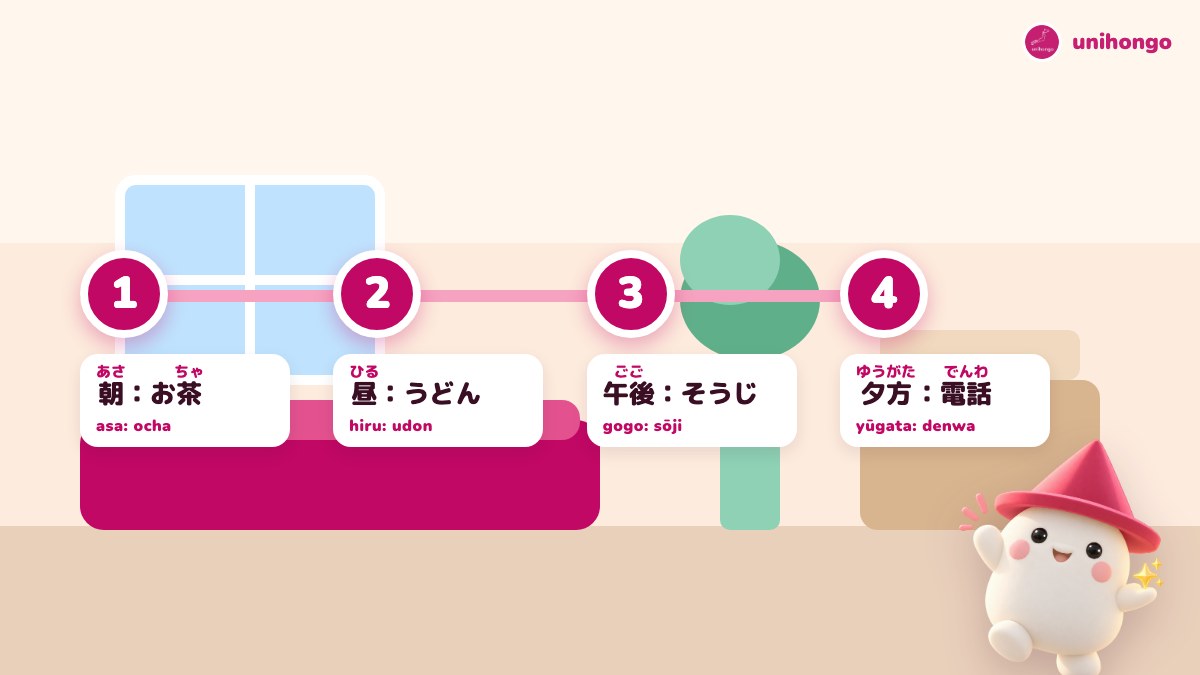
| Japanese | Romaji | Meaning |
|---|---|---|
| 朝はお茶を入れます。 | Asa wa ocha o iremasu. | Morning: make tea. |
| 昼はうどんを作ります。 | Hiru wa udon o tsukurimasu. | Midday: make udon. |
| 午後はそうじします。 | Gogo wa sōji shimasu. | Afternoon: clean. |
| 夕方は電話をかけます。 | Yūgata wa denwa o kakemasu. | Early evening: phone a friend. |
Notice that 夕方 is not quite evening in English: it covers roughly late afternoon until dark. Night is 夜 (yoru). Different people draw the line in different places, so treat these as rough times of day.
Common mistakes with weather and time
- Using 寒い for a cold drink. 寒い is for weather and air; a cold drink is 冷たい.
- Saying 朝からに or putting に after から. から already marks the starting point; it does not need another particle.
- Using に for the place of an action: 家にゆっくりします. Actions take で: 家でゆっくりします.
- Saying お茶を作ります. Tea and coffee are made with 入れます.
- Translating it is raining with a subject like それは雨です. Japanese simply says 雨です, with no it.
A read-aloud routine for this text
- Read slowly and quietly, matching the calm mood of the text. Pause at every comma.
- Practise the long vowels: kyō, sōji, yūgata, yohō. Hold each long vowel for two beats.
- Read again at a natural pace, keeping the time words at the start of each sentence slightly stronger.
- Change the weather and read it again: 今日は朝から晴れです, and swap the indoor activities for outdoor ones.
- Describe today's real weather and what you did, in five sentences, without looking.
Make it rain in your own Japanese
If 天気予報では or 電話をかけます still feels unclear, send that sentence to Mocchi, Unihongo's study assistant, with /explain: it will break the sentence down and note which part tripped you up, so it can come back in a later review. For a fresh text on the same theme, ask for /read with a sunny or snowy day; comparing two weather texts is a quick way to see what changes and what stays the same.
When you can retell the day, try it out loud: in AI Sensei, Haru-sensei can ask you about the weather where you live and what you do on rainy days. Ask him to keep his Japanese simple and slow, and use the session report to fix your weather sentences.