

The story: となりの山田さん
The narrator has just moved into an old apartment building. Read the text once without stopping.
The narrator explains a custom, then tells what happened, then reflects. The first part uses 〜そうです because the narrator is reporting something heard; the middle uses the past tense for events; the end returns to the present for feelings and plans. Following these three parts will help you understand the whole even before you know every word.
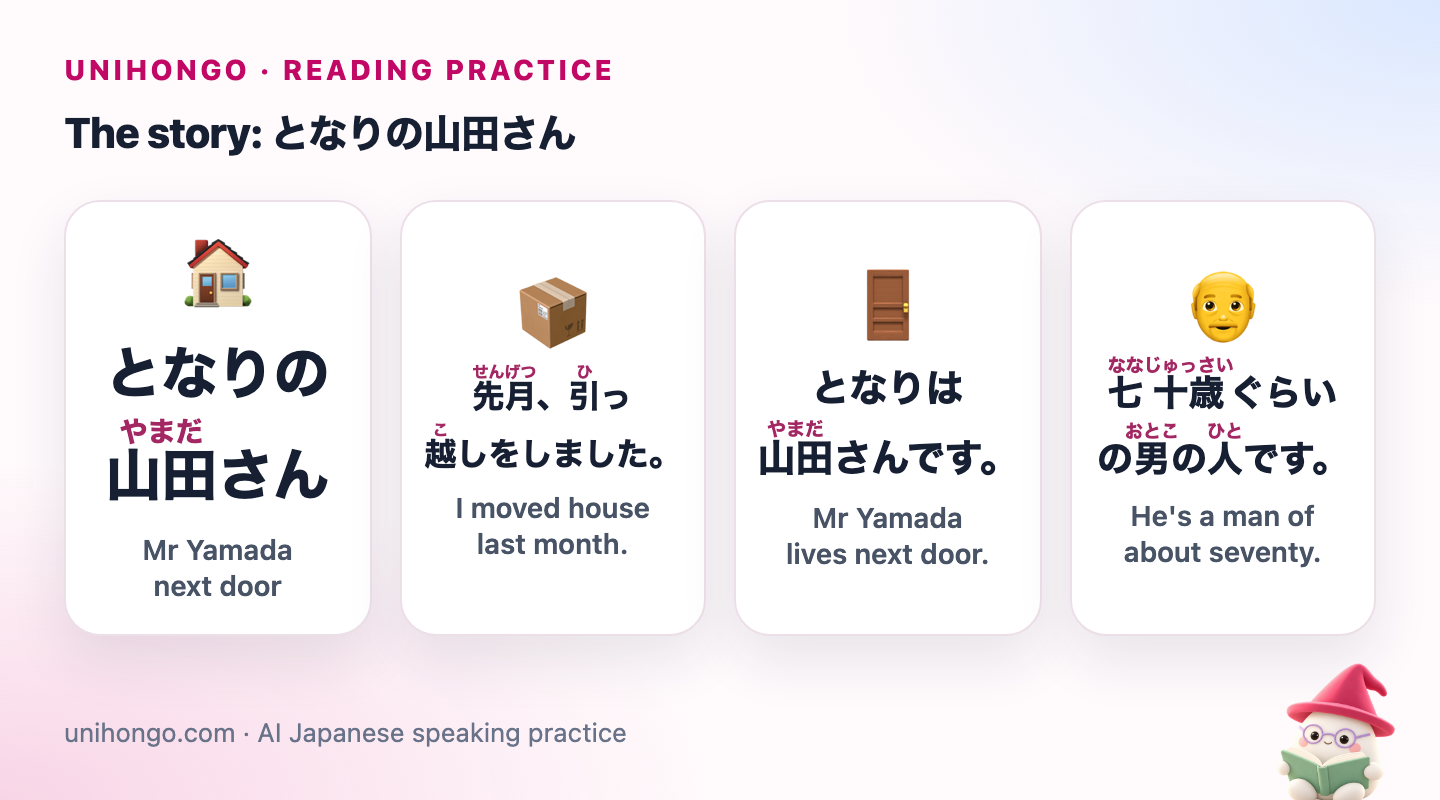
| Japanese | Romaji | Meaning |
|---|---|---|
| となりの山田さん | Tonari no Yamada-san | Mr Yamada next door |
| 先月、引っ越しをしました。 | Sengetsu, hikkoshi o shimashita. | I moved house last month. |
| となりは山田さんです。 | Tonari wa Yamada-san desu. | Mr Yamada lives next door. |
| 七十歳ぐらいの男の人です。 | Nanajussai gurai no otoko no hito desu. | He's a man of about seventy. |
| 日本では、引っ越した時に近所の人にあいさつをすることが多いそうです。 | Nihon de wa, hikkoshita toki ni kinjo no hito ni aisatsu o suru koto ga ōi sō desu. | I'd heard people in Japan often greet neighbours after moving. |
| それで、スーパーで小さいタオルのセットを買いました。 | Sorede, sūpā de chiisai taoru no setto o kaimashita. | So I bought a small set of towels at the supermarket. |
| 日曜日の午後、山田さんの部屋のチャイムを鳴らしました。 | Nichiyōbi no gogo, Yamada-san no heya no chaimu o narashimashita. | On Sunday afternoon, I rang Mr Yamada's doorbell. |
| 「となりに引っ越してきた者です。よろしくお願いします」と言って、タオルを渡しました。 | "Tonari ni hikkoshite kita mono desu. Yoroshiku onegai shimasu" to itte, taoru o watashimashita. | I said, "I've just moved in next door. Nice to meet you," and gave him the towels. |
| 山田さんは「わざわざありがとう」と言って、笑ってくれました。 | Yamada-san wa "Wazawaza arigatō" to itte, waratte kuremashita. | Mr Yamada smiled and said, "How kind of you to come." |
| それから、ごみの日やスーパーの場所を教えてくれました。 | Sorekara, gomi no hi ya sūpā no basho o oshiete kuremashita. | Then he told me the rubbish days and where the shops are. |
| 山田さんはこのアパートに三十年住んでいるそうです。 | Yamada-san wa kono apāto ni sanjūnen sunde iru sō desu. | Apparently he's lived in this building for thirty years. |
| 私は夜遅く帰ることが多いので、「うるさかったら言ってください」と言いました。 | Watashi wa yoru osoku kaeru koto ga ōi node, "Urusakattara itte kudasai" to iimashita. | I often get home late, so I said, "Please tell me if I'm noisy." |
| 次の週、山田さんがみかんを持ってきてくれました。 | Tsugi no shū, Yamada-san ga mikan o motte kite kuremashita. | The next week, Mr Yamada brought me some mandarins. |
| 前の家では、となりの人と話したことがありませんでした。 | Mae no ie de wa, tonari no hito to hanashita koto ga arimasen deshita. | At my old place, I never once spoke to my neighbours. |
| 今は、となりにいい人がいるので安心です。 | Ima wa, tonari ni ii hito ga iru node anshin desu. | Now there's a kind person next door, so I feel at ease. |
| 今度、山田さんにお茶を持っていこうと思います。 | Kondo, Yamada-san ni ocha o motte ikō to omoimasu. | Next time, I think I'll take Mr Yamada some tea. |
Vocabulary notes
Neighbourhood words that come up in every building and street.
| Japanese | Romaji | Meaning |
|---|---|---|
| となり | tonari | next door, the person next to you |
| 近所 | kinjo | neighbourhood, neighbours |
| あいさつ | aisatsu | greeting |
| チャイムを鳴らす | chaimu o narasu | to ring the doorbell |
| 渡す | watasu | to hand over |
| わざわざ | wazawaza | going out of your way, taking the trouble |
| 場所 | basho | place, location |
| うるさい | urusai | noisy, annoying |
| みかん | mikan | mandarin orange |
| 安心 | anshin | relief, peace of mind |
わざわざ is a thank-you word in disguise. わざわざありがとう means thank you for taking the trouble, and it shows the neighbour appreciated the visit. Be careful in other contexts: わざわざ can also suggest something was unnecessary, depending on tone. となり is usually written in kanji as 隣, but kana is common in friendly writing.
Grammar notes: hearsay, kindness, conditions and intentions
Each pair shows a line from the story and a new example.
| Japanese | Romaji | Meaning |
|---|---|---|
| あいさつをすることが多いそうです。 | Aisatsu o suru koto ga ōi sō desu. | From the text: I hear people often greet neighbours. |
| この店のラーメンはおいしいそうです。 | Kono mise no rāmen wa oishii sō desu. | I hear the ramen at this shop is good. |
| ごみの日を教えてくれました。 | Gomi no hi o oshiete kuremashita. | From the text: He told me the rubbish days. |
| 友だちが傘を貸してくれました。 | Tomodachi ga kasa o kashite kuremashita. | A friend lent me an umbrella. |
| うるさかったら言ってください。 | Urusakattara itte kudasai. | From the text: Please tell me if I'm noisy. |
| 分からなかったら聞いてください。 | Wakaranakattara kiite kudasai. | If you don't understand, please ask. |
| お茶を持っていこうと思います。 | Ocha o motte ikō to omoimasu. | From the text: I think I'll take him some tea. |
| 明日、山に行こうと思います。 | Ashita, yama ni ikō to omoimasu. | I'm thinking of going to the mountains tomorrow. |
Notice 〜ことが多い in two places: あいさつをすることが多い and 帰ることが多い. It means it is often the case that, and it is a neat way to describe habits without the word いつも. 〜たら言ってください is a polite, open invitation; in Japanese communication it is considered thoughtful to give people an easy way to raise a problem.
What to say at the neighbour's door
The doorstep greeting is short: who you are, where you live, a small gift and a polite request for goodwill. Some lines below are traditional and a little old-fashioned; they are marked. If nobody answers, many people leave the gift with a short note on the door handle, or simply try again another day.
Keep it brief. A long conversation at the door can feel like a burden for the other person, and a smile and a bow do much of the work.
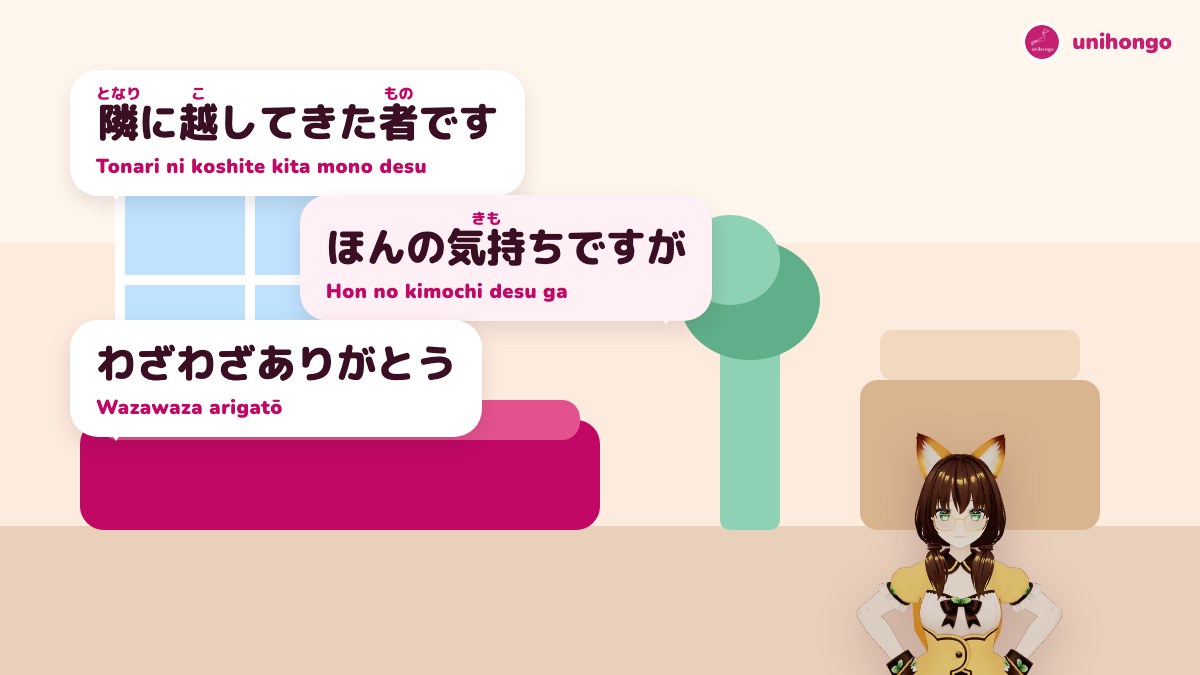
| Japanese | Romaji | Meaning |
|---|---|---|
| 隣に越してきた者です | Tonari ni koshite kita mono desu | You: I've moved in next door. (humble) |
| はじめまして。リーと申します。 | Hajimemashite. Rī to mōshimasu. | You: Nice to meet you. My name is Lee. (humble) |
| ほんの気持ちですが、どうぞ。 | Hon no kimochi desu ga, dōzo. | You: Just a small token. Please take it. |
| つまらないものですが…。 | Tsumaranai mono desu ga... | You: It's nothing much, but... (traditional, a bit old-fashioned) |
| わざわざありがとう。 | Wazawaza arigatō. | Neighbour: How kind of you to come. (casual) |
| 何かあったら言ってくださいね。 | Nanika attara itte kudasai ne. | Neighbour: If anything comes up, just let me know. |
| これからよろしくお願いします。 | Kore kara yoroshiku onegai shimasu. | You: I look forward to being your neighbour. |
Reading traps in this text
- 引っ越した時に uses the past before 時: when I had moved, after the move. 引っ越す時に would mean before or while moving.
- 隣に引っ越してきた uses 〜てくる for movement towards the speaker's place: I moved in, here. 引っ越していく would mean moving away.
- 笑ってくれました is more than he smiled. くれる shows the narrator felt the smile as a kindness towards them.
- 三十年住んでいるそうです uses ている for a long-lasting state: he has lived here for thirty years and still does. Do not translate it as is living temporarily.
- それで at the start of sentence 5 means so or that is why. It links the custom in the previous sentence to the narrator's decision.
Check your understanding
Three questions. Try to answer in Japanese, then check below.
- What gift did the narrator take to Mr Yamada?
- Why did the narrator ask Mr Yamada to say if they were noisy?
- How was the narrator's previous home different?
Answers
| Japanese | Romaji | Meaning |
|---|---|---|
| 小さいタオルのセットです。 | Chiisai taoru no setto desu. | 1. A small set of towels. |
| 夜遅く帰ることが多いからです。 | Yoru osoku kaeru koto ga ōi kara desu. | 2. Because they often come home late. |
| となりの人と話したことがありませんでした。 | Tonari no hito to hanashita koto ga arimasen deshita. | 3. They had never talked to their neighbours there. |
Answer 3 keeps the negative experience pattern, 〜たことがありませんでした. In English, never once spoke captures the feeling well; the past ありませんでした places it firmly in the old home.
A read-aloud routine
- Read the first four lines slowly; give Yamada-san a clear, even pitch without stressing any syllable.
- Practise the long sentence 8 in two parts, pausing after the quotation.
- Read Mr Yamada's lines in a warm, slightly older voice.
- Read the whole story twice, the second time a little faster.
- Close the text and act out the doorstep greeting, including a small bow.
Ring the bell with confidence
Doorstep greetings are short, so the difficulty is nerves, not grammar. Start by asking Mocchi on Unihongo to /explain the humble phrase 引っ越してきた者です and to give you two more situations where 者 fits, such as a phone call to a company. Mocchi notes which humble forms you find tricky and can quiz you on them later.
Then rehearse the visit out loud in AI Sensei. Choose Haru-sensei and ask Haru-sensei to play an elderly neighbour who is friendly but talks a little fast. Introduce yourself, hand over an imaginary gift and ask about rubbish days. Ask him to slow down if you need it; the session report will show which phrases came out naturally.