

The story: コンビニのアルバイト
The narrator is a university student who works evenings at a convenience store. Read the text once without help.
The story mixes routine and events. Sentences 1 to 3 describe what is always true, in the present; from sentence 4 the narrator tells what happened yesterday, in the past. Watch the tense switch back to the present in sentence 9, where the narrator makes a general comment about the job.
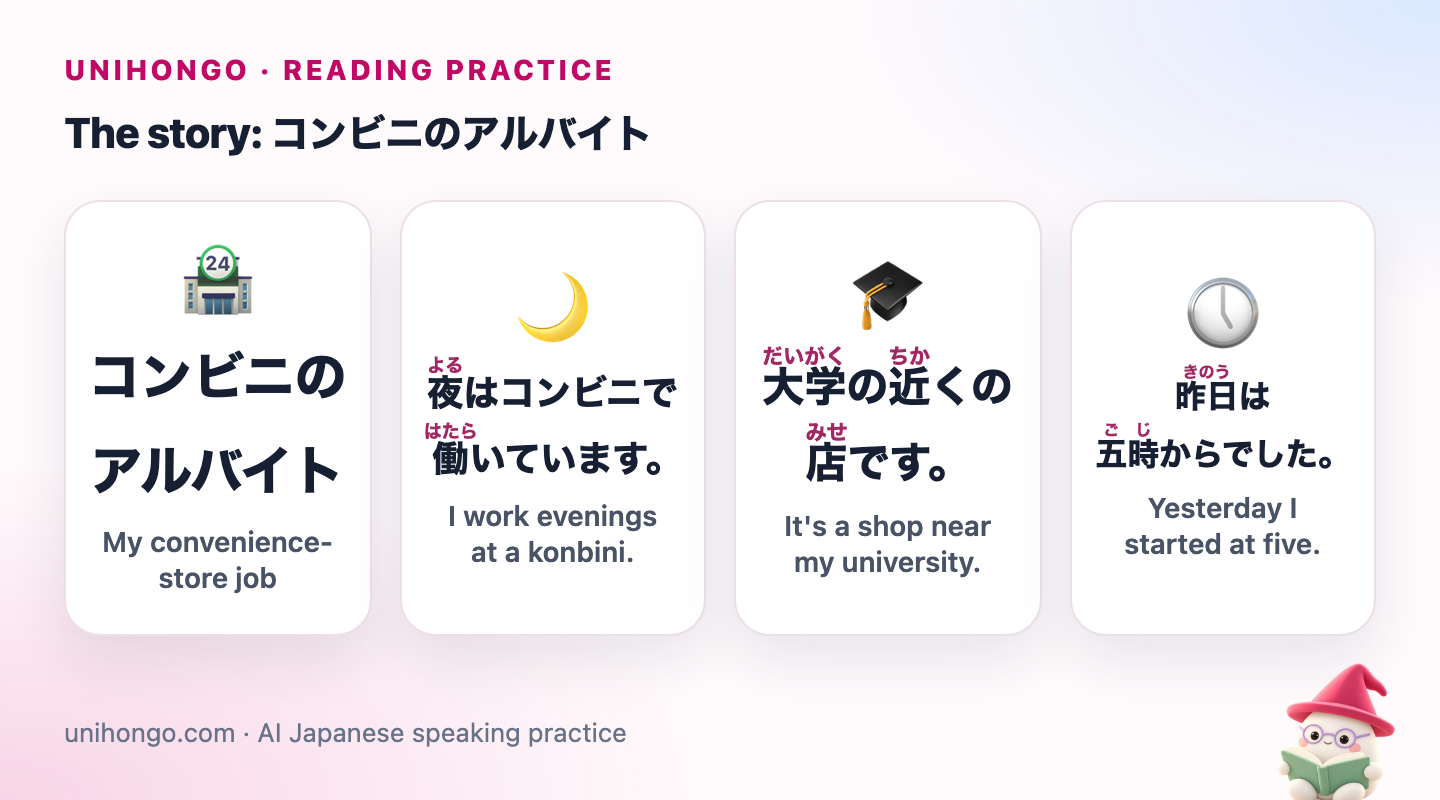
| Japanese | Romaji | Meaning |
|---|---|---|
| コンビニのアルバイト | Konbini no arubaito | My convenience-store job |
| 夜はコンビニで働いています。 | Yoru wa konbini de hataraite imasu. | I work evenings at a konbini. |
| 大学の近くの店です。 | Daigaku no chikaku no mise desu. | It's a shop near my university. |
| 昨日は五時からでした。 | Kinō wa goji kara deshita. | Yesterday I started at five. |
| 店に着いて、まず制服に着替えました。 | Mise ni tsuite, mazu seifuku ni kigaemashita. | I got to the shop and first changed into my uniform. |
| 店長に「今日は忙しくなると思うよ」と言われました。 | Tenchō ni "Kyō wa isogashiku naru to omou yo" to iwaremashita. | The manager told me, "I think it'll get busy today." |
| 近くで野球の試合があったので、お客さんがたくさん来ました。 | Chikaku de yakyū no shiai ga atta node, okyakusan ga takusan kimashita. | There was a baseball game nearby, so lots of customers came. |
| 私はレジでお弁当を温めたり、たばこを探したりしました。 | Watashi wa reji de obentō o atatametari, tabako o sagashitari shimashita. | At the register I heated bento, looked for cigarettes and so on. |
| たばこは番号で言うお客さんが多いので、覚えるのが大変です。 | Tabako wa bangō de iu okyakusan ga ōi node, oboeru no ga taihen desu. | Many customers ask for cigarettes by number, so it's hard to learn. |
| 一度、おつりを間違えてしまいました。 | Ichido, otsuri o machigaete shimaimashita. | Once, I gave the wrong change. |
| お客さんに謝って、すぐに正しいおつりを渡しました。 | Okyakusan ni ayamatte, sugu ni tadashii otsuri o watashimashita. | I apologised and gave the right change straight away. |
| 八時ごろから少し暇になったので、棚におにぎりを並べました。 | Hachiji goro kara sukoshi hima ni natta node, tana ni onigiri o narabemashita. | It got quieter around eight, so I stocked the shelves with rice balls. |
| 外国のお客さんに道を聞かれたこともあります。 | Gaikoku no okyakusan ni michi o kikareta koto mo arimasu. | Foreign customers have also asked me for directions. |
| 昨日は英語で駅までの行き方を説明しました。 | Kinō wa eigo de eki made no ikikata o setsumei shimashita. | Yesterday I explained the way to the station in English. |
| 十時に仕事が終わって、店長に「お疲れさまでした」と言いました。 | Jūji ni shigoto ga owatte, tenchō ni "Otsukaresama deshita" to iimashita. | Work ended at ten, and I said otsukaresama to the manager. |
| 大変ですが、この仕事は日本語の練習になると思います。 | Taihen desu ga, kono shigoto wa nihongo no renshū ni naru to omoimasu. | It's tough, but I think this job is good Japanese practice. |
Vocabulary notes
Work vocabulary from the shop floor. Most of it is also useful on the customer side of the counter.
| Japanese | Romaji | Meaning |
|---|---|---|
| アルバイト | arubaito | part-time job (often shortened to バイト) |
| 制服 | seifuku | uniform |
| 着替える | kigaeru | to change clothes |
| 店長 | tenchō | store manager |
| 試合 | shiai | match, game |
| 温める | atatameru | to heat up, to warm |
| おつり | otsuri | change (money) |
| 間違える | machigaeru | to make a mistake, to get wrong |
| 暇 | hima | free, not busy |
| 棚 | tana | shelf |
アルバイト comes from the German word Arbeit, work, but in Japanese it means a part-time or casual job. People usually say バイト in speech. 暇 is handy but be careful with it: 暇ですか to a colleague can sound like are you doing nothing?, so 今、お時間ありますか is safer at work.
Grammar notes: passive, listing, reasons and opinions
Each line from the story is followed by a new example in the same pattern.
| Japanese | Romaji | Meaning |
|---|---|---|
| 店長に「忙しくなると思うよ」と言われました。 | Tenchō ni "Isogashiku naru to omou yo" to iwaremashita. | From the text: The manager told me it would get busy. |
| 先生にほめられました。 | Sensei ni homeraremashita. | I was praised by my teacher. |
| お弁当を温めたり、たばこを探したりしました。 | Obentō o atatametari, tabako o sagashitari shimashita. | From the text: I heated bento, found cigarettes and so on. |
| 週末は掃除をしたり、映画を見たりします。 | Shūmatsu wa sōji o shitari, eiga o mitari shimasu. | At weekends I clean, watch films, that sort of thing. |
| お客さんが多いので、覚えるのが大変です。 | Okyakusan ga ōi node, oboeru no ga taihen desu. | From the text: There are many customers, so it's hard to learn. |
| 駅から遠いので、自転車で行きます。 | Eki kara tōi node, jitensha de ikimasu. | It's far from the station, so I go by bike. |
| 日本語の練習になると思います。 | Nihongo no renshū ni naru to omoimasu. | From the text: I think it's good Japanese practice. |
| この本は勉強になると思います。 | Kono hon wa benkyō ni naru to omoimasu. | I think this book will teach you a lot. |
The passive with に marks who did the action to you: 店長に言われました, I was told by the manager. Japanese uses it more than English does, especially when something happens to the speaker. 〜たり〜たりする lists examples, implying there was more; if you list everything you did in order, use the て form instead. 〜になる after a noun, as in 練習になる and 勉強になる, means to be useful as or to serve as.
Set phrases at the register
Convenience-store staff speak a polished, formulaic kind of polite Japanese, sometimes called manual keigo because it comes from training manuals. A few phrases sound unusual to grammar purists, such as 〜のほうお預かりします, but you will hear them every day. Learn them as chunks. Your answers can be very short.
Many stores now have self-checkout or machines that hand out change, and some phrases differ between chains, but the core exchange below is common.
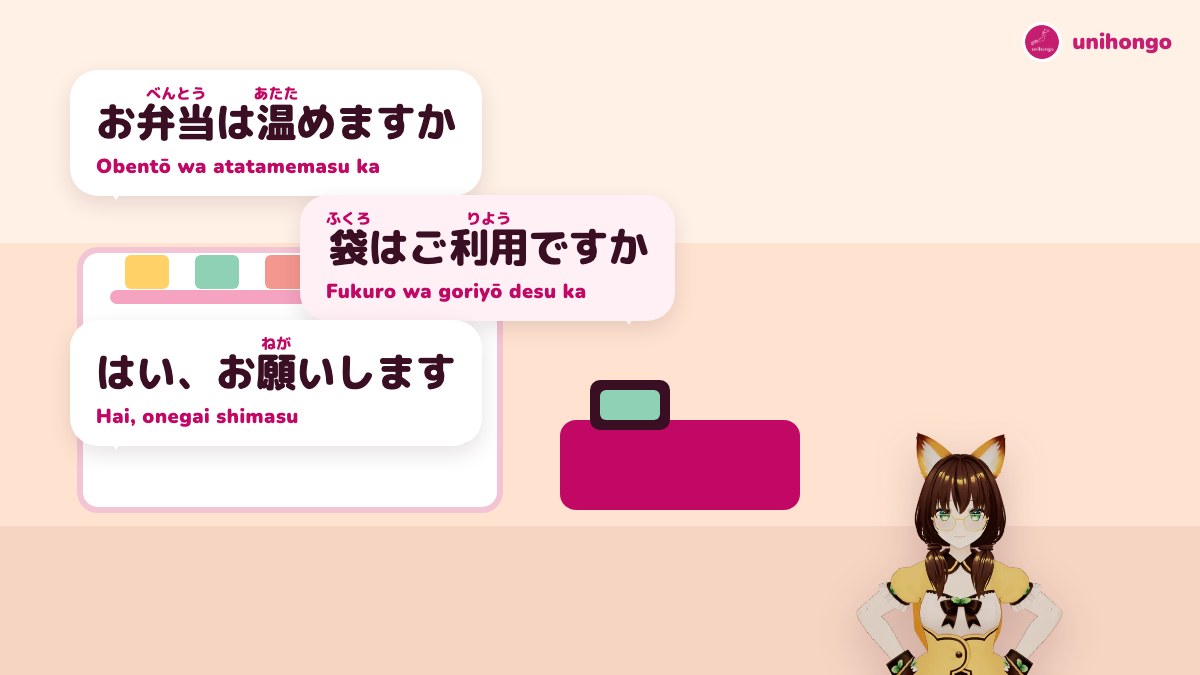
| Japanese | Romaji | Meaning |
|---|---|---|
| いらっしゃいませ。 | Irasshaimase. | Staff: Welcome. |
| お弁当は温めますか。 | Obentō wa atatamemasu ka. | Staff: Shall I heat up your bento? |
| はい、お願いします。 | Hai, onegai shimasu. | Customer: Yes, please. |
| 袋はご利用ですか。 | Fukuro wa goriyō desu ka. | Staff: Would you like a bag? |
| 大丈夫です。 | Daijōbu desu. | Customer: No, thank you. (polite refusal) |
| 千円お預かりします。 | Sen'en oazukari shimasu. | Staff: Out of a thousand yen. |
| ありがとうございました。 | Arigatō gozaimashita. | Staff: Thank you very much. |
Reading traps in this text
- 店長に「…」と言われました is passive: the manager is marked by に as the person who spoke. Do not read it as I told the manager.
- 番号で言う uses で for means: customers say it by number. Without で, the sentence would not make sense.
- 覚えるのが大変です uses の to turn 覚える into a noun: remembering them is hard. が marks what is hard.
- 暇になった is a な-adjective with になる: it became quiet. The same pattern gives 元気になった and 上手になった.
- 道を聞かれたこともあります combines the passive, 〜たことがある and も: I have also had the experience of being asked the way.
Check your understanding
Three questions about the shift. The answers follow.
- Why were there so many customers yesterday?
- What mistake did the narrator make?
- What did the narrator do when the shop got quieter?
Answers
| Japanese | Romaji | Meaning |
|---|---|---|
| 近くで野球の試合があったからです。 | Chikaku de yakyū no shiai ga atta kara desu. | 1. Because there was a baseball game nearby. |
| おつりを間違えてしまいました。 | Otsuri o machigaete shimaimashita. | 2. They gave the wrong change. |
| 棚におにぎりを並べました。 | Tana ni onigiri o narabemashita. | 3. They stocked the shelves with rice balls. |
Question 1 depends on reading the clause before ので. Many N4 reading questions ask why, and the answer is almost always in a clause ending with ので, から or the て form.
Read it aloud, then switch sides
- Read the story slowly once, with clear long vowels in tenchō, ōi and jūji.
- Read the two quotations in a different voice: the manager casual, the narrator polite.
- Read the register phrases as the clerk, bright and quick: irasshaimase.
- Read them again as the customer, answering each one with a short reply.
- Retell your own day in five sentences using 〜たり〜たりしました once.
Rehearse a busy shift
Ask Mocchi on Unihongo for a quick drill: /quiz me on konbini register phrases, mixing what the clerk says with what the customer answers. It keeps track of the phrases you miss, so the next review starts with those.
Then step behind the counter in AI Sensei. Choose Yamada-sensei, ask Yamada-sensei to play a slightly impatient customer, and serve Yamada-sensei as the clerk: greet Yamada-sensei, offer to heat the bento, ask about a bag and give the change. If you would rather stay on the customer side, the Convenience Store Checkout mission covers the same exchange from the other direction.