

The diary: 一週間の日記
The writer is a young office worker who is also learning to write kanji. Each day has one or two short lines in plain form. Read the whole week once.
Each day starts with the day of the week and a colon, so you can read the diary in any order. Try reading it once from Monday to Sunday, then once backwards, day by day. Reading backwards makes you focus on each line on its own, which is a good test of whether you really understood it.
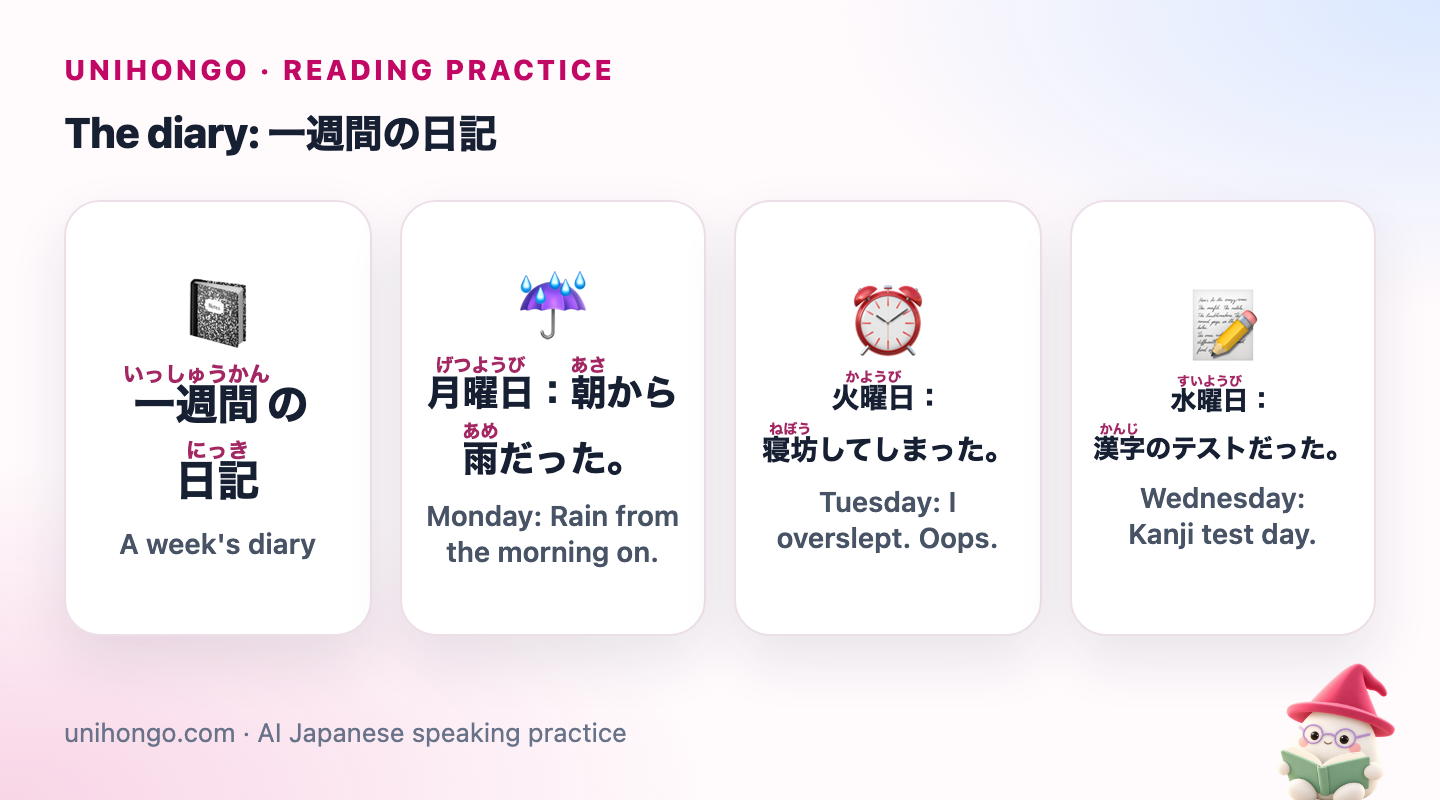
| Japanese | Romaji | Meaning |
|---|---|---|
| 一週間の日記 | Isshūkan no nikki | A week's diary |
| 月曜日:朝から雨だった。 | Getsuyōbi: asa kara ame datta. | Monday: Rain from the morning on. |
| 火曜日:寝坊してしまった。 | Kayōbi: nebō shite shimatta. | Tuesday: I overslept. Oops. |
| 水曜日:漢字のテストだった。 | Suiyōbi: kanji no tesuto datta. | Wednesday: Kanji test day. |
| 思ったより難しくなかったので、ほっとした。 | Omotta yori muzukashiku nakatta node, hotto shita. | It was easier than I'd thought, so I was relieved. |
| 木曜日:友だちに借りた本を、まだ返していないことに気がついた。 | Mokuyōbi: tomodachi ni karita hon o, mada kaeshite inai koto ni ki ga tsuita. | Thursday: I realised I still haven't returned a friend's book. |
| 明日、忘れないで持っていこうと思う。 | Ashita, wasurenaide motte ikō to omou. | I'll remember to take it tomorrow. |
| 金曜日:仕事の後、同僚と焼き鳥を食べに行った。 | Kin'yōbi: shigoto no ato, dōryō to yakitori o tabe ni itta. | Friday: After work, I went for yakitori with coworkers. |
| 本はちゃんと返した。 | Hon wa chanto kaeshita. | I did return the book. |
| 土曜日:初めて一人で美容院に行った。 | Doyōbi: hajimete hitori de biyōin ni itta. | Saturday: I went to a hair salon on my own for the first time. |
| 美容院で日本語を話したことがなかったから、緊張した。 | Biyōin de nihongo o hanashita koto ga nakatta kara, kinchō shita. | I'd never spoken Japanese at a salon, so I was nervous. |
| 「短くしてください」と言えたので、うれしかった。 | "Mijikaku shite kudasai" to ieta node, ureshikatta. | I managed to say "Short, please," so I was happy. |
| 日曜日:一日中家でゆっくりした。 | Nichiyōbi: ichinichijū ie de yukkuri shita. | Sunday: I relaxed at home all day. |
| 今週は失敗もあったけど、いい一週間だったと思う。 | Konshū wa shippai mo atta kedo, ii isshūkan datta to omou. | There were some slip-ups, but I think it was a good week. |
| 来週は早く起きられるようにがんばりたい。 | Raishū wa hayaku okirareru yō ni ganbaritai. | Next week I want to work on getting up early. |
Vocabulary notes
Diary words: small events, feelings and time expressions.
| Japanese | Romaji | Meaning |
|---|---|---|
| 日記 | nikki | diary, journal |
| 寝坊する | nebō suru | to oversleep |
| ほっとする | hotto suru | to feel relieved |
| 借りる | kariru | to borrow |
| 返す | kaesu | to return, to give back |
| 同僚 | dōryō | coworker, colleague |
| ちゃんと | chanto | properly, as I should |
| 美容院 | biyōin | hair salon |
| 一日中 | ichinichijū | all day long |
| 失敗 | shippai | mistake, failure, slip-up |
借りる and 返す pair with 貸す (to lend): 友だちに借りた, I borrowed from a friend; 友だちに貸した, I lent to a friend. The particle に is the same in both, so the verb decides the direction. 中 after a time word, read じゅう, means throughout: 一日中, 一年中. In other words it is read ちゅう, as in 午前中 (during the morning) and 仕事中 (at work), so learn each word with its reading.
Grammar notes: the diary voice
Plain form is the frame. Inside it, four patterns do most of the work. Each pair shows the diary line first and a new example second.
| Japanese | Romaji | Meaning |
|---|---|---|
| 寝坊してしまった。 | Nebō shite shimatta. | From the diary: I overslept. (regret) |
| 傘を電車に忘れてしまった。 | Kasa o densha ni wasurete shimatta. | I left my umbrella on the train. (oops) |
| まだ返していないことに気がついた。 | Mada kaeshite inai koto ni ki ga tsuita. | From the diary: I noticed I still hadn't returned it. |
| 財布がないことに気がついた。 | Saifu ga nai koto ni ki ga tsuita. | I realised my wallet was gone. |
| 「短くしてください」と言えた。 | "Mijikaku shite kudasai" to ieta. | From the diary: I managed to say "Short, please." |
| 日本語で電話ができた。 | Nihongo de denwa ga dekita. | I managed to make a phone call in Japanese. |
| 早く起きられるようにがんばりたい。 | Hayaku okirareru yō ni ganbaritai. | From the diary: I want to work at getting up early. |
| 漢字が読めるように毎日練習している。 | Kanji ga yomeru yō ni mainichi renshū shite iru. | I practise every day so I can read kanji. |
The potential form (言える, できる, 起きられる) in the past often means managed to: 言えた, I was able to say it this time. 〜ように after a potential verb gives the goal of an effort: so that I can. And 〜ことに気がついた turns a whole plain-form clause into the thing you noticed. The diary also uses けど, the casual form of が, in the Sunday line.
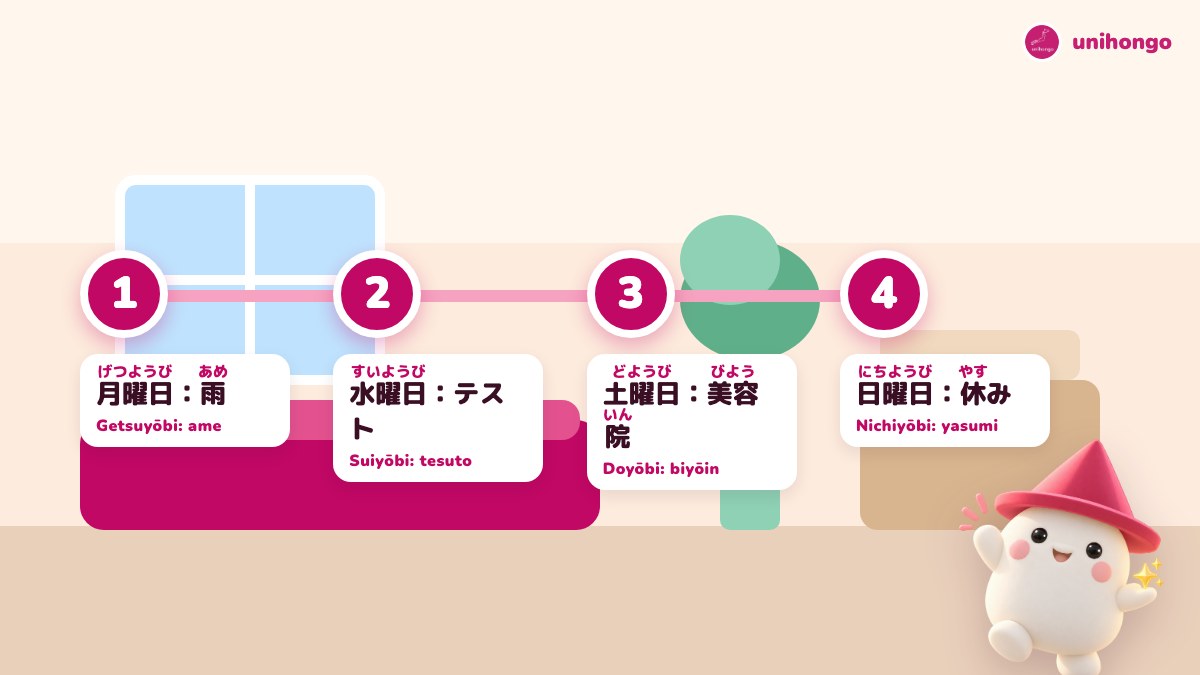
A week at a glance
Seen as a timeline, the week has a shape: a weak start, a test, a small problem solved, a social evening, a personal success and a rest. Notice that every entry is short, and that the feelings (ほっとした, 緊張した, うれしかった) carry as much information as the events. That is what makes a diary readable for others and useful for you: one event, one feeling.
Try reading the week again using only the timeline below as a prompt, and see how many full lines you can recall.
| Japanese | Romaji | Meaning |
|---|---|---|
| 今日は暑かった。 | Kyō wa atsukatta. | It was hot today. |
| 駅で友だちに会った。 | Eki de tomodachi ni atta. | I ran into a friend at the station. |
| 新しい言葉を三つ覚えた。 | Atarashii kotoba o mittsu oboeta. | I learned three new words. |
| 疲れたけど、楽しかった。 | Tsukareta kedo, tanoshikatta. | I was tired, but it was fun. |
| 今日は早く寝ようと思う。 | Kyō wa hayaku neyō to omou. | I think I'll go to bed early tonight. |
Reading traps in this text
- 朝から雨だった uses から for time, from the morning. In this diary から also appears as because, in 話したことがなかったから; the word before it tells you which one.
- 思ったより難しくなかった means it was less difficult than I'd thought. より marks what you compare with, here your own expectation.
- まだ返していない with まだ means still haven't. The ている negative describes a state that continues up to now.
- 忘れないで持っていこう uses 〜ないで, without doing: I'll take it without forgetting, in other words make sure I remember.
- 焼き鳥を食べに行った is the purpose pattern again: went in order to eat yakitori. The verb stem 食べ comes before に.
Check your understanding
Three questions about the week. The answers follow.
- Why was the writer relieved on Wednesday?
- What did the writer realise on Thursday?
- Why was the writer happy on Saturday?
Answers
| Japanese | Romaji | Meaning |
|---|---|---|
| テストが思ったより難しくなかったからです。 | Tesuto ga omotta yori muzukashiku nakatta kara desu. | 1. The test was easier than expected. |
| 友だちに借りた本をまだ返していないことです。 | Tomodachi ni karita hon o mada kaeshite inai koto desu. | 2. They still hadn't returned a friend's book. |
| 「短くしてください」と日本語で言えたからです。 | "Mijikaku shite kudasai" to nihongo de ieta kara desu. | 3. They managed to ask for a short cut in Japanese. |
Answers to questions about a plain-form text are usually given in polite form, as here. Switching registers when you answer is good practice for the exam, where the text and the answer choices often use different styles.
A read-aloud and write-along routine
- Read the days of the week aloud first: getsuyōbi to nichiyōbi, keeping each yō long.
- Read the diary once slowly, pausing after each colon.
- Read it again in a quieter, more personal voice; diaries are thoughts, not speeches.
- Choose your favourite line and change one word to make it true for you.
- Write tonight's entry: one event and one feeling, in plain form.
Keep the diary going
The hard part of a diary is day four. Make it easier by giving each entry a reader: paste it into Mocchi on Unihongo with /correct and ask it to keep the plain diary style. Mocchi keeps notes on the slips you repeat, such as forgetting だ before と思う, and its later reviews start from those. When you want new material, /read gives you another short text at your level to read before you write.
Once a week, read your seven entries aloud and check your rhythm on the pronunciation coach, choosing a sentence intonation drill at your level. Hearing how a statement falls at the end will make your diary sound as natural read aloud as it looks on paper.