

The story: 風邪をひいた日
The narrator lives alone in Japan and works at a company. Read the whole text once before checking anything.
The story covers one day in detail and then jumps three days ahead. Look for the time words 朝, 夜 and 三日後 to follow it. Health texts are full of compound kanji words; if one stops you, read the kana in the romaji once, say it aloud and move on, then check the vocabulary notes after you finish.
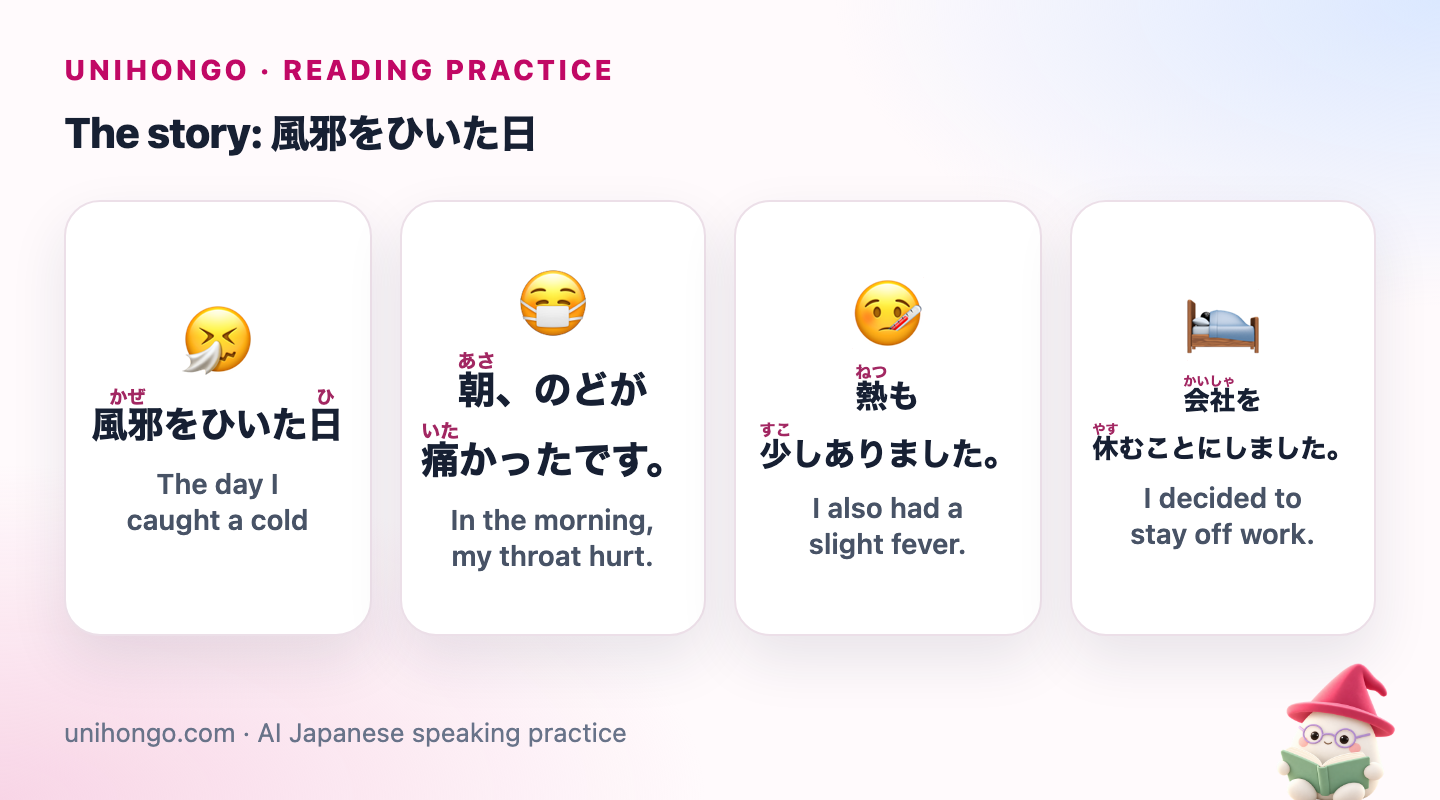
| Japanese | Romaji | Meaning |
|---|---|---|
| 風邪をひいた日 | Kaze o hiita hi | The day I caught a cold |
| 朝、のどが痛かったです。 | Asa, nodo ga itakatta desu. | In the morning, my throat hurt. |
| 熱も少しありました。 | Netsu mo sukoshi arimashita. | I also had a slight fever. |
| 会社を休むことにしました。 | Kaisha o yasumu koto ni shimashita. | I decided to stay off work. |
| 上司に電話して、「今日は休ませてください」と言いました。 | Jōshi ni denwa shite, "Kyō wa yasumasete kudasai" to iimashita. | I called my boss and asked to take the day off. |
| 熱を測ったら、三十八度ありました。 | Netsu o hakattara, sanjūhachi do arimashita. | When I took my temperature, it was 38 degrees. |
| 日本で病院に行ったことがなかったので、少し不安でした。 | Nihon de byōin ni itta koto ga nakatta node, sukoshi fuan deshita. | I'd never seen a doctor in Japan, so I was a bit worried. |
| 近くのクリニックに行って、受付で保険証を出しました。 | Chikaku no kurinikku ni itte, uketsuke de hokenshō o dashimashita. | I went to a nearby clinic and showed my insurance card. |
| 問診票に、いつから具合が悪いかを書きました。 | Monshinhyō ni, itsu kara guai ga warui ka o kakimashita. | On the form, I wrote when I'd started feeling ill. |
| 先生は「風邪ですね。三日ぐらい休んだほうがいいですよ」と言いました。 | Sensei wa "Kaze desu ne. Mikka gurai yasunda hō ga ii desu yo" to iimashita. | The doctor said, "It's a cold. Rest for about three days." |
| 薬局で薬をもらって、一日三回飲むように言われました。 | Yakkyoku de kusuri o moratte, ichinichi sankai nomu yō ni iwaremashita. | At the pharmacy I was told to take the medicine three times a day. |
| 家に帰って、すぐに寝ました。 | Ie ni kaette, sugu ni nemashita. | I went home and went straight to bed. |
| 一人暮らしなので、料理をするのが大変でした。 | Hitorigurashi na node, ryōri o suru no ga taihen deshita. | I live alone, so cooking was hard. |
| 夜、友だちがスポーツドリンクとゼリーを持ってきてくれました。 | Yoru, tomodachi ga supōtsu dorinku to zerī o motte kite kuremashita. | In the evening, a friend brought me sports drinks and jelly. |
| 三日後には熱が下がって、元気になりました。 | Mikka go ni wa netsu ga sagatte, genki ni narimashita. | Three days later my fever went down and I felt better. |
| これからは、もっと早く寝ようと思います。 | Kore kara wa, motto hayaku neyō to omoimasu. | From now on, I'm going to go to bed earlier. |
Vocabulary notes
Health words you will meet at every clinic and pharmacy in Japan.
| Japanese | Romaji | Meaning |
|---|---|---|
| 風邪をひく | kaze o hiku | to catch a cold |
| のど | nodo | throat |
| 熱 | netsu | fever, temperature |
| 測る | hakaru | to measure (temperature) |
| 上司 | jōshi | boss, manager |
| 保険証 | hokenshō | health insurance card |
| 問診票 | monshinhyō | medical questionnaire |
| 具合が悪い | guai ga warui | to feel unwell |
| 薬局 | yakkyoku | pharmacy |
| 熱が下がる | netsu ga sagaru | for a fever to go down |
Japanese says 風邪をひく, literally to pull a cold, not to get one. Doctors are called 先生, the same word as teacher, which is why the story says 先生は〜と言いました. Temperatures are in Celsius: 三十八度 is about 100 °F. Note also 三日, read mikka when it means three days, and 一人暮らし, living alone, a very common word for students and young workers.
Grammar notes: decisions, advice and instructions
The story is full of things people decide, advise and tell each other to do. Each pair shows the line from the text and a new example.
| Japanese | Romaji | Meaning |
|---|---|---|
| 会社を休むことにしました。 | Kaisha o yasumu koto ni shimashita. | From the text: I decided to take the day off. |
| 来年、日本に行くことにしました。 | Rainen, Nihon ni iku koto ni shimashita. | I've decided to go to Japan next year. |
| 三日ぐらい休んだほうがいいですよ。 | Mikka gurai yasunda hō ga ii desu yo. | From the text: You'd better rest for about three days. |
| 今日は早く帰ったほうがいいですよ。 | Kyō wa hayaku kaetta hō ga ii desu yo. | You should go home early today. |
| 一日三回飲むように言われました。 | Ichinichi sankai nomu yō ni iwaremashita. | From the text: I was told to take it three times a day. |
| 水をたくさん飲むように言われました。 | Mizu o takusan nomu yō ni iwaremashita. | I was told to drink plenty of water. |
| 熱を測ったら、三十八度ありました。 | Netsu o hakattara, sanjūhachi do arimashita. | From the text: When I took my temperature, it was 38. |
| 窓を開けたら、雪が降っていました。 | Mado o aketara, yuki ga futte imashita. | When I opened the window, it was snowing. |
〜ことにする is a decision you make yourself; compare 〜ことになる from other stories, where the decision comes from outside. 〜ほうがいい usually takes the past た form for advice to do something (休んだほうがいい) and the plain negative for advice not to (無理しないほうがいい). 〜ように言われる reports an instruction without quoting it word for word. And 〜たら with a past main clause often means when I did this, I found that, a discovery.
Phrases for the clinic reception
At a small clinic, the conversation at reception is short. Staff ask for your insurance card, whether it is your first visit and what is wrong, then hand you the questionnaire. Speak slowly and give the main symptom first, then when it started. Clinics vary, and some ask you to book online or by phone first, so check the website if you can.
This post teaches language only. If symptoms are severe or someone cannot breathe or wake, call 119 for an ambulance; the operator will ask whether it is a fire or a medical emergency, and the answer is 救急です.
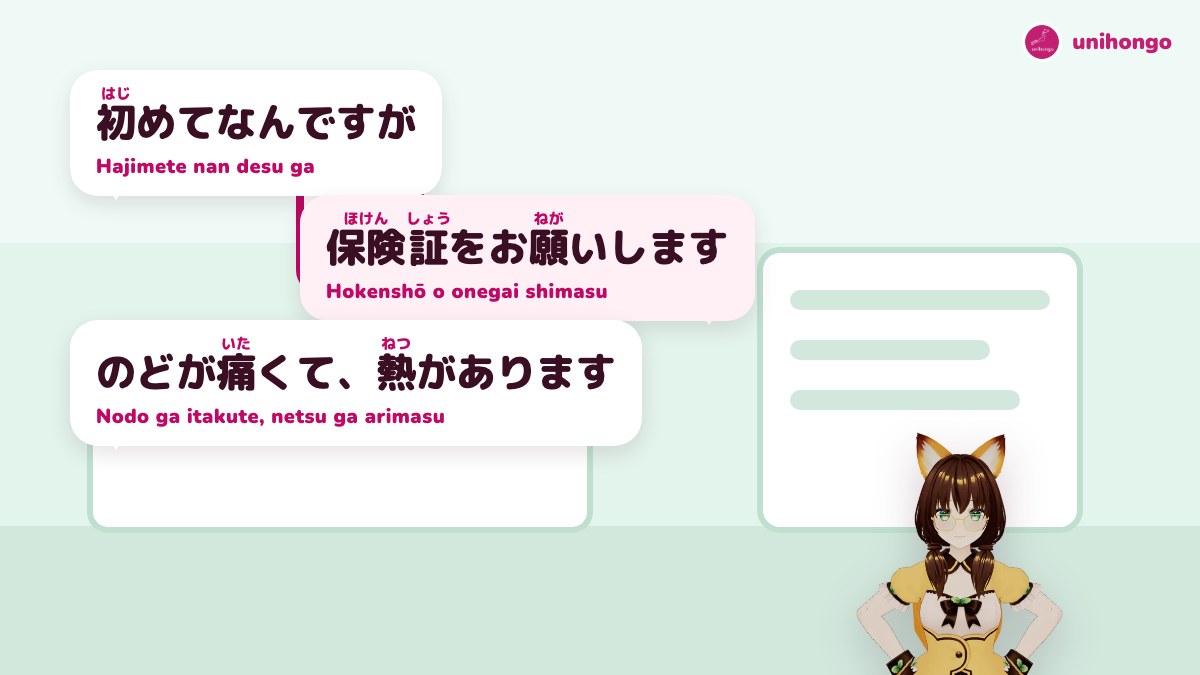
| Japanese | Romaji | Meaning |
|---|---|---|
| 初めてなんですが。 | Hajimete nan desu ga. | Patient: It's my first time here. |
| 保険証をお願いします。 | Hokenshō o onegai shimasu. | Staff: Your insurance card, please. |
| 今日はどうされましたか。 | Kyō wa dō saremashita ka. | Staff: What seems to be the problem today? |
| のどが痛くて、熱があります。 | Nodo ga itakute, netsu ga arimasu. | Patient: My throat hurts and I have a fever. |
| 昨日の夜からです。 | Kinō no yoru kara desu. | Patient: Since last night. |
| 薬のアレルギーはありますか。 | Kusuri no arerugī wa arimasu ka. | Staff: Do you have any drug allergies? |
Reading traps in this text
- 休ませてください is the causative て form plus ください: please let me rest. It does not mean please make me rest; asking for permission this way is very common at work.
- 三十八度ありました uses ある for a measured amount: my temperature was as high as 38. You will also hear 熱が三十八度ある.
- 病院に行ったことがなかったので puts the experience pattern in the past negative: I had never been, up to that day.
- 一人暮らしなので needs な between a noun and ので. Forgetting it, 一人暮らしので, is one of the most common N4 writing mistakes.
- 持ってきてくれました joins three verbs: brought (持ってくる) for me (くれる). Read the chain from left to right.
Check your understanding
Three questions about the story. The answers follow.
- Why was the narrator a little worried about going to the clinic?
- How long did the doctor say the narrator should rest?
- What did the friend bring in the evening?
Answers
| Japanese | Romaji | Meaning |
|---|---|---|
| 日本で病院に行ったことがなかったからです。 | Nihon de byōin ni itta koto ga nakatta kara desu. | 1. They had never seen a doctor in Japan. |
| 三日ぐらいです。 | Mikka gurai desu. | 2. About three days. |
| スポーツドリンクとゼリーです。 | Supōtsu dorinku to zerī desu. | 3. Sports drinks and jelly. |
The answer to question 1 is not about the illness at all. Reading questions often ask about feelings, and the reason is usually just before a feeling word such as 不安, うれしい or 大変.
A read-aloud routine
- Read sentences 1 to 4 slowly in a tired voice; it helps the meaning stick.
- Practise the long vowels: jōshi, hokenshō, monshinhyō, byōin. Each long vowel takes two beats.
- Read the doctor's line with a calm, kind tone and a soft ending on yo.
- Read the whole story once at a natural pace.
- Then say the clinic reception lines from memory, changing the symptom each time.
Prepare before you need it
Health Japanese is easiest to learn while you are well. Tell Mocchi on Unihongo which symptoms you want to be able to explain, for example: /vocab words for a cold, a stomach ache and a headache at N4. Mocchi gives you the words with example sentences and remembers them for your later reviews, so the list does not disappear after one session.
Then rehearse the visit itself with the Describe Symptoms at a Clinic mission in AI Sensei. The Sensei plays the receptionist and the doctor, asks follow-up questions and gives you a session report afterwards with the corrections and the words you used.