

Four phrases to know before you open the email
These four expressions appear in a huge number of internal emails in Japan. The first one opens the message, the last one usually hides the actual request. If you recognise them instantly, you can spend your reading energy on the details instead.
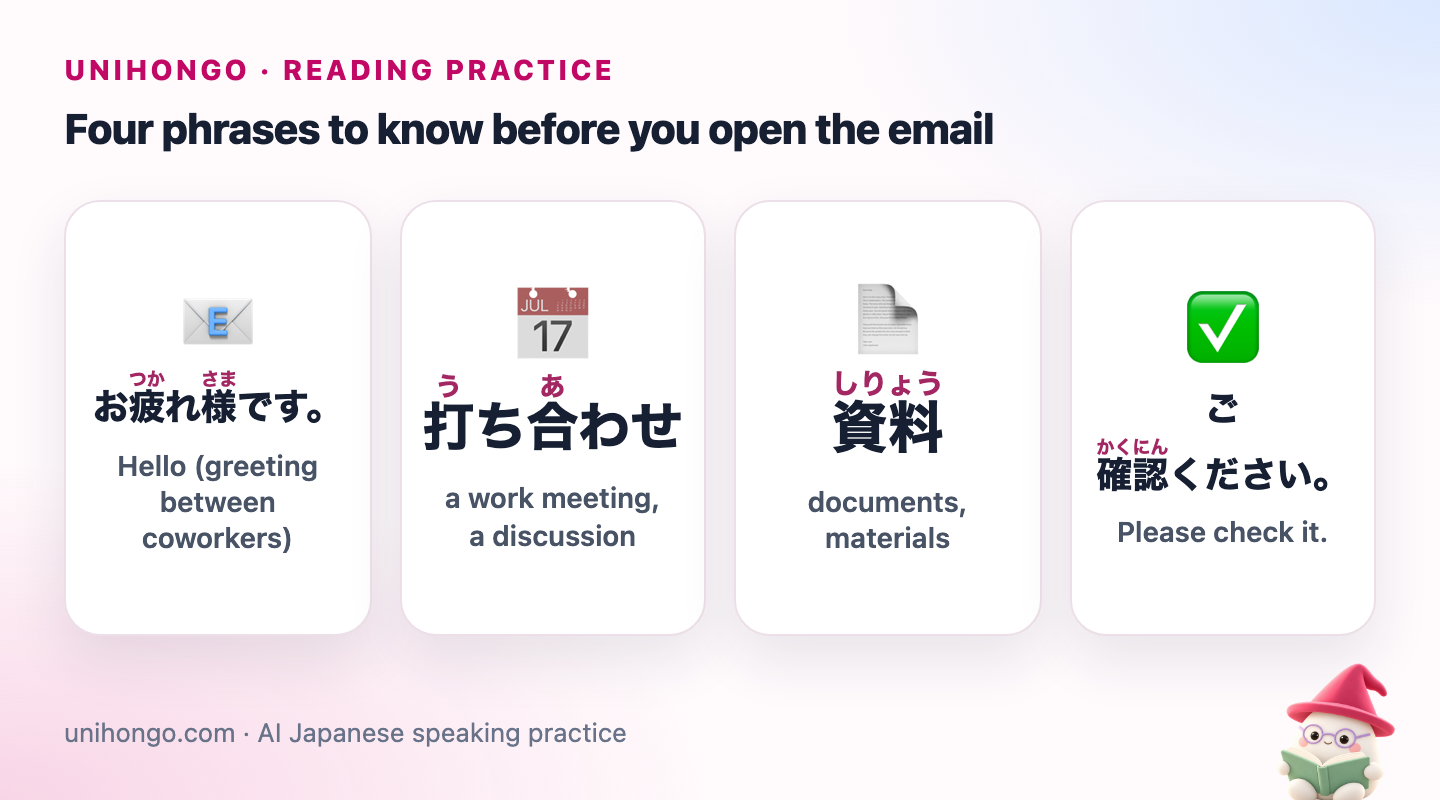
| Japanese | Romaji | Meaning |
|---|---|---|
| お疲れ様です。 | Otsukaresama desu. | Hello (greeting between coworkers) |
| 打ち合わせ | uchiawase | a work meeting, a discussion |
| 資料 | shiryō | documents, materials |
| ご確認ください。 | Gokakunin kudasai. | Please check it. |
The email, part 1: greeting and the change
Sato from the sales team writes to a coworker, Yamamoto, the afternoon before a meeting with a client. Read the Japanese first and try to find the most important fact before you look at the translation.
| Japanese | Romaji | Meaning |
|---|---|---|
| 件名:明日の打ち合わせについて | Kenmei: ashita no uchiawase ni tsuite | Subject: About tomorrow's meeting |
| 山本さん | Yamamoto san | Yamamoto-san, |
| お疲れ様です。営業部の佐藤です。 | Otsukaresama desu. Eigyōbu no Satō desu. | Hello, this is Sato from Sales. |
| 昨日は会議の準備を手伝っていただき、ありがとうございました。 | Kinō wa kaigi no junbi o tetsudatte itadaki, arigatō gozaimashita. | Thank you for helping me prepare for the meeting yesterday. |
| 明日の打ち合わせについて、ご連絡いたします。 | Ashita no uchiawase ni tsuite, gorenraku itashimasu. | I'm writing about tomorrow's meeting. |
| お客様のご都合により、開始時間が午前十時から午後二時に変更になりました。 | Okyakusama no gotsugō ni yori, kaishi jikan ga gozen jūji kara gogo niji ni henkō ni narimashita. | Because of the client's schedule, the start time has changed from 10 a.m. to 2 p.m. |
| 場所は前回と同じ、三階の第二会議室です。 | Basho wa zenkai to onaji, sangai no daini kaigishitsu desu. | The place is the same as last time: Meeting Room 2 on the third floor. |
| なお、会議室は午前中、別の部署に予約されているため、早めに入ることはできません。 | Nao, kaigishitsu wa gozenchū, betsu no busho ni yoyaku sarete iru tame, hayame ni hairu koto wa dekimasen. | Please note that another department has booked the room for the morning, so we can't go in early. |
The email, part 2: the attachment, the request and the closing
The second half contains the real work. Look for what Yamamoto is asked to do, what Sato offers to do, and who else will come to the meeting.
| Japanese | Romaji | Meaning |
|---|---|---|
| 当日使う資料を添付いたしましたので、事前にご確認いただけると助かります。 | Tōjitsu tsukau shiryō o tenpu itashimashita node, jizen ni gokakunin itadakeru to tasukarimasu. | I've attached the documents for the day, so it would help if you could check them beforehand. |
| 特に、五ページの売上の数字は、先月のデータで作成しております。 | Toku ni, go pēji no uriage no sūji wa, sengetsu no dēta de sakusei shite orimasu. | In particular, the sales figures on page 5 are based on last month's data. |
| 最新の数字が必要であれば、本日中に修正いたします。 | Saishin no sūji ga hitsuyō de areba, honjitsu-chū ni shūsei itashimasu. | If the latest figures are needed, I'll update them by the end of today. |
| 当日は先方の部長もいらっしゃる予定です。 | Tōjitsu wa senpō no buchō mo irassharu yotei desu. | The client's department manager is also expected to attend. |
| 鈴木部長によると、話の中心は来年の新商品になるそうです。 | Suzuki buchō ni yoru to, hanashi no chūshin wa rainen no shinshōhin ni naru sō desu. | According to our manager, Suzuki, the discussion will focus on next year's new products. |
| そのため、新商品のパンフレットも十部ほど用意しておきます。 | Sono tame, shinshōhin no panfuretto mo jūbu hodo yōi shite okimasu. | So I'll also prepare about ten copies of the new product brochure. |
| ご不明な点がございましたら、お気軽にお知らせください。 | Gofumei na ten ga gozaimashitara, okigaru ni oshirase kudasai. | If anything is unclear, please feel free to let me know. |
| お忙しいところ恐れ入りますが、どうぞよろしくお願いいたします。 | Oisogashii tokoro osoreirimasu ga, dōzo yoroshiku onegai itashimasu. | Sorry to trouble you when you're busy, and thank you in advance. |
| 営業部 佐藤 | Eigyōbu Satō | Sato, Sales Department |
Vocabulary notes
Most of these are business words you will meet again and again. Several have an everyday equivalent, which is given in the gloss so you can see the change in register.
| Japanese | Romaji | Meaning |
|---|---|---|
| 件名 | kenmei | subject (of an email) |
| 営業部 | eigyōbu | sales department |
| 都合 | tsugō | convenience, schedule (ご都合 is polite) |
| 変更になる | henkō ni naru | to be changed (formal for 変わる) |
| 部署 | busho | department, section |
| 添付する | tenpu suru | to attach (a file) |
| 事前に | jizen ni | in advance (formal for 前もって) |
| 本日中に | honjitsu-chū ni | by the end of today (formal for 今日中に) |
| 先方 | senpō | the other party, the client side |
| 部 | bu | counter for copies of documents |
| 不明な点 | fumei na ten | unclear points, questions |
当日 (tōjitsu) means on the day itself, and 前回 (zenkai) means last time. Both are much more common in writing than in casual speech, where people say その日 and この前.
Grammar notes: reading the keigo and the N3 patterns
1. Humble forms for the writer's own actions. ご連絡いたします (I will contact you), 添付いたしました (I attached), 作成しております (it has been made, by me) and 修正いたします (I will fix it) all lower the writer. A quick rule: いたします and おります almost always describe what the writer or the writer's side does.
2. Respectful forms for other people's actions. いらっしゃる is the respectful form of 来る, used for the client's manager. ご確認いただける and 手伝っていただき use いただく, receiving a favour, so the coworker's actions are treated with respect. If a sentence has いただく, the action belongs to the reader.
3. 〜ば as 〜であれば. With nouns and な-adjectives, the ば conditional is であれば: 必要であれば, if it is necessary. It is slightly more formal than 必要なら and is very common in business writing.
4. 〜によると〜そうです and the passive. Sato reports the manager's words with によると and そうです, the clear, professional way to pass on information. The passive 予約されている (has been booked) focuses on the room, not on who booked it.
| Japanese | Romaji | Meaning |
|---|---|---|
| 資料をお送りいたします。 | Shiryō o ookuri itashimasu. | Pattern 1: I'll send you the documents. (humble) |
| 社長がいらっしゃいました。 | Shachō ga irasshaimashita. | Pattern 2: The company president has arrived. (respectful) |
| ご質問があれば、お知らせください。 | Goshitsumon ga areba, oshirase kudasai. | Pattern 3: If you have any questions, please let me know. |
| 課長によると、会議は延期になるそうです。 | Kachō ni yoru to, kaigi wa enki ni naru sō desu. | Pattern 4: According to the section chief, the meeting will be postponed. |
Three common mistakes when reading work emails
Learners at N3 usually understand the words in an email like this but misread who does what, or miss the request. These three traps cause most of the confusion.
- Treating every formula as content. いつもお世話になっております, お疲れ様です and よろしくお願いいたします carry almost no information. Skip them on the first read and look for numbers, places and verbs of action.
- Missing the request because it has no ください. ご確認いただけると助かります and ご在宅をお願いいたします are requests as firm as any command. If a sentence mentions how much something would help, it is asking you to do it.
- Mixing up the actor. ご連絡いたします (humble) is something the writer does; ご確認いただける (receiving a favour) is something the reader does. When in doubt, the humble forms point at the writer and いただく points at you.
A useful habit is to write a one-line summary in English after reading any work email: what changed, what you must do, and by when. For this email: the meeting is now at 2 p.m., check the attachment today, and tell Sato if the figures need updating.
Comprehension questions
These questions test the facts, which is what you must not miss when you read a real work email. Answer in a short polite sentence.
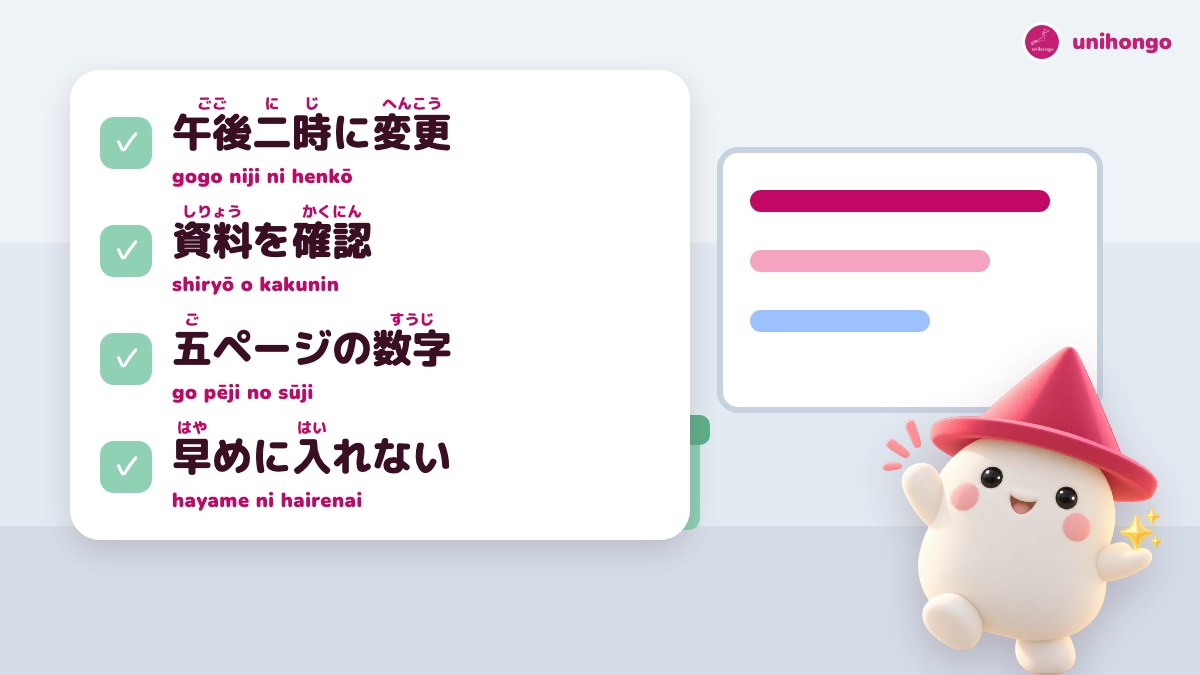
- Question 1: What time does the meeting start now?
- Question 2: Why can't they enter the meeting room early?
- Question 3: What will Sato do if the newest figures are needed?
| Japanese | Romaji | Meaning |
|---|---|---|
| 午後二時からです。 | Gogo niji kara desu. | Answer 1: From 2 p.m. |
| 午前中、別の部署に予約されているからです。 | Gozenchū, betsu no busho ni yoyaku sarete iru kara desu. | Answer 2: Because another department has booked it for the morning. |
| 本日中に資料を修正します。 | Honjitsu-chū ni shiryō o shūsei shimasu. | Answer 3: Sato will update the documents by the end of today. |
Read it aloud the way a colleague would
Reading an email aloud sounds odd, but it is the fastest way to make keigo formulas automatic. These lines also come out of people's mouths in meetings and on the phone.
- Read the whole email silently once and note the new time and room.
- Read the five formula lines aloud until they feel smooth: お疲れ様です, ご連絡いたします, ご確認いただけると助かります, ご不明な点がございましたら, よろしくお願いいたします.
- Read part 2 aloud at a calm, even speed, as if you were reading it to Yamamoto in person.
- Say the three facts from memory in casual Japanese, then in polite Japanese.
- Read the email once more and time yourself. Aim to get faster each day for a week without losing the long vowels in 営業 (eigyō) and 本日中 (honjitsu-chū).
Untangle any line that still feels foggy
If one sentence still resists, paste it into Mocchi after /explain. 最新の数字が必要であれば、本日中に修正いたします is a good test: Mocchi splits it into the condition, the time and the humble verb, and tells you who does what. Mocchi keeps track of the keigo forms you keep asking about, so a later /review can bring them back when you are likely to forget them.
To hear the same politeness in speech, open AI Sensei, choose Ibuki-sensei and ask Ibuki-sensei to play Yamamoto. Tell her about the meeting change in your own words, politely, and let her ask you questions about the documents.