

The verdict first: four lines to scan for
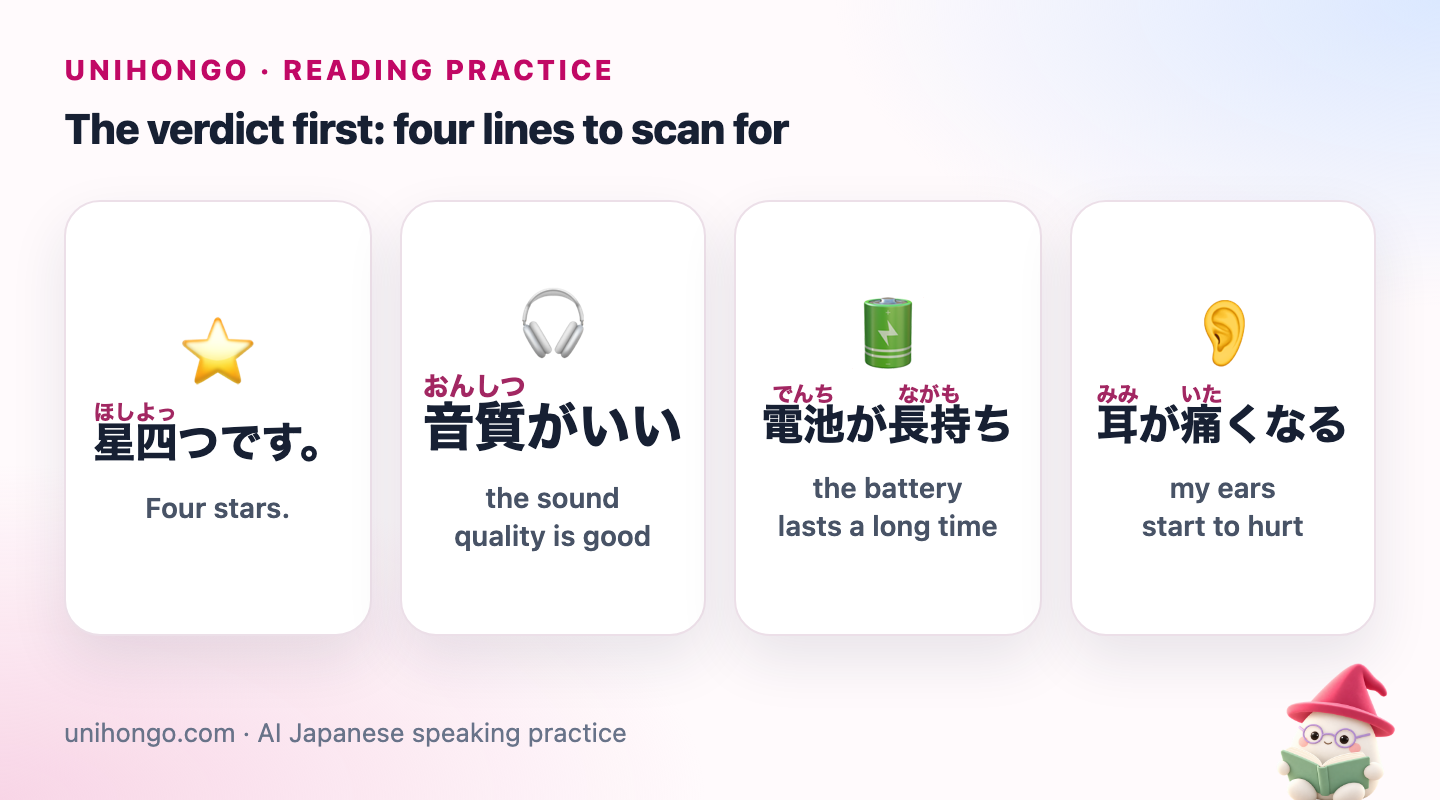
When Japanese shoppers skim a review, they look for the rating and a few key judgments. Learn these four lines first; they summarise this review in seconds.
| Japanese | Romaji | Meaning |
|---|---|---|
| 星四つです。 | Hoshi yottsu desu. | Four stars. |
| 音質がいい | onshitsu ga ii | the sound quality is good |
| 電池が長持ち | denchi ga nagamochi | the battery lasts a long time |
| 耳が痛くなる | mimi ga itaku naru | my ears start to hurt |
The review, part 1: why I bought them and what is good
The review is written in polite です and ます, which is common on Japanese shopping sites, although many reviewers use plain form too. Read for the facts the writer checked personally.
| Japanese | Romaji | Meaning |
|---|---|---|
| 通勤用に買いましたが、全体的には満足しています。 | Tsūkin-yō ni kaimashita ga, zentaiteki ni wa manzoku shite imasu. | I bought these for my commute, and overall I'm satisfied. |
| 前のヘッドホンが壊れたので、レビューの評価が高いこちらを選びました。 | Mae no heddohon ga kowareta node, rebyū no hyōka ga takai kochira o erabimashita. | My old headphones broke, so I chose these because they had high ratings. |
| まず、音質は値段のわりにかなりいいと思います。 | Mazu, onshitsu wa nedan no wari ni kanari ii to omoimasu. | First, I think the sound quality is very good for the price. |
| 特に低音がはっきりしていて、ロックを聞くと気持ちがいいです。 | Toku ni teion ga hakkiri shite ite, rokku o kiku to kimochi ga ii desu. | The bass is especially clear, so rock music feels great. |
| ノイズキャンセリングをオンにすれば、電車の音はほとんど聞こえません。 | Noizu kyanseringu o on ni sureba, densha no oto wa hotondo kikoemasen. | If you turn noise cancelling on, you can barely hear the train. |
| 説明書によると、電池は最大三十時間持つらしいです。 | Setsumeisho ni yoru to, denchi wa saidai sanjū jikan motsu rashii desu. | According to the manual, the battery lasts up to thirty hours. |
| 実際に、毎日二時間使って、一週間に一回充電すれば十分でした。 | Jissai ni, mainichi nijikan tsukatte, isshūkan ni ikkai jūden sureba jūbun deshita. | In practice, using them two hours a day, charging once a week was enough. |
| デザインがシンプルなので、よくほめられます。 | Dezain ga shinpuru na node, yoku homeraremasu. | The design is simple, so people often compliment them. |
The review, part 2: the weak points and the verdict
Watch for the turn. 一方で (on the other hand) tells you the complaints are coming, and the last sentences give the verdict and who the product suits.
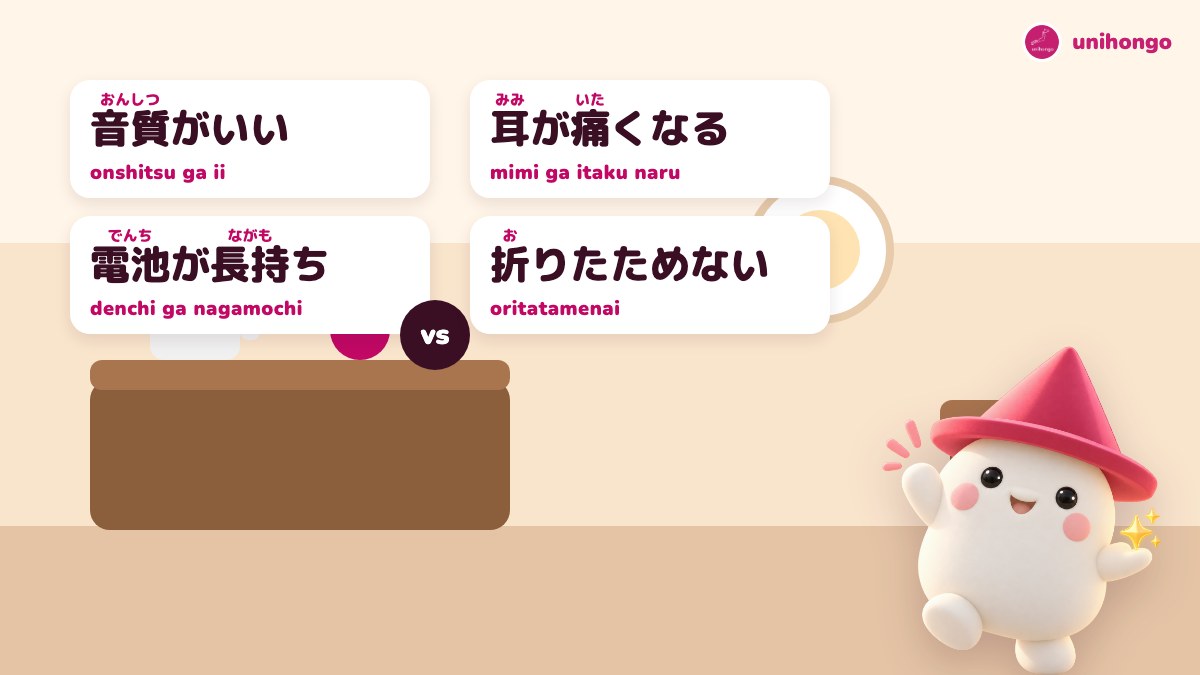
| Japanese | Romaji | Meaning |
|---|---|---|
| 先日も、カフェで友達に「それ、どこのヘッドホン?」と聞かれました。 | Senjitsu mo, kafe de tomodachi ni sore, doko no heddohon? to kikaremashita. | Just the other day, a friend at a café asked me what brand they were. |
| 一方で、気になる点もあります。 | Ippō de, ki ni naru ten mo arimasu. | On the other hand, there are a few things that bother me. |
| 二時間以上つけていると、耳が少し痛くなります。 | Nijikan ijō tsukete iru to, mimi ga sukoshi itaku narimasu. | If I wear them for more than two hours, my ears start to hurt a little. |
| 耳が大きい人は、一度お店で試したほうがいいかもしれません。 | Mimi ga ōkii hito wa, ichido omise de tameshita hō ga ii kamoshiremasen. | If you have large ears, it might be better to try them in a shop first. |
| また、折りたためないので、かばんの中で場所をとります。 | Mata, oritatamenai node, kaban no naka de basho o torimasu. | Also, they don't fold, so they take up space in my bag. |
| 値段がもう少し安ければ、星五つにしたと思います。 | Nedan ga mō sukoshi yasukereba, hoshi itsutsu ni shita to omoimasu. | If they were a little cheaper, I think I would have given five stars. |
| 通勤や勉強に使うなら、おすすめです。 | Tsūkin ya benkyō ni tsukau nara, osusume desu. | If you'll use them for commuting or studying, I recommend them. |
| 星四つです。 | Hoshi yottsu desu. | Four stars. |
Vocabulary notes
These words appear on almost every Japanese product page and review. Many are written in katakana, so read them aloud slowly to recognise the English underneath.
| Japanese | Romaji | Meaning |
|---|---|---|
| 通勤用 | tsūkin-yō | for commuting (〜用 means for the purpose of) |
| 満足する | manzoku suru | to be satisfied |
| 評価 | hyōka | rating, evaluation |
| 音質 | onshitsu | sound quality |
| 低音 | teion | bass, low notes |
| 説明書 | setsumeisho | instruction manual |
| 充電する | jūden suru | to charge (a battery) |
| 気になる点 | ki ni naru ten | points that bother you, concerns |
| 折りたたむ | oritatamu | to fold up |
| 場所をとる | basho o toru | to take up space |
| おすすめ | osusume | recommended, a recommendation |
気になる is a gentle word for a complaint. Japanese reviewers often prefer it to strong words like 悪い (bad) or 不満 (dissatisfied), so a review full of 気になる can still be fairly negative.
Grammar notes: four patterns that shape the review
1. 〜わりに: considering. Attach it to a noun with の (値段のわりに) or to a plain-form verb or adjective (高いわりに). The second half is surprising compared with the first.
2. 〜ば: if. すれば (if you do), 安ければ (if it were cheap). In sentence 14 the ば clause is contrary to fact: the price is not cheaper, so 星五つにしたと思います means I would have given five stars.
3. 〜によると〜らしい: the writer has not tested thirty hours personally, so the claim from the manual is marked as hearsay with らしい. In the next sentence, 実際に (in practice) introduces the writer's own experience.
4. The passive for other people's reactions: ほめられます (I get complimented) and 聞かれました (I was asked). The writer stays the subject and the other people are marked with に.
| Japanese | Romaji | Meaning |
|---|---|---|
| このカフェは、駅前のわりに静かです。 | Kono kafe wa, ekimae no wari ni shizuka desu. | Pattern 1: This café is quiet, considering it's by the station. |
| もっと早く買えばよかったです。 | Motto hayaku kaeba yokatta desu. | Pattern 2: I should have bought it sooner. |
| 店員さんによると、この色は人気らしいです。 | Ten'in san ni yoru to, kono iro wa ninki rashii desu. | Pattern 3: According to the shop assistant, this colour is popular. |
| 新しい靴を友達にほめられました。 | Atarashii kutsu o tomodachi ni homeraremashita. | Pattern 4: My friend complimented my new shoes. |
How to skim a Japanese review in one minute
Real shopping sites show dozens of reviews, and you will not read them all closely. Experienced readers look for a handful of set phrases that reveal the verdict immediately. Learn these four and you can sort reviews into positive, neutral and negative at a glance.
| Japanese | Romaji | Meaning |
|---|---|---|
| 期待以上でした。 | Kitai ijō deshita. | It was better than I expected. |
| 値段相応です。 | Nedan sōō desu. | You get what you pay for. (neutral) |
| リピートします。 | Ripīto shimasu. | I'll buy it again. |
| 二度と買いません。 | Nido to kaimasen. | I'll never buy it again. |
- Read the title and the star rating first; reviewers often put the verdict there.
- Jump to the word after 一方で, ただ or 残念なのは: the complaint starts there.
- Check whether a claim is personal (実際に使ってみると) or copied from the maker (説明書によると), because only the first is real evidence.
Comprehension questions
Answer in short polite Japanese. Question 3 asks about a condition, so try to use ば in your answer.
- Question 1: Why did the writer buy new headphones?
- Question 2: What happens after two hours of use?
- Question 3: What would have made the review five stars?
| Japanese | Romaji | Meaning |
|---|---|---|
| 前のヘッドホンが壊れたからです。 | Mae no heddohon ga kowareta kara desu. | Answer 1: Because their old headphones broke. |
| 耳が少し痛くなります。 | Mimi ga sukoshi itaku narimasu. | Answer 2: Their ears start to hurt a little. |
| もう少し安ければ、星五つでした。 | Mō sukoshi yasukereba, hoshi itsutsu deshita. | Answer 3: If they had been a little cheaper, it would have been five stars. |
Read it aloud as if you were recommending them
A review is really one side of a conversation about a product. Reading it aloud with feeling helps you remember the evaluative phrases.
- Read the review silently and mark the turn with 一方で.
- Read part 1 aloud in a bright, positive voice, stressing かなりいい and 気持ちがいい.
- Read part 2 aloud in a calmer voice, as if giving honest advice to a friend.
- Read sentence 14 three times until 安ければ comes out without hesitation: ya-su-ke-re-ba.
- Close the text and give your own verdict in three sentences: one good point, one weak point and a star rating.
Turn the review into your own
Write a review of something you own and send it to Mocchi with /correct. Mocchi corrects it, explains why each change sounds more natural, and keeps note of the patterns you get wrong, such as the missing の in 値段のわりに, so they come back in a later /review. For more of this kind of text, ask /read for another N3 review, perhaps of a hotel or a café.
To use the vocabulary out loud, open AI Sensei, choose Hana-sensei and ask Hana-sensei to play a friend who wants to buy the same headphones. Retell the review in your own words and answer her questions about the battery and the fit.