

Four words you will hear in every typhoon report
Before reading, learn the four words that carry most typhoon news. If you catch only these, you already know whether the situation is serious.
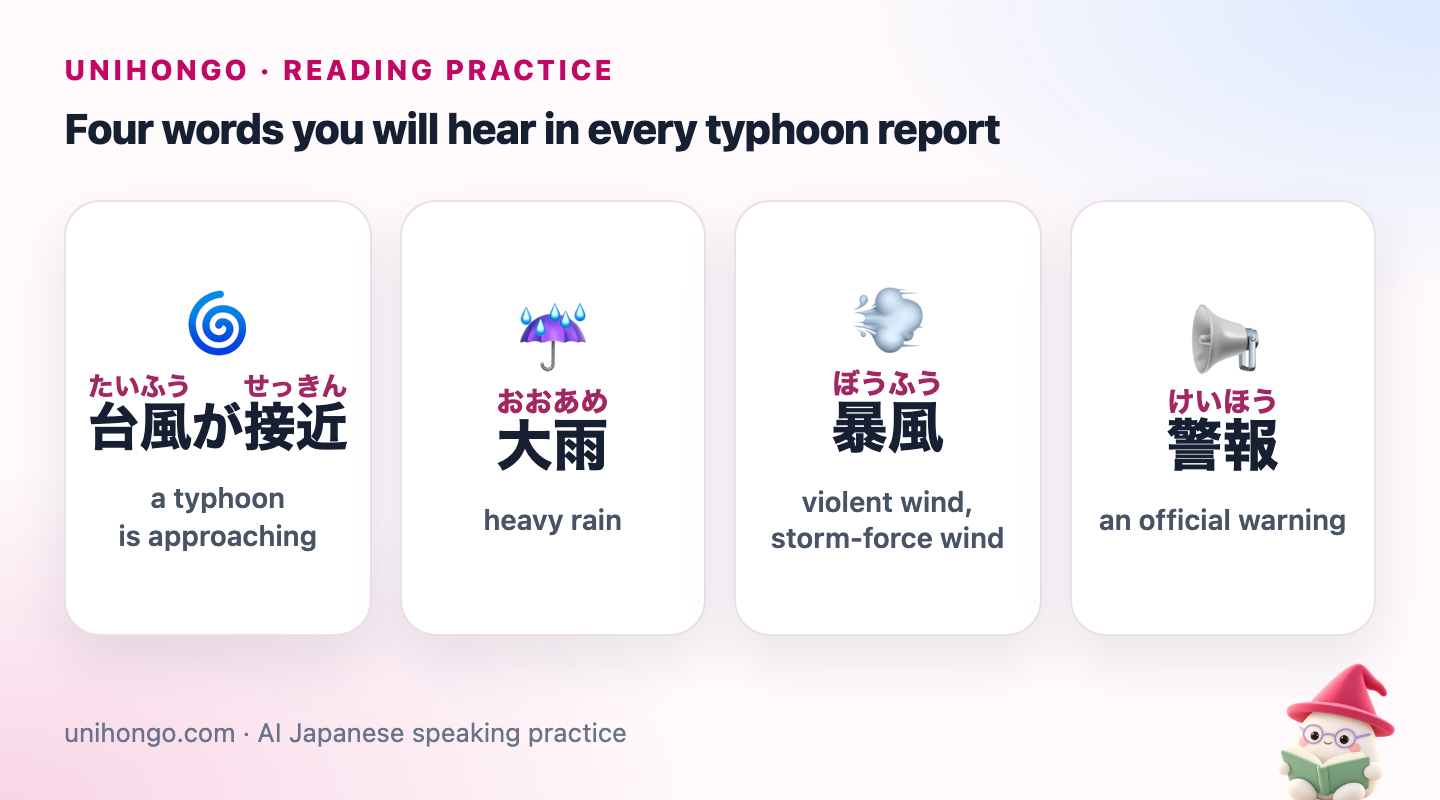
| Japanese | Romaji | Meaning |
|---|---|---|
| 台風が接近 | taifū ga sekkin | a typhoon is approaching |
| 大雨 | ōame | heavy rain |
| 暴風 | bōfū | violent wind, storm-force wind |
| 警報 | keihō | an official warning |
The news, part 1: the typhoon and the rain
The text is written in the polite news style, with です and ます. Read each sentence and ask yourself one question: is this happening now, or is it a prediction?
| Japanese | Romaji | Meaning |
|---|---|---|
| 強い台風が、今夜から明日の朝にかけて九州に接近する見込みです。 | Tsuyoi taifū ga, kon'ya kara ashita no asa ni kakete Kyūshū ni sekkin suru mikomi desu. | A strong typhoon is expected to approach Kyushu from tonight into tomorrow morning. |
| 気象庁によると、台風は北へ進んでおり、勢力を保ったまま上陸するおそれがあります。 | Kishōchō ni yoru to, taifū wa kita e susunde ori, seiryoku o tamotta mama jōriku suru osore ga arimasu. | According to the Meteorological Agency, the typhoon is moving north and may make landfall without weakening. |
| 九州南部では、すでに一時間に五十ミリを超える激しい雨が降っています。 | Kyūshū nanbu de wa, sude ni ichijikan ni gojū miri o koeru hageshii ame ga futte imasu. | In southern Kyushu, intense rain of over 50 millimetres an hour is already falling. |
| 鹿児島県の一部の地域には、大雨警報が発表されました。 | Kagoshima ken no ichibu no chiiki ni wa, ōame keihō ga happyō saremashita. | A heavy rain warning has been issued for parts of Kagoshima Prefecture. |
| 海の近くでは、高い波にも注意が必要です。 | Umi no chikaku de wa, takai nami ni mo chūi ga hitsuyō desu. | Near the sea, people also need to watch out for high waves. |
| この影響で、明日は九州を発着する飛行機の多くが欠航になる見込みです。 | Kono eikyō de, ashita wa Kyūshū o hacchaku suru hikōki no ōku ga kekkō ni naru mikomi desu. | As a result, many flights to and from Kyushu are expected to be cancelled tomorrow. |
| 新幹線も、朝から運転を見合わせる可能性があります。 | Shinkansen mo, asa kara unten o miawaseru kanōsei ga arimasu. | The shinkansen may also suspend service from the morning. |
| 鉄道会社によると、運転再開の時間は、雨と風の状況を見て決めるということです。 | Tetsudō gaisha ni yoru to, unten saikai no jikan wa, ame to kaze no jōkyō o mite kimeru to iu koto desu. | According to the railway company, it will decide when to restart service after watching the rain and wind. |
The news, part 2: schools, shelters and what to do
The second half moves from the weather to people's lives. This is the part you most need to understand in a real typhoon, so read it twice.
| Japanese | Romaji | Meaning |
|---|---|---|
| 一部の小学校や中学校は、明日休校にすることを決めました。 | Ichibu no shōgakkō ya chūgakkō wa, ashita kyūkō ni suru koto o kimemashita. | Some elementary and junior high schools have decided to close tomorrow. |
| 市は、川や崖の近くに住む人に、早めに避難するよう呼びかけています。 | Shi wa, kawa ya gake no chikaku ni sumu hito ni, hayame ni hinan suru yō yobikakete imasu. | The city is urging people who live near rivers or steep slopes to evacuate early. |
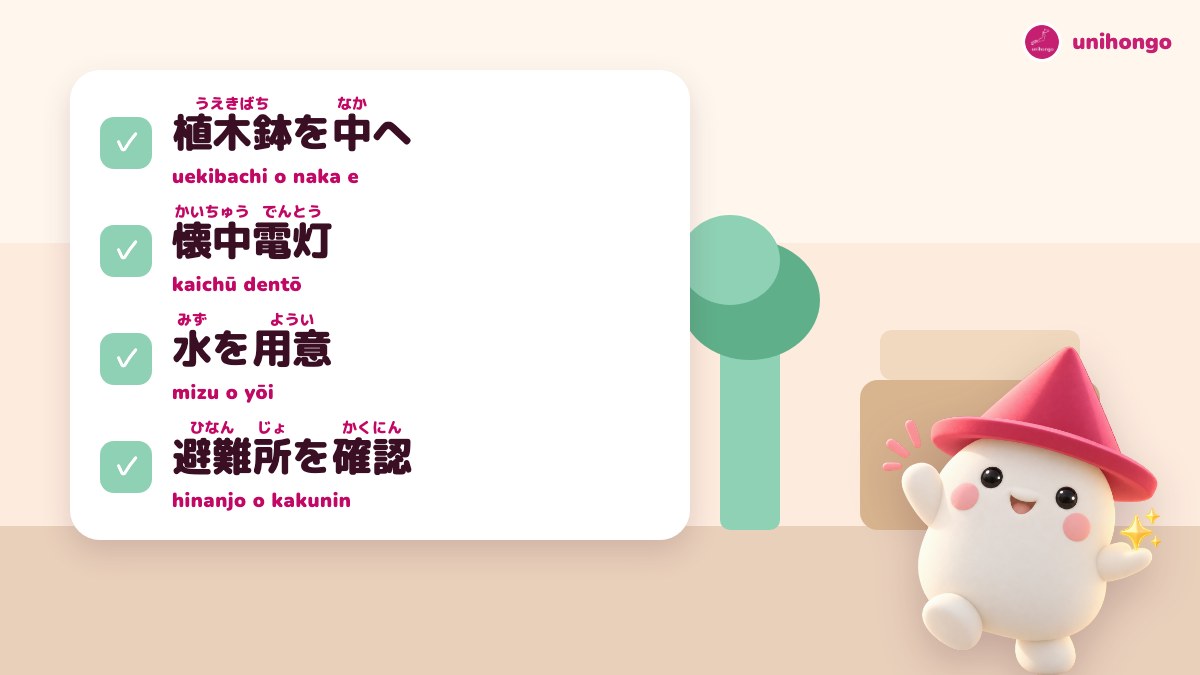
| 避難所は、市内の公民館など二十か所に開設されています。 | Hinanjo wa, shinai no kōminkan nado nijikkasho ni kaisetsu sarete imasu. | Shelters have been opened at twenty places in the city, including community centres. |
| 風が強くなれば、外に出るのは非常に危険です。 | Kaze ga tsuyoku nareba, soto ni deru no wa hijō ni kiken desu. | Once the wind gets stronger, going outside will be extremely dangerous. |
| ベランダの植木鉢などは、家の中に入れておきましょう。 | Beranda no uekibachi nado wa, ie no naka ni irete okimashō. | Bring plant pots and other things on your balcony indoors. |
| 停電に備えて、懐中電灯や水を用意しておくと安心です。 | Teiden ni sonaete, kaichū dentō ya mizu o yōi shite oku to anshin desu. | To be ready for a power cut, it's reassuring to have a flashlight and water prepared. |
| 台風は、あさっての朝までに日本海へ抜ける見込みです。 | Taifū wa, asatte no asa made ni Nihonkai e nukeru mikomi desu. | The typhoon is expected to move out into the Sea of Japan by the morning after tomorrow. |
| 最新の情報に十分注意してください。 | Saishin no jōhō ni jūbun chūi shite kudasai. | Please pay close attention to the latest information. |
Vocabulary notes
Weather news reuses a small set of formal words. Many of them are written with kanji you already know, so try to guess the meaning before you read the gloss.
| Japanese | Romaji | Meaning |
|---|---|---|
| 〜にかけて | ni kakete | from … into …, over a period |
| 気象庁 | Kishōchō | the Japan Meteorological Agency |
| 上陸する | jōriku suru | to make landfall |
| 発着する | hacchaku suru | to arrive and depart |
| 欠航 | kekkō | cancellation (of a flight or ferry) |
| 運転を見合わせる | unten o miawaseru | to suspend (train) service |
| 休校 | kyūkō | school closure for the day |
| 避難する | hinan suru | to evacuate, take shelter |
| 避難所 | hinanjo | evacuation shelter |
| 停電 | teiden | power cut |
| 〜に備えて | ni sonaete | in preparation for … |
欠航 is used for planes and boats; trains are 運休 (unkyū) when cancelled or 運転見合わせ when temporarily stopped. Learners often say 電車が欠航する, which sounds wrong to native ears.
Grammar notes: how the news sounds certain and careful
1. 〜によると〜ということです: reported information. The railway company's plan in sentence 8 is passed on with ということです. In conversation you might say らしい or んだって, but news keeps to this neutral form.
2. Prediction endings: 見込みです (expected), おそれがあります (there is a risk of something bad) and 可能性があります (it is possible). Each attaches to the dictionary form of a verb: 接近する見込み, 上陸するおそれ, 見合わせる可能性.
3. The passive in reports: 発表されました (was issued) and 開設されています (have been opened). The news cares about the warning and the shelters, not about which office acted, so the passive is natural.
4. 〜ば and 〜ておく for advice: 強くなれば (once it gets stronger) sets a condition, and 入れておきましょう and 用意しておく ask you to act in advance, before the condition arrives.
| Japanese | Romaji | Meaning |
|---|---|---|
| 警察によると、けが人はいないということです。 | Keisatsu ni yoru to, keganin wa inai to iu koto desu. | Pattern 1: According to the police, no one was injured. |
| 週末は雪が降るおそれがあります。 | Shūmatsu wa yuki ga furu osore ga arimasu. | Pattern 2: There is a risk of snow at the weekend. |
| 新しい駅の名前が発表されました。 | Atarashii eki no namae ga happyō saremashita. | Pattern 3: The name of the new station has been announced. |
| 雨が降れば、試合は中止です。 | Ame ga fureba, shiai wa chūshi desu. | Pattern 4: If it rains, the match is cancelled. |
From reading the news to staying safe
In a real typhoon, the language in this text becomes practical. Japanese TV, radio and city apps use the same words, and many cities also offer information in English and other languages. Arrangements differ between cities, so learn where your own city posts its information before the season starts.
These short questions are useful when you need to check what is happening with someone at a station, at work or at a shelter.
| Japanese | Romaji | Meaning |
|---|---|---|
| 電車は動いていますか。 | Densha wa ugoite imasu ka. | Are the trains running? |
| 明日は休校ですか。 | Ashita wa kyūkō desu ka. | Is school closed tomorrow? |
| いちばん近い避難所はどこですか。 | Ichiban chikai hinanjo wa doko desu ka. | Where is the nearest shelter? |
| 警報はもう解除されましたか。 | Keihō wa mō kaijo saremashita ka. | Has the warning been lifted yet? |
解除 (kaijo) means a warning has been lifted, another word you will hear at the end of every storm. In an emergency where someone needs an ambulance, the number in Japan is 119.
Comprehension questions
Answer these as if a friend had just asked you about the news. Keep the answers short and polite.
- Question 1: Where and when is the typhoon expected to approach?
- Question 2: How will the railway company decide when to restart service?
- Question 3: Whom is the city asking to evacuate early?
| Japanese | Romaji | Meaning |
|---|---|---|
| 今夜から明日の朝にかけて、九州に接近します。 | Kon'ya kara ashita no asa ni kakete, Kyūshū ni sekkin shimasu. | Answer 1: It will approach Kyushu from tonight into tomorrow morning. |
| 雨と風の状況を見て決めます。 | Ame to kaze no jōkyō o mite kimemasu. | Answer 2: It will decide after watching the rain and wind. |
| 川や崖の近くに住む人です。 | Kawa ya gake no chikaku ni sumu hito desu. | Answer 3: People living near rivers or steep slopes. |
Read it aloud like a newsreader
News Japanese has a recognisable rhythm: steady, slightly slow, with clear pauses at commas. Copying it is excellent practice for long sentences.
- Read part 1 silently and circle every sentence ending: 見込みです, おそれがあります, ということです.
- Read part 1 aloud, pausing at each comma for a full beat. Do not rush the long vowels in 気象庁 (Kishōchō) and 状況 (jōkyō).
- Read part 2 aloud a little faster, as if the situation were getting more urgent.
- Record sentences 9 to 12 and compare your pauses with the commas in the text.
- Finish by reading the whole report in under two minutes without stopping.
Make the news your own
Type /read in Mocchi and ask for another short N3 news item, this time about heavy snow or a heatwave, so you meet the same endings in a new setting. If a sentence in this report still feels heavy, paste it after /explain and Mocchi will show you which part is the fact and which part is the prediction. Mocchi remembers the words you struggled with, so they come back in your next review.
Then retell the typhoon news in AI Sensei. Choose Sakura-sensei and ask Sakura-sensei to play a worried friend who missed the news; tell Sakura-sensei what is happening, what is only expected and what Sakura-sensei should do tonight.