

Before you read: the title and three key words
The essay is called 私のふるさと. ふるさと has a warmer, more nostalgic feeling than the everyday word 地元, which is why it appears in essays and songs. Learn the title and these three key words first.
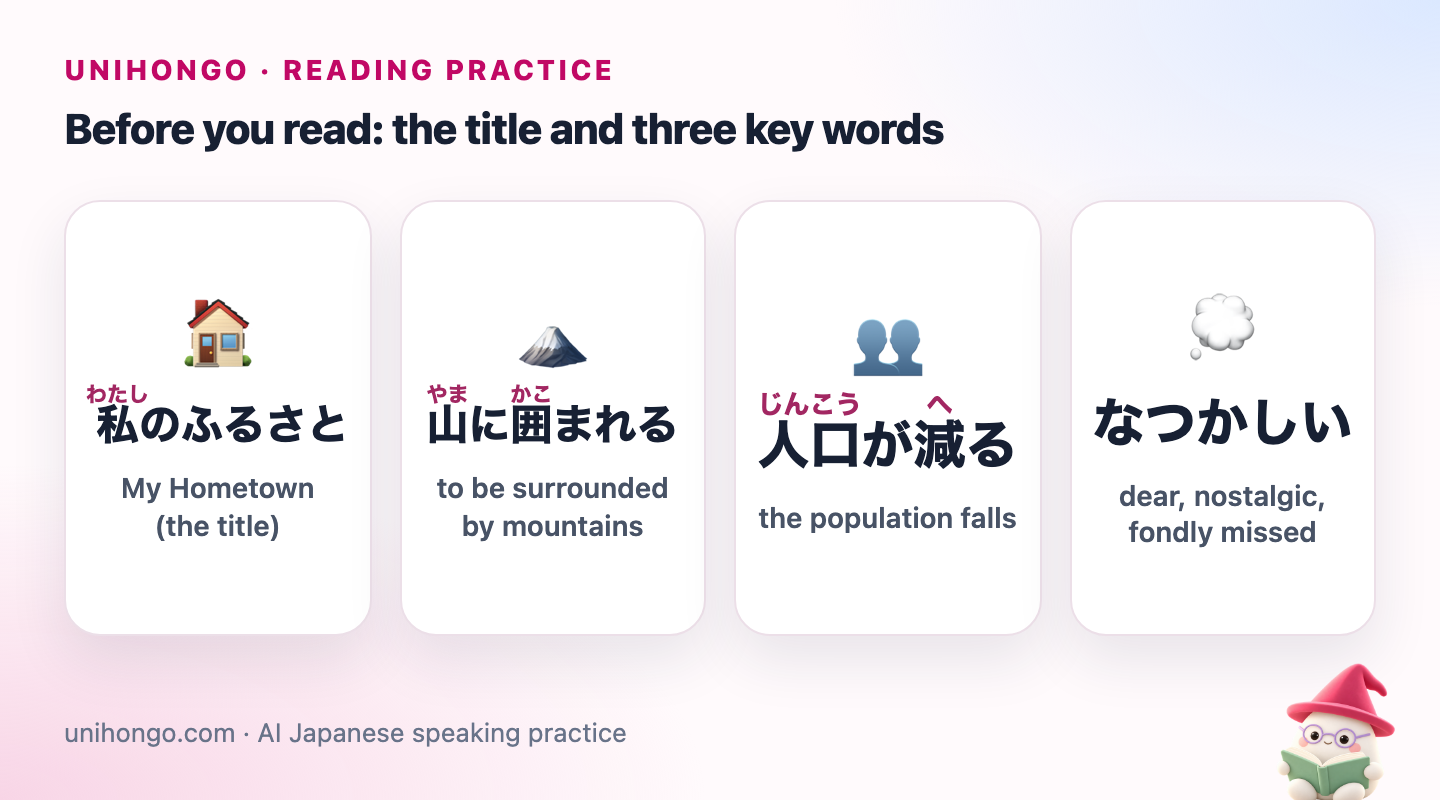
| Japanese | Romaji | Meaning |
|---|---|---|
| 私のふるさと | Watashi no furusato | My Hometown (the title) |
| 山に囲まれる | yama ni kakomareru | to be surrounded by mountains |
| 人口が減る | jinkō ga heru | the population falls |
| なつかしい | natsukashii | dear, nostalgic, fondly missed |
The essay, part 1: the town and childhood
The first half describes the town and the writer's memories. Notice that every sentence ends in plain form: だ, 〜る, 〜た.
| Japanese | Romaji | Meaning |
|---|---|---|
| 私のふるさとは、山に囲まれた小さな町だ。 | Watashi no furusato wa, yama ni kakomareta chiisana machi da. | My hometown is a small town surrounded by mountains. |
| 東京から電車で三時間ほどかかる。 | Tōkyō kara densha de sanjikan hodo kakaru. | It takes about three hours by train from Tokyo. |
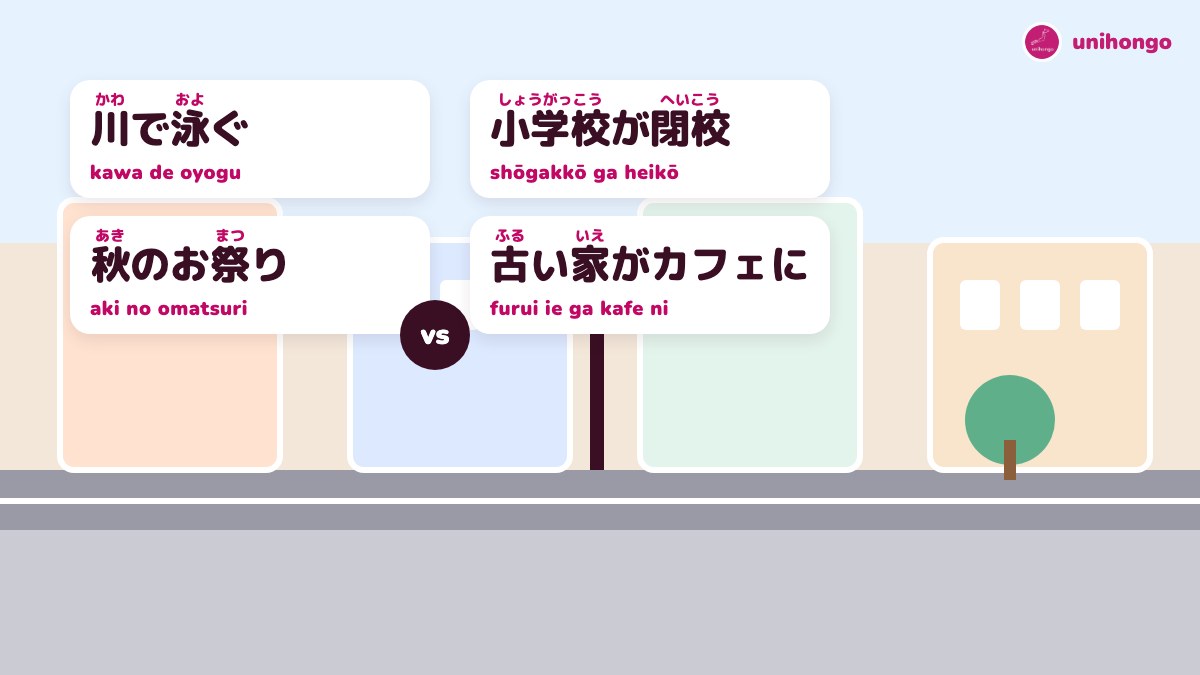
| 町の真ん中には川が流れていて、夏になると子どもたちがそこで泳ぐ。 | Machi no mannaka ni wa kawa ga nagarete ite, natsu ni naru to kodomotachi ga soko de oyogu. | A river runs through the middle of town, and in summer the children swim there. |
| 祖母によると、昔はこの川で魚がたくさんとれたらしい。 | Sobo ni yoru to, mukashi wa kono kawa de sakana ga takusan toreta rashii. | According to my grandmother, people used to catch lots of fish in this river. |
| 秋には町のお祭りがあり、遠くからも大勢の人が訪れる。 | Aki ni wa machi no omatsuri ga ari, tōku kara mo ōzei no hito ga otozureru. | In autumn there is a town festival, and crowds of people come even from far away. |
| 私も子どものころは、毎年はっぴを着て、みこしを担いだ。 | Watashi mo kodomo no koro wa, maitoshi happi o kite, mikoshi o katsuida. | As a child, I too wore a festival coat every year and helped carry the portable shrine. |
| しかし、最近は町の人口が少しずつ減っている。 | Shikashi, saikin wa machi no jinkō ga sukoshi zutsu hette iru. | Recently, however, the town's population has been slowly falling. |
| 若い人の多くは、大学や仕事のために都会へ出てしまう。 | Wakai hito no ōku wa, daigaku ya shigoto no tame ni tokai e dete shimau. | Many young people leave for the cities for university or work. |
The essay, part 2: change and hope
The second half turns to change. Look for the word that signals the turn from loss to something new, and for the writer's feelings at the end.
| Japanese | Romaji | Meaning |
|---|---|---|
| 私が通っていた小学校も、三年前に閉校になった。 | Watashi ga kayotte ita shōgakkō mo, sannen mae ni heikō ni natta. | Even the elementary school I went to closed three years ago. |
| 去年帰ったとき、駅前の古い本屋がなくなっていて、とてもさびしかった。 | Kyonen kaetta toki, ekimae no furui hon'ya ga naku natte ite, totemo sabishikatta. | When I went back last year, the old bookshop by the station was gone, and I felt very sad. |
| 一方で、新しい動きもある。 | Ippō de, atarashii ugoki mo aru. | On the other hand, there are new developments. |
| 古い家がカフェに生まれ変わり、外国人の観光客にも知られるようになった。 | Furui ie ga kafe ni umarekawari, gaikokujin no kankōkyaku ni mo shirareru yō ni natta. | Old houses have been reborn as cafés, and the town has become known to foreign tourists too. |
| 町に来る人が増えれば、若い人も戻ってくるかもしれない。 | Machi ni kuru hito ga fuereba, wakai hito mo modotte kuru kamoshirenai. | If more people visit the town, young people might come back too. |
| 都会の生活は便利だが、ときどき川の音や山の空気がなつかしくなる。 | Tokai no seikatsu wa benri da ga, tokidoki kawa no oto ya yama no kūki ga natsukashiku naru. | City life is convenient, but sometimes I miss the sound of the river and the mountain air. |
| いつか、ふるさとの良さをもっと多くの人に伝えたいと思う。 | Itsuka, furusato no yosa o motto ōku no hito ni tsutaetai to omou. | Someday I want to tell more people about the good things in my hometown. |
| 次の休みには、友達を連れて帰るつもりだ。 | Tsugi no yasumi ni wa, tomodachi o tsurete kaeru tsumori da. | On my next holiday, I plan to go back and take a friend with me. |
Vocabulary notes
Most of these words are useful for any text about places, towns and change. The festival words are worth knowing if you ever join a local matsuri.
| Japanese | Romaji | Meaning |
|---|---|---|
| 真ん中 | mannaka | the middle, the centre |
| 訪れる | otozureru | to visit (written style) |
| はっぴ | happi | a short festival coat |
| みこしを担ぐ | mikoshi o katsugu | to carry a portable shrine |
| 人口 | jinkō | population |
| 都会 | tokai | the city, urban areas |
| 閉校になる | heikō ni naru | (a school) to close for good |
| 生まれ変わる | umarekawaru | to be reborn, to be transformed |
| 観光客 | kankōkyaku | tourists |
| 動き | ugoki | a movement, a development |
| 良さ | yosa | good points, merits |
Compare 閉校 with 休校 from news reports: 休校 is a school closed for a day or a period, for example because of a typhoon, while 閉校 is a school closed permanently.
Grammar notes: four patterns in the essay
1. Plain essay style. だ replaces です (小さな町だ), and verbs end in the dictionary or た form. Even the writer's wishes stay plain: 伝えたいと思う, 帰るつもりだ. Mixing です and ます into a plain essay is one of the most common mistakes in learner compositions.
2. The passive to describe places and reputation: 山に囲まれた町 (a town surrounded by mountains) and 観光客に知られるようになった (became known to tourists). The passive lets the town stay at the centre of the sentence.
3. 〜によると〜らしい for family stories. The writer did not see the old fishing days, so the grandmother's account is marked as hearsay.
4. 〜ば with かもしれない for a hopeful guess: 増えれば…戻ってくるかもしれない, if more people come, the young might return. Alongside it, 〜ようになった marks a gradual change and 〜ている (減っている) marks a trend that is still going on.
| Japanese | Romaji | Meaning |
|---|---|---|
| 駅から歩いて十分ほどだ。 | Eki kara aruite juppun hodo da. | Pattern 1: It is about ten minutes on foot from the station. (plain style) |
| この町は、海に囲まれている。 | Kono machi wa, umi ni kakomarete iru. | Pattern 2: This town is surrounded by the sea. |
| 父によると、この店は百年前からあるらしい。 | Chichi ni yoru to, kono mise wa hyakunen mae kara aru rashii. | Pattern 3: According to my father, this shop has been here for a hundred years. |
| 毎日練習すれば、上手になるかもしれない。 | Mainichi renshū sureba, jōzu ni naru kamoshirenai. | Pattern 4: If I practise every day, I might get good at it. |
| 最近、朝早く起きられるようになった。 | Saikin, asa hayaku okirareru yō ni natta. | Pattern 4: Recently I've become able to get up early. |
A frame for writing your own hometown essay
The essay follows a frame you can reuse for any place: where it is, what it is like, a memory, a change and a hope. The lines below are templates in plain form. Replace the words in each to describe your own town, and you will have the first five sentences of your essay.
| Japanese | Romaji | Meaning |
|---|---|---|
| 私のふるさとは、海の近くの町だ。 | Watashi no furusato wa, umi no chikaku no machi da. | Template: My hometown is a town near the sea. |
| この町は、温泉で知られている。 | Kono machi wa, onsen de shirarete iru. | Template: This town is known for its hot springs. |
| 子どものころは、よく友達と山に登った。 | Kodomo no koro wa, yoku tomodachi to yama ni nobotta. | Template: As a child, I often climbed the mountain with friends. |
| 最近、駅の周りが便利になった。 | Saikin, eki no mawari ga benri ni natta. | Template: Recently, the area around the station has become convenient. |
- Keep every sentence in plain form; do not switch to です halfway.
- Use one passive to describe the place (〜に囲まれた, 〜で知られている).
- End with a feeling or a plan (〜たいと思う, 〜つもりだ), as the model essay does.
Comprehension questions
Answer in polite Japanese, even though the essay is in plain form. In a conversation about the text, です and ます are normal.
- Question 1: How long does it take to reach the town from Tokyo?
- Question 2: Why is the population falling?
- Question 3: What new change gives the writer hope?
| Japanese | Romaji | Meaning |
|---|---|---|
| 電車で三時間ほどです。 | Densha de sanjikan hodo desu. | Answer 1: About three hours by train. |
| 若い人が大学や仕事のために都会へ出てしまうからです。 | Wakai hito ga daigaku ya shigoto no tame ni tokai e dete shimau kara desu. | Answer 2: Because young people leave for the cities for university or work. |
| 古い家がカフェになって、観光客に知られるようになったことです。 | Furui ie ga kafe ni natte, kankōkyaku ni shirareru yō ni natta koto desu. | Answer 3: Old houses have become cafés and the town has become known to tourists. |
Read it aloud slowly, like a speech
Hometown essays are sometimes read aloud in class or at a speech contest, so this is a natural text to perform. Aim for a calm, warm voice rather than speed.
- Read the essay silently and draw a line between the four parts: description, memory, change and hope.
- Read part 1 aloud, pausing after every 。. Check the long vowels in 東京 (Tōkyō) and 大勢 (ōzei).
- Read part 2 aloud and let your voice drop a little on さびしかった and rise again on 一方で.
- Record the last three sentences and listen for the small っ in 伝えたいと思う and the clear ん in 本屋.
- Replace the details with your own town and read the essay aloud again as your own.
Write and tell your own hometown story
Start by asking Mocchi to /explain sentence 12, the one with 生まれ変わり and 知られるようになった, because it packs three patterns into one line. Then write your own six-sentence essay and send it with /correct. Mocchi remembers your goal and the mistakes you repeat, such as slipping into です in a plain-form essay, and builds them into later quizzes.
Finally, say it out loud. In AI Sensei, choose Hana-sensei and ask Hana-sensei to play a new classmate who wants to know where you are from. Retell the essay about your own hometown and answer her questions about what has changed.