

The title and three places to know
The blog entry is called 広島で過ごした一日, A Day Spent in Hiroshima. Learn the title and these three words first; together they trace the morning of the trip.
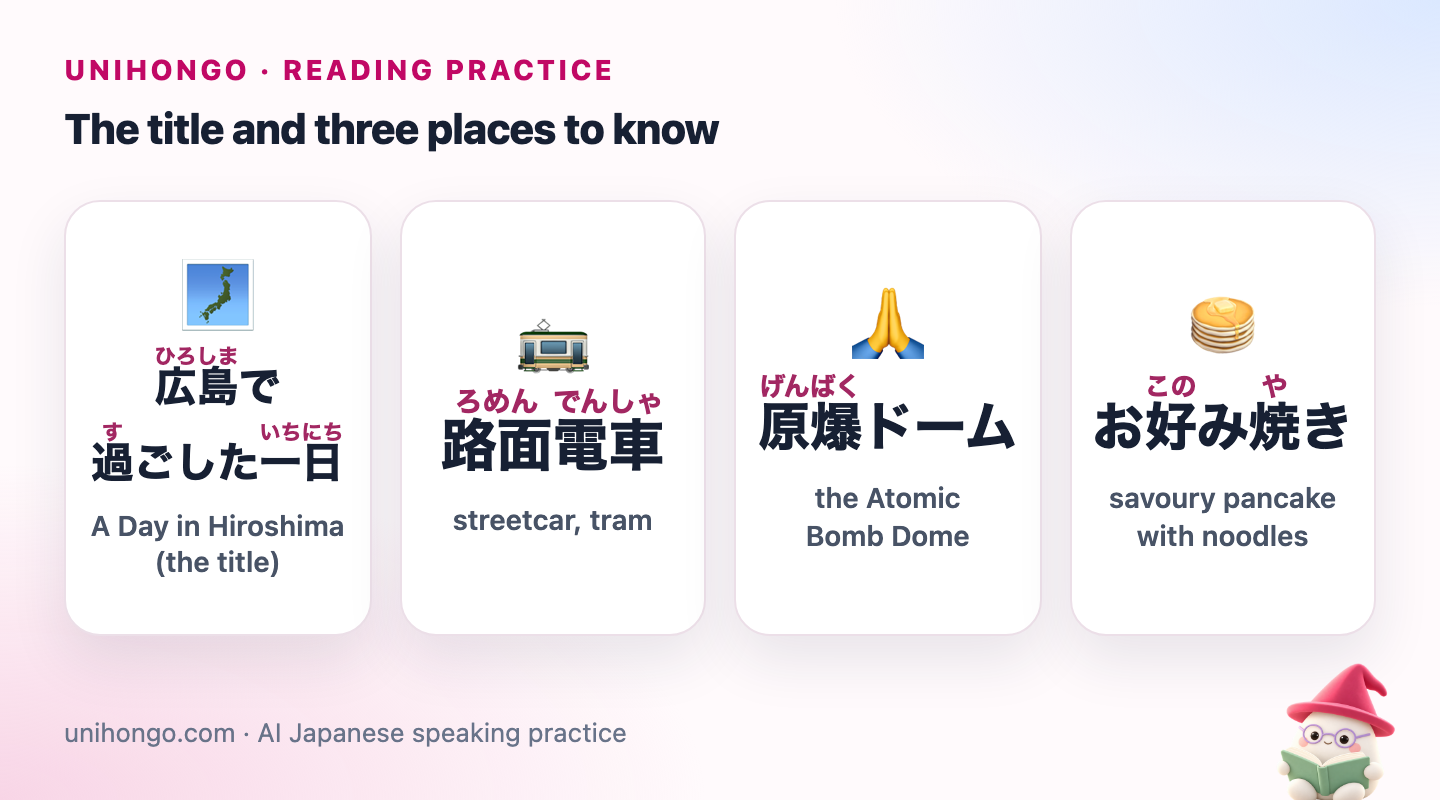
| Japanese | Romaji | Meaning |
|---|---|---|
| 広島で過ごした一日 | Hiroshima de sugoshita ichinichi | A Day in Hiroshima (the title) |
| 路面電車 | romen densha | streetcar, tram |
| 原爆ドーム | Genbaku Dōmu | the Atomic Bomb Dome |
| お好み焼き | okonomiyaki | savoury pancake with noodles |
The blog, part 1: the city and the park
The writer uses polite です and ます throughout, as many personal blogs do. Read for the route first: where does the writer go, and how?
| Japanese | Romaji | Meaning |
|---|---|---|
| 先週末、一人で広島へ行ってきました。 | Senshūmatsu, hitori de Hiroshima e itte kimashita. | Last weekend I went to Hiroshima on my own. |
| 朝早く新幹線で広島駅に着いて、まず路面電車に乗りました。 | Asa hayaku shinkansen de Hiroshima eki ni tsuite, mazu romen densha ni norimashita. | I arrived at Hiroshima Station by shinkansen early in the morning and first took a streetcar. |
| 古い車両も走っていて、窓から見る町の景色が新鮮でした。 | Furui sharyō mo hashitte ite, mado kara miru machi no keshiki ga shinsen deshita. | Some old cars were still running, and the view of the city from the window felt fresh. |
| 最初に行ったのは、平和記念公園です。 | Saisho ni itta no wa, Heiwa Kinen Kōen desu. | The first place I went was the Peace Memorial Park. |
| 原爆ドームは写真で何度も見ていましたが、実際に見ると言葉が出ませんでした。 | Genbaku Dōmu wa shashin de nando mo mite imashita ga, jissai ni miru to kotoba ga demasen deshita. | I had seen the Atomic Bomb Dome in photos many times, but seeing it for real left me speechless. |
| 資料館では、被爆した人たちの服や手紙が展示されていて、静かに見て回りました。 | Shiryōkan de wa, hibaku shita hitotachi no fuku ya tegami ga tenji sarete ite, shizuka ni mite mawarimashita. | In the museum, clothes and letters of people affected by the bombing are on display, and I walked around quietly. |
| ガイドの方によると、毎年たくさんの外国人がここを訪れるそうです。 | Gaido no kata ni yoru to, maitoshi takusan no gaikokujin ga koko o otozureru sō desu. | According to a guide, many people from abroad visit here every year. |
| お昼は、広島風のお好み焼きを食べました。 | Ohiru wa, Hiroshima fū no okonomiyaki o tabemashita. | For lunch I had Hiroshima-style okonomiyaki. |
The blog, part 2: lunch and the island
The afternoon moves to Miyajima. Look for the small problem the writer meets, and how they turn it into something positive.
| Japanese | Romaji | Meaning |
|---|---|---|
| 大阪風と違って、そばが入っていて、キャベツもたっぷりです。 | Ōsaka fū to chigatte, soba ga haitte ite, kyabetsu mo tappuri desu. | Unlike the Osaka style, it has noodles in it and plenty of cabbage. |
| 午後は電車とフェリーで宮島に渡りました。 | Gogo wa densha to ferī de Miyajima ni watarimashita. | In the afternoon I crossed to Miyajima by train and ferry. |
| 海の中に立つ大きな鳥居は、潮が引けば歩いて近くまで行けるらしいです。 | Umi no naka ni tatsu ōkina torii wa, shio ga hikeba aruite chikaku made ikeru rashii desu. | Apparently, when the tide goes out, you can walk right up to the big torii that stands in the sea. |
| 残念ながら、私が行ったときは満潮で、近くには行けませんでした。 | Zannen nagara, watashi ga itta toki wa manchō de, chikaku ni wa ikemasen deshita. | Unfortunately, it was high tide when I went, so I couldn't get close. |
| その代わり、夕日に照らされた鳥居がとてもきれいでした。 | Sono kawari, yūhi ni terasareta torii ga totemo kirei deshita. | Instead, the torii lit by the setting sun was beautiful. |
| 宮島では鹿にも会いましたが、地図を食べられそうになって、少しあわてました。 | Miyajima de wa shika ni mo aimashita ga, chizu o taberaresō ni natte, sukoshi awatemashita. | I also met deer on Miyajima, and one nearly ate my map, which made me panic a little. |
| 一日で回るのは少し忙しかったです。 | Ichinichi de mawaru no wa sukoshi isogashikatta desu. | Seeing it all in one day was a bit of a rush. |
| 時間があれば、次は二日かけてゆっくり回りたいです。 | Jikan ga areba, tsugi wa futsuka kakete yukkuri mawaritai desu. | If I have time, next time I'd like to take two days and see everything slowly. |
Vocabulary notes
Travel blogs are rich in place and transport words. These are worth learning even if you never visit Hiroshima, because they apply to trips anywhere in Japan.
| Japanese | Romaji | Meaning |
|---|---|---|
| 車両 | sharyō | a train car, a carriage |
| 景色 | keshiki | scenery, view |
| 新鮮 | shinsen | fresh (food, or a new feeling) |
| 資料館 | shiryōkan | museum, archive (of historical materials) |
| 展示する | tenji suru | to display, to exhibit |
| 〜風 | fū | … style (広島風, 大阪風) |
| 渡る | wataru | to cross (water or a road) |
| 潮が引く | shio ga hiku | the tide goes out |
| 満潮 | manchō | high tide |
| 照らす | terasu | to light up, to shine on |
| あわてる | awateru | to panic, to get flustered |
The opposite of 満潮 is 干潮 (kanchō), low tide. Both appear on tide tables and on signs near the shore.
Grammar notes: four patterns from the trip
1. 〜によると〜そうです and 〜らしい. The guide's information gets a clean report with そうです. The general claim about walking to the torii gets らしい, because the writer has heard it but could not check it.
2. The passive for exhibits and scenery: 展示されている (is displayed) and 夕日に照らされた鳥居 (the torii lit by the setting sun). In sentence 14 there is also the suffering passive: 地図を食べられそうになった, my map nearly got eaten, which shows the writer was affected.
3. 〜ば for conditions: 潮が引けば (when the tide goes out) and 時間があれば (if I have time). The first is a general rule, the second a wish for the future.
4. 〜と違って: unlike. 大阪風と違って compares the two styles of okonomiyaki. It is handy whenever you compare places, foods or customs.
| Japanese | Romaji | Meaning |
|---|---|---|
| 駅員さんによると、次の電車は遅れるそうです。 | Ekiin san ni yoru to, tsugi no densha wa okureru sō desu. | Pattern 1: According to the station staff, the next train will be late. |
| 雨に降られて、服がぬれました。 | Ame ni furarete, fuku ga nuremashita. | Pattern 2: I got caught in the rain and my clothes got wet. |
| 天気がよければ、富士山が見えます。 | Tenki ga yokereba, Fujisan ga miemasu. | Pattern 3: If the weather is good, you can see Mount Fuji. |
| 東京と違って、この町は夜が静かです。 | Tōkyō to chigatte, kono machi wa yoru ga shizuka desu. | Pattern 4: Unlike Tokyo, this town is quiet at night. |
Travel-blog phrases you can reuse anywhere
Most Japanese travel blogs are built from a small set of phrases. The ones below come straight from the entry, generalised so you can drop in any place, food or feeling. Collect them, and writing about your own trips becomes much faster.
| Japanese | Romaji | Meaning |
|---|---|---|
| 京都へ行ってきました。 | Kyōto e itte kimashita. | I went to Kyoto (and came back). |
| 思ったより広かったです。 | Omotta yori hirokatta desu. | It was bigger than I expected. |
| お昼は、名物のうどんを食べました。 | Ohiru wa, meibutsu no udon o tabemashita. | For lunch, I had the local speciality, udon. |
| 次は家族と来たいです。 | Tsugi wa kazoku to kitai desu. | Next time I'd like to come with my family. |
〜てきました, as in 行ってきました, is the natural way to say you went somewhere and are now back. Learners often write 広島へ行きました, which is correct but sounds flatter in a blog; 行ってきました tells the reader the trip is finished and the story is about to begin.
名物 (meibutsu) means a local speciality, something a place is famous for. Asking 名物は何ですか is one of the most useful questions you can ask anywhere in Japan.
Comprehension questions
Answer with short polite sentences. Use から for the reason in question 3.
- Question 1: How did the writer travel around the city in the morning?
- Question 2: How is Hiroshima-style okonomiyaki different from the Osaka style?
- Question 3: Why couldn't the writer get close to the torii?
| Japanese | Romaji | Meaning |
|---|---|---|
| 路面電車に乗りました。 | Romen densha ni norimashita. | Answer 1: By streetcar. |
| そばが入っていて、キャベツもたっぷりです。 | Soba ga haitte ite, kyabetsu mo tappuri desu. | Answer 2: It has noodles and plenty of cabbage. |
| 満潮だったからです。 | Manchō datta kara desu. | Answer 3: Because it was high tide. |
Read it aloud as if you were sharing your trip
Travel stories are made for telling. Read the entry the way you would describe a good weekend to a friend: warm, a little lively, with pauses where the feelings change.
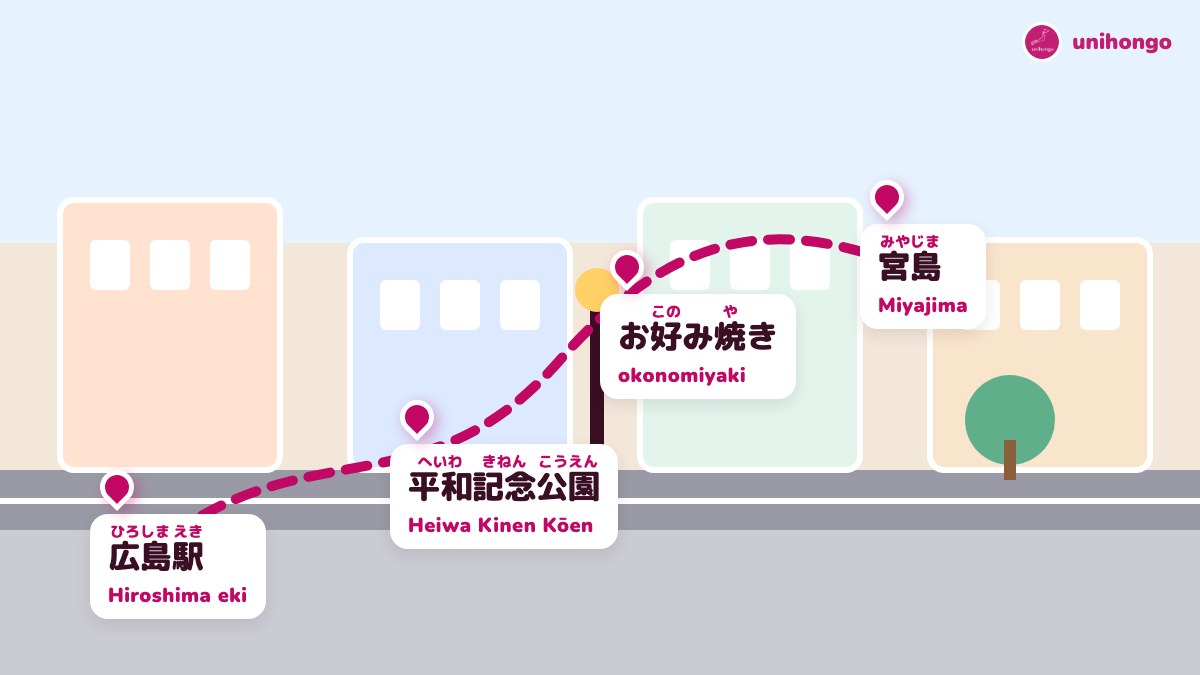
- Read the entry silently and trace the route on the map figure.
- Read part 1 aloud. Slow down for the museum sentence and keep your voice low and quiet there.
- Read part 2 aloud with more energy, and let the deer sentence sound slightly comic.
- Practise the long vowels in 平和記念公園 (Heiwa Kinen Kōen) and 大阪風 (Ōsaka fū) until they are clearly long.
- Close the text and retell the day in six sentences, starting with 先週末.
Retell the trip to someone who has never been
Paste sentence 11 into Mocchi with /explain to see how 潮が引けば, 歩いて and らしい fit together, then ask /read for another N3 travel entry, perhaps about Kanazawa or Nara. Mocchi notes which travel words you look up most and folds them into your next review.
For speaking, open AI Sensei and choose Haru-sensei. Ask him to play a friend who is planning a trip to Hiroshima and wants your advice. Retell your day from the blog, recommend what to eat and warn him about the tide.