
How this N5 vocabulary quiz works
Each question has four options. Choose one, write the letter down, and do not check the answer key until you have finished all fifteen. The questions use the same skills as the real vocabulary section: reading a kanji word, choosing a word that fits a sentence, and spotting a word that does not belong.
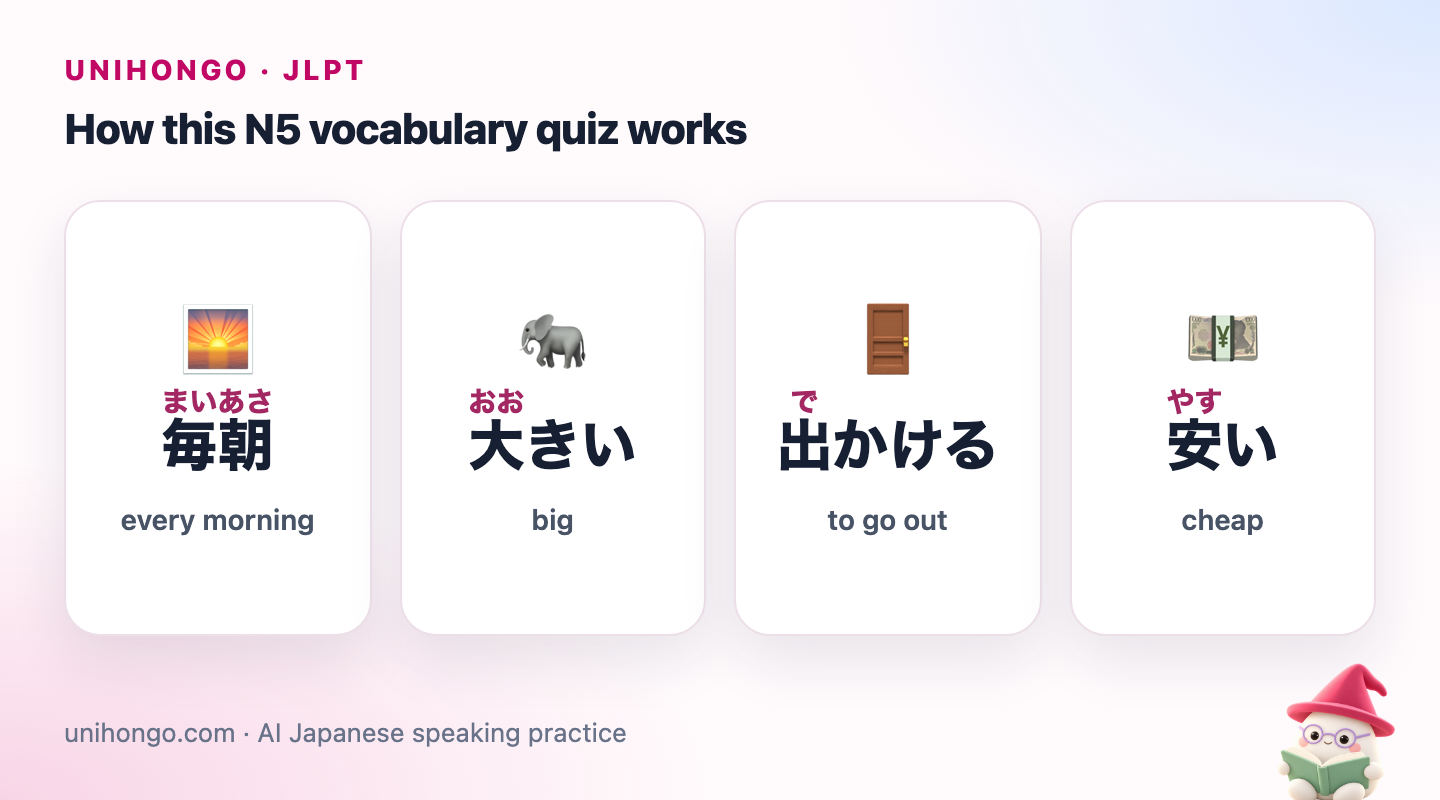
Here are four words that appear in the quiz. If you already know all four, you are in good shape; if one is new, learn it now with its example and the quiz will feel fairer.
| Japanese | Romaji | Meaning |
|---|---|---|
| 毎朝 | maiasa | every morning |
| 大きい | ōkii | big |
| 出かける | dekakeru | to go out |
| 安い | yasui | cheap |
| 毎朝、七時に起きます。 | Maiasa, shichiji ni okimasu. | I get up at seven every morning. |
Questions 1-5: readings and meanings
The first set checks whether you can read common kanji words and connect them to a meaning.
- 1. What does 毎朝 mean? (a) every morning (b) every evening (c) every day (d) this morning
- 2. How do you read 来週? (a) こんしゅう (b) せんしゅう (c) らいしゅう (d) らいねん
- 3. Which word is the opposite of 高い when you talk about prices? (a) 低い (b) 安い (c) 短い (d) 古い
- 4. Choose the word that fits: 「すみません、トイレは ___ ですか。」 (a) だれ (b) いつ (c) どこ (d) なに
- 5. Which word means to go out? (a) 出かける (b) 入る (c) 帰る (d) 休む
Questions 6-10: words in context
The second set puts words inside short sentences. Read the whole sentence before you look at the options.
- 6. 「わたしは まいにち ___ で がっこうに いきます。」 (a) くつ (b) へや (c) まど (d) じてんしゃ
- 7. What is おととい? (a) the day after tomorrow (b) the day before yesterday (c) yesterday (d) last week
- 8. How do you read 六つ? (a) むっつ (b) ろっつ (c) ろくつ (d) やっつ
- 9. 「さむいですから、まどを ___ ください。」 (a) あけて (b) けして (c) つけて (d) しめて
- 10. You are talking about your own family. Which word means my older sister? (a) おねえさん (b) いもうと (c) あね (d) おとうと
Questions 11-15: word choice and odd one out
The last set tests which words go together, a skill that word lists alone do not teach.
- 11. Which word does not belong with the others? (a) りんご (b) バナナ (c) みかん (d) いす
- 12. Which verb do you use for turning on a light? 「でんきを ___ 。」 (a) つけます (b) きります (c) あけます (d) かけます
- 13. How do you read 上手? (a) うえて (b) じょうず (c) じょうしゅ (d) へた
- 14. What does ゆうめい (有名) mean? (a) quiet (b) famous (c) busy (d) kind
- 15. Which verb goes with くすり (medicine)? 「くすりを ___ 。」 (a) たべます (b) とります (c) します (d) のみます
Answer key: questions 1-8
Give yourself one point for each correct answer. The gloss after each answer says why it is right.
| Japanese | Romaji | Meaning |
|---|---|---|
| 毎朝 | maiasa | 1 (a) every morning: mai means every, asa is morning |
| 来週 | raishū | 2 (c) next week: rai is coming, shū is week; konshū is this week |
| 安い | yasui | 3 (b) cheap: hikui is the opposite of tall or high, not of expensive |
| トイレはどこですか。 | Toire wa doko desu ka. | 4 (c) Where is the toilet? Doko asks about a place |
| 出かける | dekakeru | 5 (a) to go out; hairu is enter, kaeru is go home |
| 自転車で学校に行きます。 | Jitensha de gakkō ni ikimasu. | 6 (d) I go to school by bike; de marks the means |
| おととい | ototoi | 7 (b) the day before yesterday; the day after tomorrow is asatte |
| 六つ | muttsu | 8 (a) six things: the native count goes hitotsu to tō |
Answer key: questions 9-15
| Japanese | Romaji | Meaning |
|---|---|---|
| 窓を閉めてください。 | Mado o shimete kudasai. | 9 (d) Please close the window, because it is cold |
| 姉 | ane | 10 (c) my older sister; onēsan is for someone else's sister |
| いす | isu | 11 (d) chair: the other three are fruit |
| 電気をつけます。 | Denki o tsukemasu. | 12 (a) I turn on the light; kesu turns it off |
| 上手 | jōzu | 13 (b) skilful: a special reading; heta means unskilful |
| 有名 | yūmei | 14 (b) famous, as in yūmei na mise, a famous shop |
| 薬を飲みます。 | Kusuri o nomimasu. | 15 (d) I take medicine: Japanese drinks medicine |
Questions 10 and 15 catch the most learners. Japanese uses humble words for your own family (ane, ani, haha, chichi) and polite words for other people's family or when you call your own sister (onēsan). And medicine is drunk, nomu, even when it is a tablet.
The traps behind the wrong options
Every wrong option in this quiz was chosen because learners really pick it. Knowing the trap is often more useful than knowing the right answer, because the same trap returns on the real test with different words.
| Japanese | Romaji | Meaning |
|---|---|---|
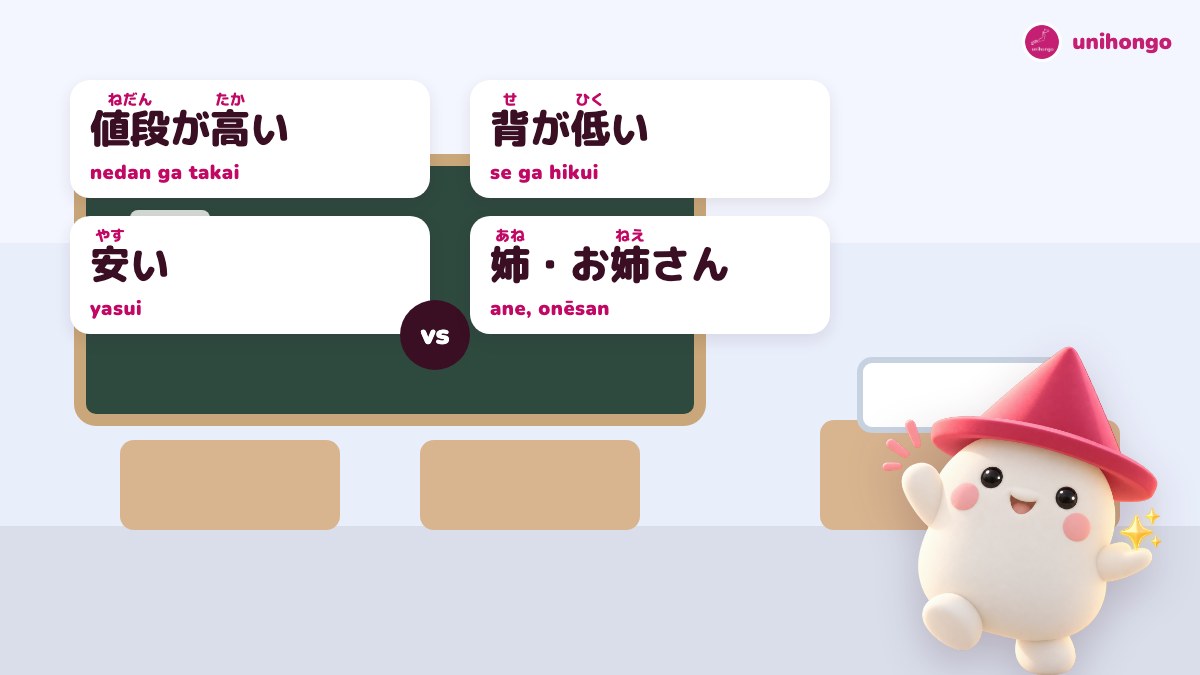
| 値段が高い | nedan ga takai | the price is high (expensive) |
| 背が低い | se ga hikui | short (in height) |
| 電気を消します。 | Denki o keshimasu. | I turn off the light. |
- Opposites depend on the meaning. 高い means both expensive and tall or high, so it has two opposites: 安い for price and 低い for height.
- Pairs of verbs look alike. 閉める (close) and 開ける (open), つける (turn on) and 消す (turn off) are often tested together; learn them as pairs.
- Family words change with the speaker. 姉 is your own sister when you talk to others; お姉さん is someone else's sister.
- Collocations do not follow English. You drink medicine, you put on a light, and you ride on a bike with に: 自転車に乗る.
What your score means
| Score | What it suggests | Next step |
|---|---|---|
| 13-15 | Your core N5 vocabulary is solid | Move on to full practice papers and timing |
| 9-12 | You know most words but slip on context | Study words inside short example sentences |
| 5-8 | Readings or meanings still feel shaky | Review a themed list: time, family, food, verbs |
| 0-4 | N5 vocabulary is mostly new to you | Learn ten words a day for two weeks, then retake |
If you scored 13 or more, do not stop at vocabulary. At N5 the vocabulary, grammar and reading sections are short, and listening often decides the result, so a timed mock test is now a better use of your time than another word list.
A single quiz of fifteen questions is a snapshot, not a verdict. If you scored low on readings but high on context, your problem is kanji, not vocabulary, and the fix is different.
Turn your missed words into a two-week review
Open Mocchi and type something like: "Here are the N5 words I missed: ane, ototoi, kusuri o nomu. Make flashcards and quiz me on them tomorrow." Mocchi can build the cards with /create-flashcards, review them with spaced repetition through /review-flashcards, and keep track of which words keep slipping so later quizzes come back to them.
When the words feel safe, take the N5 paper at unihongo.com/jlpt-mock-test. It has the real sections and time limits, including listening, and gives you an estimated score, so you can see whether vocabulary is still the weak link or whether grammar and listening now need the time.