
Four sentences to warm up
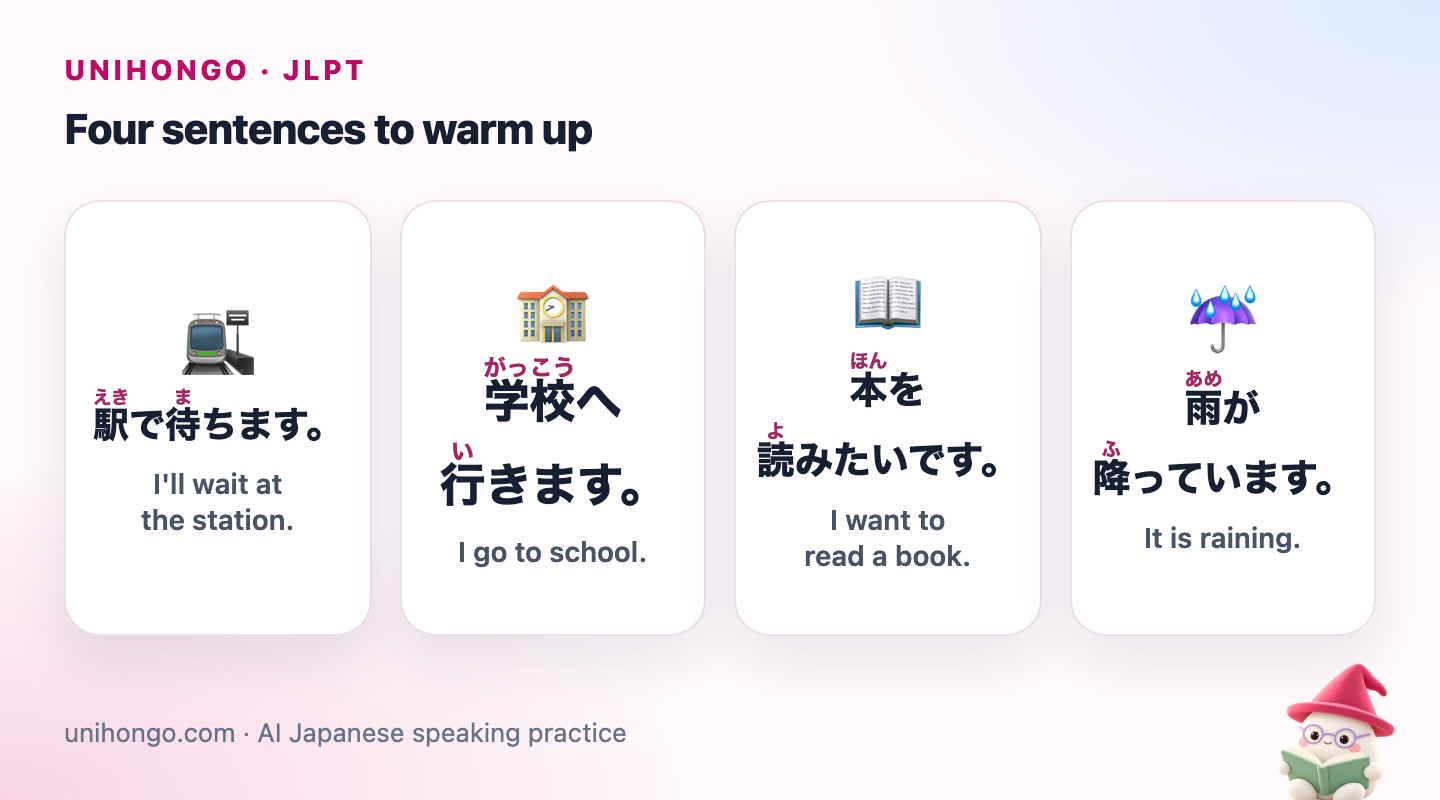
Each of these four sentences uses one pattern from the quiz. Read them aloud and notice the small word that holds each sentence together: で, へ, たい and ています.
On the test you will not be asked to translate. You will be asked to choose the right piece for a blank, so the goal is to feel which piece sounds right, not to recite a rule.
| Japanese | Romaji | Meaning |
|---|---|---|
| 駅で待ちます。 | Eki de machimasu. | I'll wait at the station. |
| 学校へ行きます。 | Gakkō e ikimasu. | I go to school. |
| 本を読みたいです。 | Hon o yomitai desu. | I want to read a book. |
| 雨が降っています。 | Ame ga futte imasu. | It is raining. |
Questions 1-5
Choose the option that fits the blank. Write down the letter and move on; do not check yet.
- 1. 「わたし ___ 学生です。」 (a) を (b) に (c) は (d) で
- 2. 「図書館 ___ 勉強します。」 (a) に (b) で (c) を (d) へ
- 3. 「毎朝 コーヒー ___ 飲みます。」 (a) が (b) に (c) を (d) で
- 4. 「きのうは さむ ___ 。」 (a) かったです (b) いでした (c) いかったです (d) でした
- 5. 「日本へ 行った ___ が ありますか。」 (a) もの (b) ところ (c) とき (d) こと
Questions 6-10
- 6. 「ここで たばこを すわないで ___ 。」 (a) います (b) ください (c) あります (d) なります
- 7. 「へやに ねこ ___ います。」 (a) が (b) を (c) で (d) へ
- 8. 「山田さんは いま 本を 読んで ___ 。」 (a) あります (b) なります (c) します (d) います
- 9. 「あした いっしょに えいがを 見 ___ か。」 (a) ました (b) なかった (c) ません (d) ない
- 10. 「この かばんは ___ 、 じょうぶです。」 (light and strong) (a) かるい (b) かるいで (c) かるいくて (d) かるくて
Questions 11-15
- 11. 「しずか ___ へやが すきです。」 (a) な (b) の (c) い (d) に
- 12. 「バスと でんしゃと、 ___ が はやいですか。」 (a) どれ (b) どちら (c) なに (d) どこ
- 13. 「ごはんを 食べた ___ 、 はを みがきます。」 (a) まえに (b) あとで (c) ながら (d) たい
- 14. 「わたしは 日本語 ___ すこし わかります。」 (a) を (b) で (c) に (d) が
- 15. 「きのうは どこ ___ 行きませんでした。」 (a) にも (b) でも (c) をも (d) がも
Answer key with reasons
Each row gives the correct sentence, then the answer letter and the rule behind it.
| Japanese | Romaji | Meaning |
|---|---|---|
| 私は学生です。 | Watashi wa gakusei desu. | 1 (c) wa marks the topic: I am a student |
| 図書館で勉強します。 | Toshokan de benkyō shimasu. | 2 (b) de marks where an action happens |
| 毎朝コーヒーを飲みます。 | Maiasa kōhī o nomimasu. | 3 (c) o marks the object of nomu |
| 昨日は寒かったです。 | Kinō wa samukatta desu. | 4 (a) i-adjective past: drop i, add katta |
| 日本へ行ったことがありますか。 | Nihon e itta koto ga arimasu ka. | 5 (d) ta koto ga aru: have you ever been? |
| ここでたばこを吸わないでください。 | Koko de tabako o suwanaide kudasai. | 6 (b) naide kudasai: please don't |
| 部屋に猫がいます。 | Heya ni neko ga imasu. | 7 (a) ga marks what exists with iru |
| 山田さんは今本を読んでいます。 | Yamada san wa ima hon o yonde imasu. | 8 (d) te imasu: an action in progress |
| 明日一緒に映画を見ませんか。 | Ashita issho ni eiga o mimasen ka. | 9 (c) masen ka: a polite invitation |
| このかばんは軽くて、丈夫です。 | Kono kaban wa karukute, jōbu desu. | 10 (d) i-adjective te-form: kute links two |
| 静かな部屋が好きです。 | Shizuka na heya ga suki desu. | 11 (a) na-adjective + na before a noun |
| バスと電車と、どちらが速いですか。 | Basu to densha to, dochira ga hayai desu ka. | 12 (b) dochira compares two things |
| ご飯を食べた後で、歯を磨きます。 | Gohan o tabeta ato de, ha o migakimasu. | 13 (b) ta form + ato de: after eating |
| 日本語が少しわかります。 | Nihongo ga sukoshi wakarimasu. | 14 (d) wakaru takes ga, not o |
| 昨日はどこにも行きませんでした。 | Kinō wa doko ni mo ikimasen deshita. | 15 (a) doko ni mo + negative: nowhere |
The four rules behind most wrong answers
If you lost points, they probably came from one of these rules. Each one is small, but the exam returns to them with new vocabulary every year.
| Japanese | Romaji | Meaning |
|---|---|---|
| 誰も来ませんでした。 | Dare mo kimasen deshita. | Nobody came. |
| 何も食べていません。 | Nani mo tabete imasen. | I haven't eaten anything. |
| 寿司が好きです。 | Sushi ga suki desu. | I like sushi. |
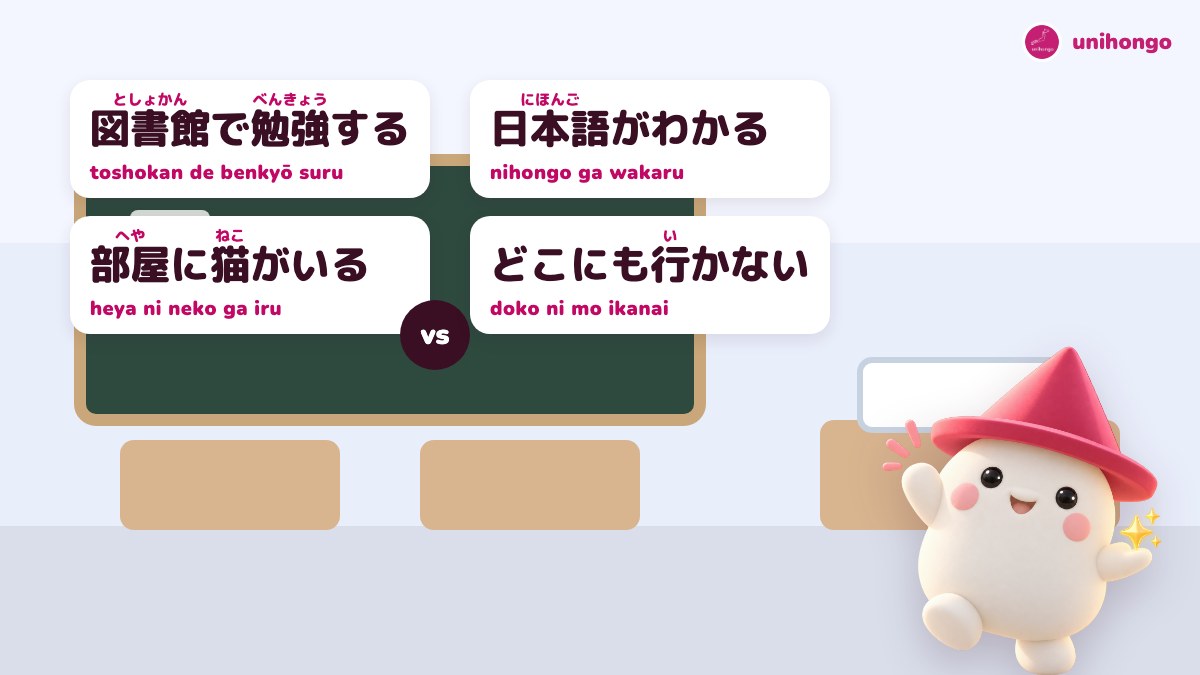
- De or ni for places: で marks where you do something (study, eat, wait); に marks where something is (iru, aru) or where you go.
- Wakaru, suki and jōzu take が. English makes them feel like verbs with objects, so learners reach for を.
- Adjective past forms split by type: i-adjectives become katta (samukatta), na-adjectives use deshita (shizuka deshita). Samui deshita is a common mistake.
- Question word plus mo with a negative means none: doko ni mo (nowhere), dare mo (nobody), nani mo (nothing). Note doko ni mo keeps the に.
Score bands and what to study
| Score | What it means | Focus next |
|---|---|---|
| 13-15 | N5 grammar is in place | Timed practice and listening |
| 10-12 | A few patterns slip under pressure | Rewrite each missed sentence about yourself |
| 6-9 | Particles and forms are still mixed | One pattern a day with five example sentences |
| 0-5 | Most N5 grammar is still new | Work through a beginner textbook in order |
Look at which questions you missed, not only how many. Errors in questions 2, 7, 14 and 15 point to particles; errors in 4, 10 and 11 point to adjectives; errors in 5, 6, 8 and 13 point to verb forms.
Once you score 13 or more, a full timed paper is the better test: the N5 mock test at unihongo.com/jlpt-mock-test has the real sections and time limits and shows how grammar holds up next to reading and listening.
Slips the quiz did not cover
Fifteen questions cannot cover everything. These four slips are also common at N5, and they appear on the test in reading and listening even when no single question targets them.
Each one comes from translating English word by word. The fix is the same every time: learn the whole phrase as a unit, say it aloud a few times, and use it in a sentence about yourself.
| Japanese | Romaji | Meaning |
|---|---|---|
| おいしいケーキです。 | Oishii kēki desu. | It's a delicious cake. |
| 明日行きます。 | Ashita ikimasu. | I'll go tomorrow. |
| いいえ、行きます。 | Iie, ikimasu. | No, I am going. (to: aren't you going?) |
- Using desu after a verb. Tabemasu already ends the sentence politely; tabemasu desu is wrong.
- Adding no between an i-adjective and a noun. Say oishii kēki, not oishii no kēki.
- Answering a negative question the English way. To ikanai n desu ka? (Aren't you going?), hai means yes, that's right, I'm not going. If you are going, say iie, ikimasu.
- Forgetting that ni is needed with clock times but not with words like kyō, ashita or maiasa. Ashita ni ikimasu sounds wrong; ashita ikimasu is natural.
Say the patterns out loud this week
Grammar sticks faster when you use it in a conversation. Ask Mocchi something like "Explain the difference between de and ni with places, then quiz me with five new sentences" using /grammar and /quiz. Mocchi will explain the rule with fresh examples, quiz you, and remember which particle tripped you so your next review starts there.
Then open AI Sensei, pick Haru-sensei and ask for a slow self-introduction practice in polite Japanese. Talk about where you study, what you like and what you did yesterday: that one short conversation uses de, ga with suki, past forms and masen ka. The session report afterwards lists any particle or verb-form corrections.