

Four chat phrases to know first
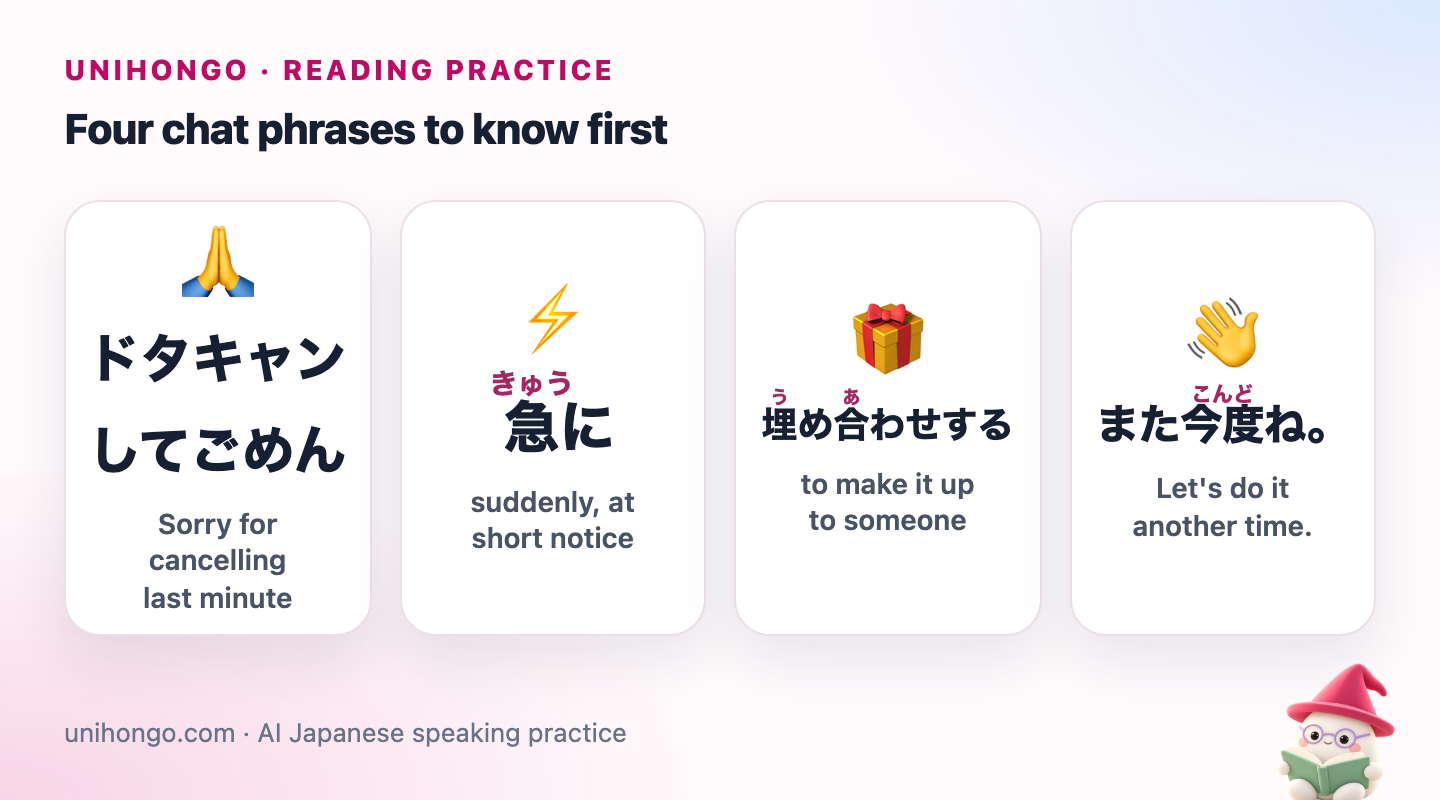
These four expressions carry the whole conversation. The first is the heart of Aya's apology, the last is how friends usually close the topic.
| Japanese | Romaji | Meaning |
|---|---|---|
| ドタキャンしてごめん | Dotakyan shite gomen | Sorry for cancelling last minute |
| 急に | kyū ni | suddenly, at short notice |
| 埋め合わせする | umeawase suru | to make it up to someone |
| また今度ね。 | Mata kondo ne. | Let's do it another time. |
The chat, part 1: Aya's apology
Aya sends several messages in a row, as people often do on LINE. Read them as one long apology. Notice how many sentences end with a softening particle such as ね, の or よ.
| Japanese | Romaji | Meaning |
|---|---|---|
| まいちゃん、本当にごめん! | Mai chan, hontō ni gomen! | Aya: Mai, I'm really sorry! |
| 明日の映画、行けなくなっちゃった。 | Ashita no eiga, ikenaku natchatta. | Aya: I can't make it to the film tomorrow after all. |
| さっき店長から電話があって、急にバイトに入ってほしいって頼まれちゃった。 | Sakki tenchō kara denwa ga atte, kyū ni baito ni haitte hoshii tte tanomarechatta. | Aya: My manager just called and asked me to work a shift at short notice. |
| 同じシフトの人が熱を出したらしくて、ほかに入れる人がいないんだって。 | Onaji shifuto no hito ga netsu o dashita rashikute, hoka ni haireru hito ga inai n datte. | Aya: Apparently the person on that shift has a fever, and the manager says no one else can cover. |
| 先月も休ませてもらったから、断れなかったの。 | Sengetsu mo yasumasete moratta kara, kotowarenakatta no. | Aya: He let me take a day off last month, so I couldn't say no. |
| チケットまで取ってくれたのに、ドタキャンして本当にごめんね。 | Chiketto made totte kureta noni, dotakyan shite hontō ni gomen ne. | Aya: You even got the tickets, and I'm cancelling last minute. I'm so sorry. |
| チケット代はもちろん払うから、金額を教えてね。 | Chiketto dai wa mochiron harau kara, kingaku o oshiete ne. | Aya: Of course I'll pay for my ticket, so tell me how much it was. |
| もしほかに行ける人がいれば、その人と行ってきて! | Moshi hoka ni ikeru hito ga ireba, sono hito to itte kite! | Aya: If there's someone else who can go, go with them! |
| 埋め合わせに、今度ランチおごらせて。 | Umeawase ni, kondo ranchi ogorasete. | Aya: To make it up to you, let me treat you to lunch next time. |
| 来週の土曜日なら一日あいてるんだけど、どうかな? | Raishū no doyōbi nara ichinichi aiteru n da kedo, dō ka na? | Aya: I'm free all day next Saturday. How about it? |
The chat, part 2: Mai's reply
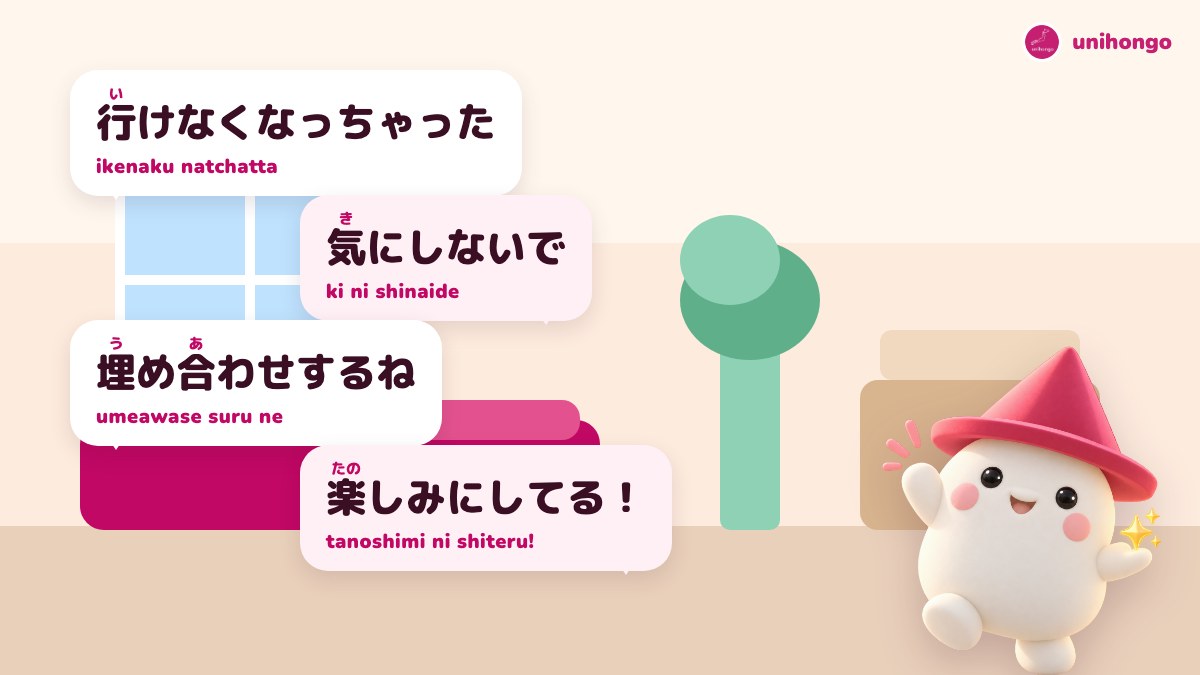
Mai's answer is short and kind. Japanese friends often reply to an apology by playing it down and turning to the next plan.
| Japanese | Romaji | Meaning |
|---|---|---|
| 大丈夫だよ!気にしないで。 | Daijōbu da yo! Ki ni shinaide. | Mai: It's fine! Don't worry about it. |
| バイト大変だね。頑張って! | Baito taihen da ne. Ganbatte! | Mai: Work sounds tough. Good luck! |
| チケットは妹が行きたいって言ってたから、妹と行くね。 | Chiketto wa imōto ga ikitai tte itteta kara, imōto to iku ne. | Mai: My little sister said she wanted to go, so I'll go with her. |
| 土曜日のランチ、楽しみにしてる! | Doyōbi no ranchi, tanoshimi ni shiteru! | Mai: Looking forward to lunch on Saturday! |
| ありがとう!助かる! | Arigatō! Tasukaru! | Aya: Thank you! That's a big help! |
| じゃあ、土曜日の十二時に駅前でね。 | Jā, doyōbi no jūniji ni ekimae de ne. | Aya: OK, see you in front of the station at twelve on Saturday. |
Vocabulary notes
Chat Japanese is full of short words borrowed from speech. These are the ones in the thread that textbooks often skip.
| Japanese | Romaji | Meaning |
|---|---|---|
| 店長 | tenchō | store manager |
| バイトに入る | baito ni hairu | to work a shift (at a part-time job) |
| シフト | shifuto | a work shift |
| 熱を出す | netsu o dasu | to come down with a fever |
| 断る | kotowaru | to turn down, to refuse |
| チケットを取る | chiketto o toru | to get (book) tickets |
| 金額 | kingaku | the amount of money |
| おごる | ogoru | to treat someone (to a meal) |
| あいてる | aiteru | free, available (casual for あいている) |
| 気にしないで | ki ni shinaide | don't worry about it |
| 助かる | tasukaru | that helps, that's a relief |
Notice the dropped particles: 明日の映画、行けなくなっちゃった has no は or に, and 土曜日のランチ、楽しみにしてる has no は. In chat and speech this is normal, but put the particles back when you write anything formal.
Grammar notes: casual N3 grammar in the chat
1. 〜ちゃった: the spoken form of 〜てしまった. It shows that something happened and the speaker regrets it. 行けなくなっちゃった means I've ended up not being able to go.
2. The passive with ちゃう: 頼まれちゃった combines 頼まれる (to be asked) and ちゃった. Aya is the subject who received the request, and the passive hints that it was not her choice.
3. Hearsay: 〜らしい and 〜んだって. 熱を出したらしくて uses らしい in its て form to join the sentence, and いないんだって reports what the manager said. Both are common in chat; in writing to a senior, use 〜そうです.
4. 〜ば: いれば (if there is). もし at the start makes the condition clearer but is optional. Aya also uses 〜のに (even though), which expresses regret that Mai's kindness was wasted.
| Japanese | Romaji | Meaning |
|---|---|---|
| 財布を忘れちゃった。 | Saifu o wasurechatta. | Pattern 1: I forgot my wallet. (casual) |
| 先生に作文を直されちゃった。 | Sensei ni sakubun o naosarechatta. | Pattern 2: My essay got corrected by the teacher. |
| 明日、雪が降るんだって。 | Ashita, yuki ga furu n datte. | Pattern 3: I heard it's going to snow tomorrow. |
| 時間があれば、一緒に行こう。 | Jikan ga areba, issho ni ikō. | Pattern 4: If you have time, let's go together. |
The same apology, politely
If the film had been with a senior colleague, Aya would need a very different register: no slang, no ちゃった, and polite or humble forms throughout. Compare these lines with the chat above.
| Japanese | Romaji | Meaning |
|---|---|---|
| 本当に申し訳ありません。 | Hontō ni mōshiwake arimasen. | I'm truly sorry. (polite) |
| 急に仕事が入ってしまい、明日は伺えなくなりました。 | Kyū ni shigoto ga haitte shimai, ashita wa ukagaenaku narimashita. | Some work has suddenly come up, and I won't be able to come tomorrow. (humble) |
| 直前のご連絡になってしまい、申し訳ございません。 | Chokuzen no gorenraku ni natte shimai, mōshiwake gozaimasen. | I'm very sorry to tell you at the last minute. (very polite) |
| チケット代はお支払いいたします。 | Chiketto dai wa oshiharai itashimasu. | I will of course pay for the ticket. (humble) |
| もしよろしければ、また改めてお誘いさせてください。 | Moshi yoroshikereba, mata aratamete osasoi sasete kudasai. | If it's all right with you, please let me invite you again another time. |
The structure is the same: apology, reason, offer, new plan. Only the register changes. Many learners keep the structure but forget to remove slang, so a line like ドタキャンして申し訳ありません sounds oddly mixed.
Comprehension questions
Answer in short polite Japanese.
- Question 1: Why can't Aya go to the film?
- Question 2: What does Aya offer to do to make up for it?
- Question 3: Who will Mai go to the film with?
| Japanese | Romaji | Meaning |
|---|---|---|
| 急にバイトに入ってほしいと頼まれたからです。 | Kyū ni baito ni haitte hoshii to tanomareta kara desu. | Answer 1: Because she was suddenly asked to work a shift. |
| 今度ランチをおごります。 | Kondo ranchi o ogorimasu. | Answer 2: She will treat Mai to lunch next time. |
| 妹と行きます。 | Imōto to ikimasu. | Answer 3: With her little sister. |
Read it aloud as two voices
Chat messages are written speech, so reading them aloud with the right intonation is the best way to absorb them.
- Read Aya's messages aloud in a sorry, slightly rushed voice. Let ごめん and ごめんね fall gently at the end.
- Read Mai's replies in a bright, relaxed voice. 大丈夫だよ should sound reassuring, not formal.
- Practise the small っ and the ゃ in 行けなくなっちゃった until it flows in one breath.
- Read the five polite lines aloud and notice how your voice becomes slower and lower.
- Without looking, reply to Aya as Mai in your own words, then compare with the original.
Say sorry out loud, not just in writing
Ask Mocchi to /explain message 4, the one with らしくて and んだって, and you will see how two kinds of hearsay sit in one sentence. Mocchi keeps track of the casual forms you ask about and can quiz you on them later with /quiz.
Then move to speech. In AI Sensei, choose Sakura-sensei and ask Sakura-sensei to play Mai. Phone her, apologise for cancelling, explain the shift and suggest a new day. Ask her to switch to polite Japanese and play your senior next, so you practise both registers in one session.