
Two verbs for one event
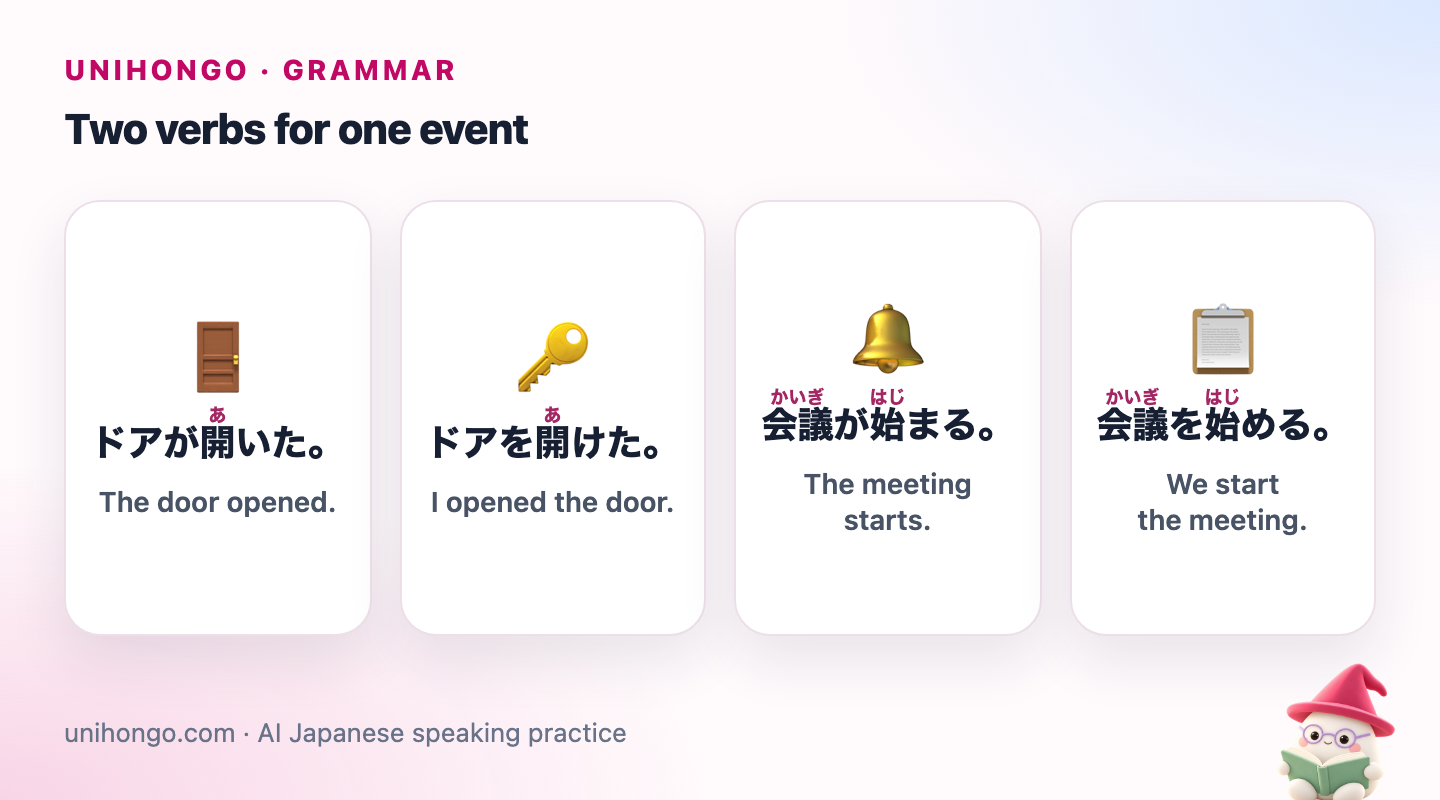
Every pair describes the same event from two angles. The transitive verb focuses on the person who does something to an object. The intransitive verb focuses on the thing that changes, with no person mentioned. The particle is the giveaway: o for the object of a transitive verb, ga for the subject of an intransitive one.
| Japanese | Romaji | Meaning |
|---|---|---|
| ドアが開いた。 | Doa ga aita. | The door opened. |
| ドアを開けた。 | Doa o aketa. | I opened the door. |
| 会議が始まる。 | Kaigi ga hajimaru. | The meeting starts. |
| 会議を始める。 | Kaigi o hajimeru. | We start the meeting. |
Mistake 1: the right verb with the wrong particle
The most frequent error is not choosing the wrong verb but mixing the verb of one sentence with the particle of the other: denki o tsuita, doa ga aketa. It happens because learners think in English, where the particle question does not exist, and pick whichever form they remember first.
A quick test: ask whether a person is doing something to the thing. If yes, you need o and the transitive verb. If the thing changes on its own, or you do not care who did it, use ga and the intransitive verb.
| Japanese | Romaji | Meaning |
|---|---|---|
| 電気をつけてください。 | Denki o tsukete kudasai. | Please turn on the light. |
| あ、電気がついた。 | A, denki ga tsuita. | Oh, the light came on. |
| 窓を閉めましょうか。 | Mado o shimemashō ka. | Shall I close the window? |
| 自動でドアが閉まります。 | Jidō de doa ga shimarimasu. | The door closes automatically. |
Mistake 2: hajimaru and hajimeru at work
At work and at school, the pair hajimaru and hajimeru appears every day, and so do kimaru and kimeru, decide. Learners often say kaigi o hajimarimasu or kaigi ga hajimemasu. The meeting starts at ten is kaigi wa jūji ni hajimarimasu; let's start the meeting is kaigi o hajimemashō.
The same goes for decisions. When a plan has been settled, especially by a group, Japanese often prefers the intransitive kimarimashita, it has been decided, even if a person decided it. This sounds less personal and is very common in meetings and announcements.
| Japanese | Romaji | Meaning |
|---|---|---|
| 会議は十時に始まります。 | Kaigi wa jūji ni hajimarimasu. | The meeting starts at ten. |
| では、始めましょう。 | De wa, hajimemashō. | Well then, let's begin. |
| 日程が決まりました。 | Nittei ga kimarimashita. | The schedule has been decided. |
| 来週までに決めます。 | Raishū made ni kimemasu. | I'll decide by next week. |
Spot the pair from its ending
Pairs are not random. Several ending patterns repeat, and once you know them you can often guess which verb is which. There are exceptions, so use the table as a hint and confirm with a dictionary.
| Japanese | Romaji | Meaning |
|---|---|---|
| 財布を落としました。 | Saifu o otoshimashita. | I dropped my wallet. |
| 財布が落ちていますよ。 | Saifu ga ochite imasu yo. | There's a wallet on the ground. |
| 荷物が届きました。 | Nimotsu ga todokimashita. | The parcel has arrived. |
| Pattern | Intransitive (ga) | Transitive (o) |
|---|---|---|
| -aru / -eru | hajimaru, kimaru, shimaru | hajimeru, kimeru, shimeru |
| -u / -eru | aku, tsuku, todoku | akeru, tsukeru, todokeru |
| -eru / -asu | deru, hieru, sameru | dasu, hiyasu, samasu |
| -reru / -su | kowareru, taoreru, nagareru | kowasu, taosu, nagasu |
| -iru / -osu | okiru, ochiru | okosu, otosu |
Notice the trap: in the first two rows the -eru verb is transitive, but in the third row the -eru verb is the intransitive one. This is why learning pairs as pairs works better than learning one rule.
Mistake 3: te iru and te aru
To describe a state, Japanese uses te iru with the intransitive verb: mado ga aite iru, the window is open; denki ga tsuite iru, the light is on. Learners who use te iru with the transitive verb, mado o akete iru, produce a different meaning: someone is in the middle of opening the window.
Te aru adds a layer. It uses the transitive verb with ga and says the state exists because someone did it on purpose, usually as preparation. Mado ga akete aru means the window has been left open, for example to air the room. Te aru does not work with intransitive verbs, so mado ga aite aru is wrong.
| Japanese | Romaji | Meaning |
|---|---|---|
| 窓が開いています。 | Mado ga aite imasu. | The window is open. |
| 窓が開けてあります。 | Mado ga akete arimasu. | The window has been opened (on purpose). |
| 今、窓を開けています。 | Ima, mado o akete imasu. | I'm opening the window now. |
| 飲み物は冷やしてあります。 | Nomimono wa hiyashite arimasu. | The drinks have been chilled. |
Mistake 4: a passive where none is needed
English speakers in particular reach for the passive to describe something with no clear doer: the door was opened, the meeting was started. Japanese usually uses the intransitive verb instead. Doa ga akerareta is grammatical but heavy, and it suggests that someone did it, sometimes with an unpleasant effect on you. Doa ga aita is the everyday way.
Use the passive when the doer matters or when you were affected by someone's action: kaban o nusumareta, my bag was stolen. For neutral changes, choose the intransitive verb.
| Japanese | Romaji | Meaning |
|---|---|---|
| 店が閉まりました。 | Mise ga shimarimashita. | The shop has closed. |
| 会議が始まりました。 | Kaigi ga hajimarimashita. | The meeting has started. |
| 電車でかばんを盗まれました。 | Densha de kaban o nusumaremashita. | My bag was stolen on the train. |
Mistake 5: an apology with the wrong verb
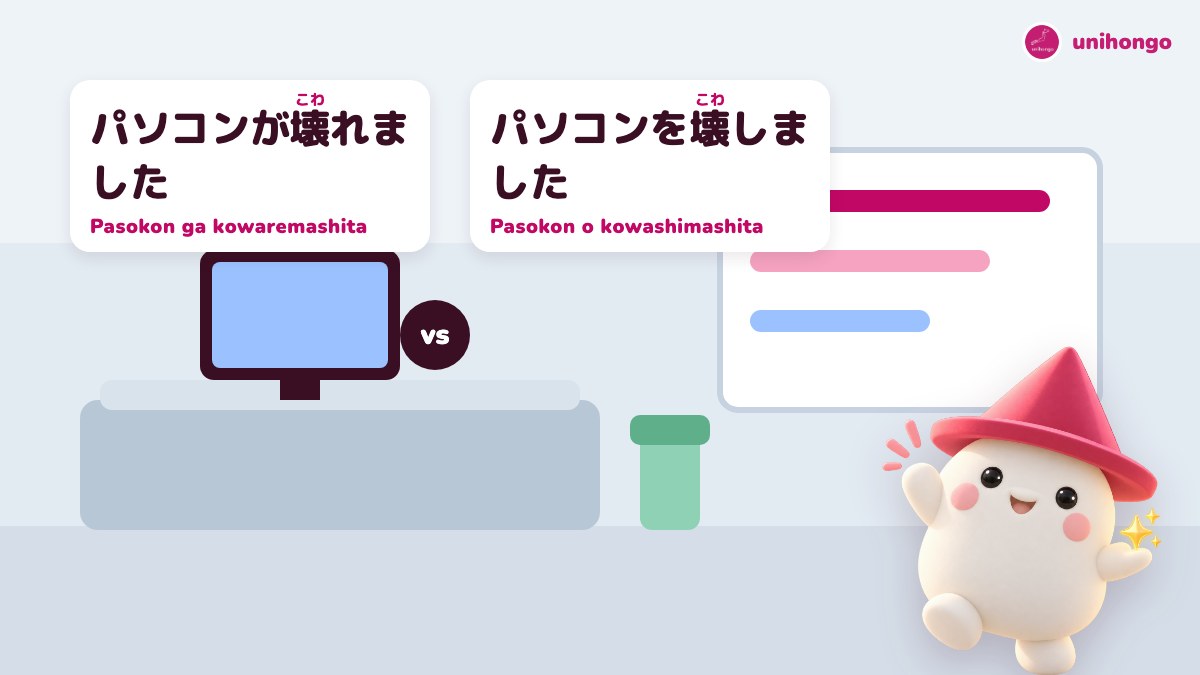
Here the choice is not just grammar. If you borrowed a colleague's umbrella and broke it, kasa ga kowaremashita, the umbrella broke, describes the event as if it happened by itself. The colleague will understand, but it can sound like you are avoiding blame. Kasa o kowashite shimaimashita, I broke your umbrella, with te shimau adding regret, takes responsibility, and a sincere sumimasen follows naturally.
Equally, if something truly broke without your doing anything, the intransitive is the honest choice. Many Japanese speakers pay attention to this difference in apologies at work and with neighbours, so it is worth getting right.
| Japanese | Romaji | Meaning |
|---|---|---|
| パソコンが壊れました | Pasokon ga kowaremashita | The computer broke. (it just happened) |
| パソコンを壊しました | Pasokon o kowashimashita | I broke the computer. (my fault) |
| 傘を壊してしまいました。 | Kasa o kowashite shimaimashita. | I'm afraid I broke your umbrella. |
| 本当にすみません。 | Hontō ni sumimasen. | I'm really sorry. |
Mini dialogue: closing up the office
Two colleagues leave the office at night. Count the pairs: shimaru and shimeru, tsuku and kesu, and a te aru for something prepared.
| Japanese | Romaji | Meaning |
|---|---|---|
| 窓、閉まってる? | Mado, shimatteru? | Aoi: Are the windows closed? (casual) |
| うん、さっき閉めたよ。 | Un, sakki shimeta yo. | Ken: Yes, I closed them earlier. |
| あれ、会議室の電気がついてる。 | Are, kaigishitsu no denki ga tsuiteru. | Aoi: Huh, the meeting room light is on. |
| 消してくるね。 | Keshite kuru ne. | Ken: I'll go and turn it off. |
| 明日の資料は机に置いてあるから。 | Ashita no shiryō wa tsukue ni oite aru kara. | Aoi: Tomorrow's papers are on your desk, ready. |
| ありがとう。じゃあ、鍵をかけるよ。 | Arigatō. Jā, kagi o kakeru yo. | Ken: Thanks. Okay, I'll lock up. |
Build the pairs into memory
- Ask Mocchi to /create-flashcards for ten verb pairs, with the intransitive sentence on one card and the transitive sentence on its partner, and pick a photo of a door, a light or a window for each.
- Review them with /review-flashcards; the spaced repetition brings back the pairs you hesitate on more often.
- When a sentence from your own life feels unclear, paste it after /explain and ask Mocchi which verb and particle a native speaker would use.
- For speed, load the same deck into Kotoba Stack on unihongo.com/games and play a round when you have five spare minutes.