
Three verbs and one direction rule
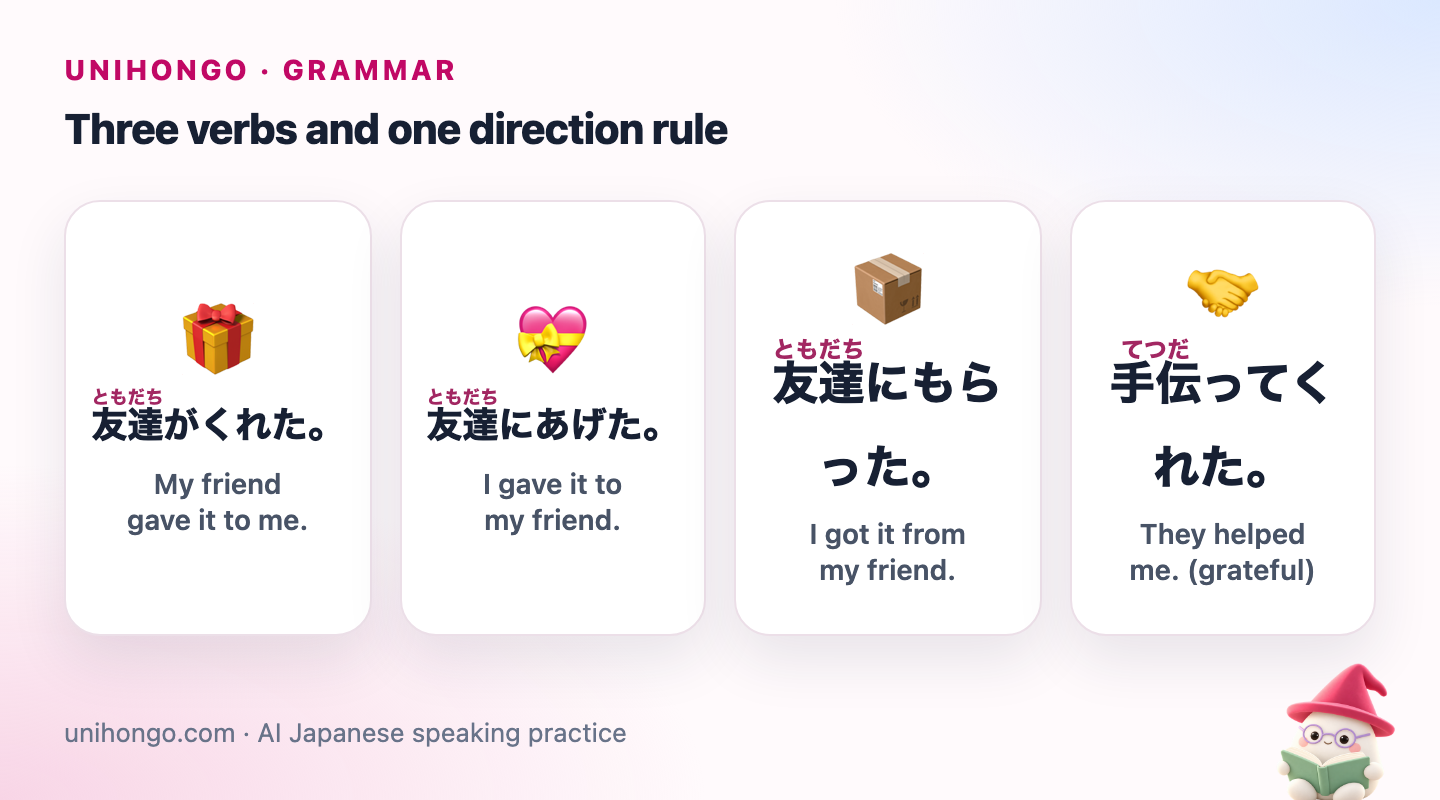
Picture yourself at the centre. Things that move away from you, or from people on your side, use ageru. Things that come towards you use kureru. When you tell the story from the receiver's point of view, use morau. The fourth card shows the same verbs after the te form, where they talk about favours instead of objects.
| Japanese | Romaji | Meaning |
|---|---|---|
| 友達がくれた。 | Tomodachi ga kureta. | My friend gave it to me. |
| 友達にあげた。 | Tomodachi ni ageta. | I gave it to my friend. |
| 友達にもらった。 | Tomodachi ni moratta. | I got it from my friend. |
| 手伝ってくれた。 | Tetsudatte kureta. | They helped me. (grateful) |
Mistake 1: ageru towards yourself
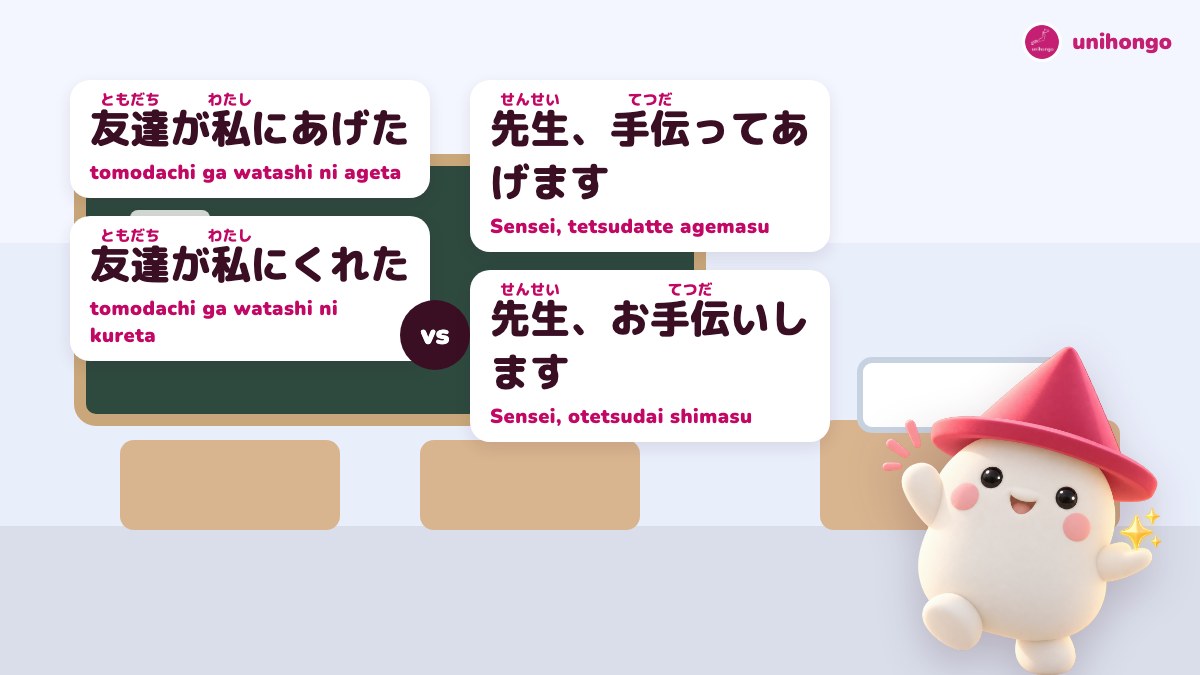
Because give is one verb in English, many learners learn ageru first and use it for every gift: tomodachi ga watashi ni ageta. Japanese listeners understand, but the sentence sounds backwards, as if you were describing yourself from the outside. When the thing arrives at you, the verb is kureru.
Your side includes more than you. If a friend gives something to your mother, your sister or your child, kureru is usually natural too: tomodachi ga haha ni kureta. Between two people outside your circle, use ageru: Tanaka san ga Suzuki san ni ageta.
A quick check while speaking: is the thing coming in my direction? If yes, kureru. If it is leaving me, or moving between others, ageru.
| Japanese | Romaji | Meaning |
|---|---|---|
| 姉が誕生日にマフラーをくれました。 | Ane ga tanjōbi ni mafurā o kuremashita. | My sister gave me a scarf for my birthday. |
| 友達が母に花をくれました。 | Tomodachi ga haha ni hana o kuremashita. | My friend gave my mother flowers. |
| 田中さんが鈴木さんに本をあげました。 | Tanaka san ga Suzuki san ni hon o agemashita. | Mr Tanaka gave Ms Suzuki a book. |
Mistake 2: the particles with morau
Morau is told from the receiver's side, so the receiver is the subject, usually with wa or left out, and the giver takes ni or kara. Learners often turn it around and say tomodachi ga moratta when they mean a friend gave it to me; that sentence actually says the friend received something.
Ni and kara are both fine with a person. With an organisation, a shop or a place, kara is more natural: kaisha kara bōnasu o moratta, I got a bonus from the company. Kara also avoids confusion when ni could be read as a destination.
| Japanese | Romaji | Meaning |
|---|---|---|
| 先輩にチケットをもらいました。 | Senpai ni chiketto o moraimashita. | I got a ticket from my senpai. |
| 市役所から書類をもらいました。 | Shiyakusho kara shorui o moraimashita. | I got the documents from city hall. |
| 友達がプレゼントをもらった。 | Tomodachi ga purezento o moratta. | My friend got a present. (friend received it) |
Mistake 3: leaving out te kureru
When someone does something that helps you, Japanese usually marks it with te kureru or te moratta. Tomodachi ga tetsudatta, a friend helped, is grammatical but sounds like a neutral report, almost as if the help had nothing to do with you. Tomodachi ga tetsudatte kureta adds the sense that you received the favour and are grateful.
This matters most when you thank people or tell others about their kindness. Leaving te kureru out does not make you rude, but it can make you sound oddly detached. Te moratta says the same from your side and often hints that you asked for the help.
| Japanese | Romaji | Meaning |
|---|---|---|
| 駅まで送ってくれてありがとう。 | Eki made okutte kurete arigatō. | Thanks for taking me to the station. |
| 先輩が資料を直してくれました。 | Senpai ga shiryō o naoshite kuremashita. | My senpai fixed my documents for me. |
| 友達に引っ越しを手伝ってもらいました。 | Tomodachi ni hikkoshi o tetsudatte moraimashita. | I had a friend help me move. |
Mistake 4: te ageru that sounds condescending
The opposite slip is just as common. Te ageru means doing a favour for someone. Said about a third person, it is fine: imōto ni ehon o yonde ageta, I read my little sister a picture book. Said directly to the person, especially someone older or senior, it can sound like I will do you the favour of…, and that you expect thanks.
To offer help, use a question or the humble o…shimasu pattern instead. Otetsudai shimashō ka, shall I help?, and onimotsu, omochi shimasu, let me carry your bags, are polite and warm. With friends, a simple tetsudau yo, I'll help, is enough.
| Japanese | Romaji | Meaning |
|---|---|---|
| 友達が私にあげた | tomodachi ga watashi ni ageta | Wrong: ageru never comes to you |
| 友達が私にくれた | tomodachi ga watashi ni kureta | Right: kureru when it comes to you |
| 先生、手伝ってあげます | Sensei, tetsudatte agemasu | Risky: sounds like doing a big favour |
| 先生、お手伝いします | Sensei, otetsudai shimasu | Right: Let me help you, Sensei. |
Keigo versions, and when not to use them
With teachers, clients and anyone senior, the three verbs have respectful forms. Use them in formal situations and business; with friends they would sound sarcastic.
| Japanese | Romaji | Meaning |
|---|---|---|
| 先生にお礼の手紙を差し上げました。 | Sensei ni orei no tegami o sashiagemashita. | I gave my teacher a thank-you letter. |
| 社長がお土産をくださいました。 | Shachō ga omiyage o kudasaimashita. | The company president gave us a souvenir. |
| お客様にお花をいただきました。 | Okyakusama ni ohana o itadakimashita. | We received flowers from a customer. |
| Plain | Respectful form | Use it when |
|---|---|---|
| ageru | sashiageru (humble) | You give to someone senior |
| kureru | kudasaru (honorific) | Someone senior gives to you |
| morau | itadaku (humble) | You receive from someone senior |
Two cautions. First, sashiageru can sound heavy in daily life; when handing a present to a teacher, many people simply say dōzo or kore, yokattara, if you like. Second, ageru is now widely used for pets and plants, as in inu ni esa o ageru, feed the dog; the older yaru is still used, especially by some older speakers and in some regions, and it can sound blunt to others.
Mini dialogue: a souvenir at work
A colleague returns from a trip with omiyage. Watch how kureru, morau and a humble offer appear in a natural exchange.
| Japanese | Romaji | Meaning |
|---|---|---|
| これ、北海道のお土産です。どうぞ。 | Kore, Hokkaidō no omiyage desu. Dōzo. | Colleague: Here's a souvenir from Hokkaido. |
| わあ、いいんですか。ありがとうございます。 | Wā, ii n desu ka. Arigatō gozaimasu. | You: Oh, really? Thank you. |
| 部長にもお渡ししました。 | Buchō ni mo owatashi shimashita. | Colleague: I've given some to the manager too. |
| このクッキー、前に田中さんにもらったことがあります。 | Kono kukkī, mae ni Tanaka san ni moratta koto ga arimasu. | You: Tanaka once gave me these cookies. |
| そうなんですね。みんなに配りましょうか。 | Sō nan desu ne. Minna ni kubarimashō ka. | Colleague: Oh really. Shall we hand them out? |
| 私がお配りしますよ。 | Watashi ga okubari shimasu yo. | You: I'll hand them out. |
Say who gave what, out loud
Direction becomes automatic only with lots of quick decisions. Ask Mocchi: give me ten short situations about presents and favours, and ask me to choose between ageru, kureru and morau. After each answer, Mocchi explains the direction in one line, and it remembers whether your weak spot is kureru, morau or te ageru.
Then practise thanking and offering in real time. In AI Sensei, ask Hana-sensei to play a friend who has just come back from a trip with a present for you. Thank Hana-sensei with te kureta, say who else gave you something recently, and offer to help with something without using te ageru.