
Four sentences that sort out most errors
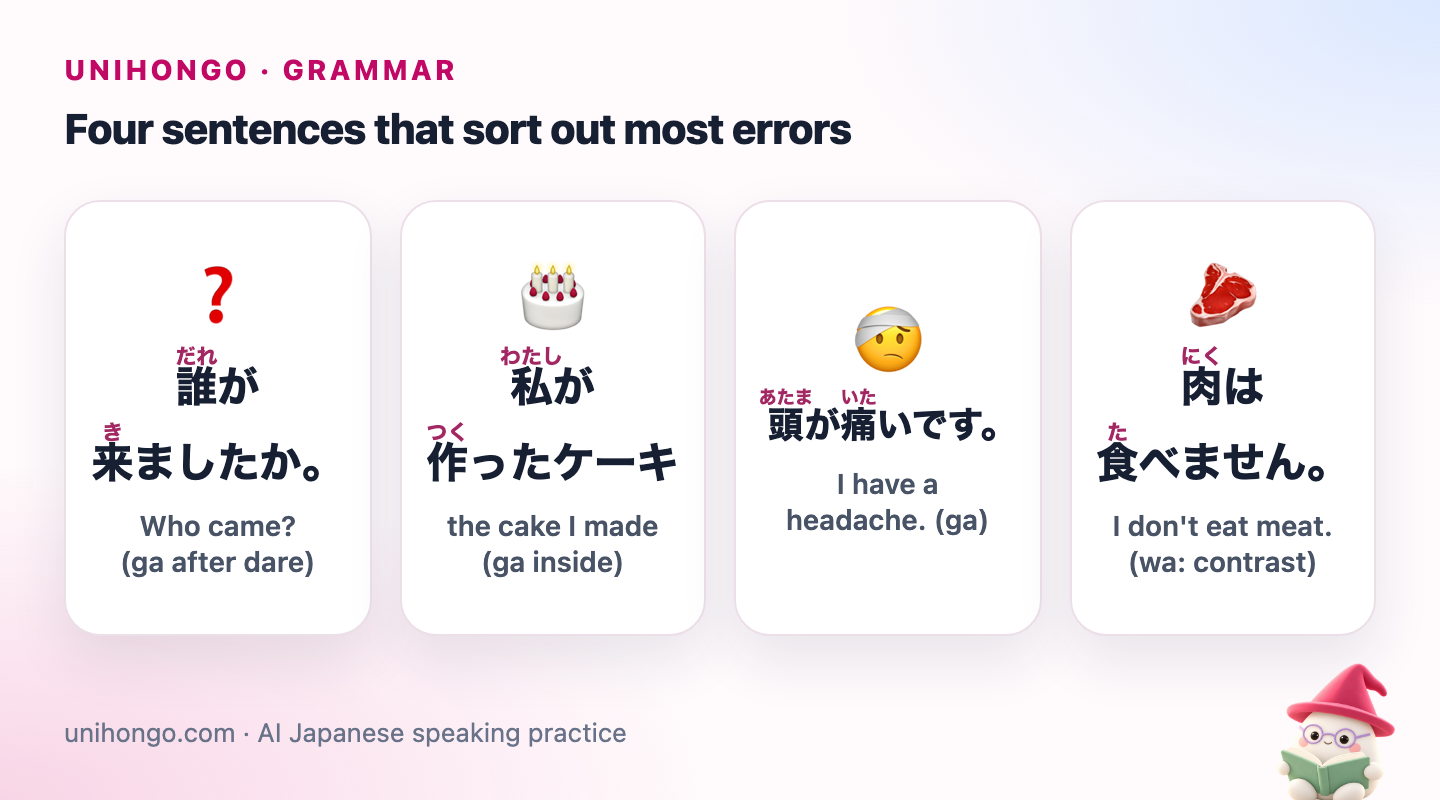
If you remember only four model sentences, make them these. Each one is a small rule in disguise: ga after a question word, ga inside a description, ga with feelings and sensations, and wa for contrast. Most of the other mistakes in this guide are variations on these four.
| Japanese | Romaji | Meaning |
|---|---|---|
| 誰が来ましたか。 | Dare ga kimashita ka. | Who came? (ga after dare) |
| 私が作ったケーキ | watashi ga tsukutta kēki | the cake I made (ga inside) |
| 頭が痛いです。 | Atama ga itai desu. | I have a headache. (ga) |
| 肉は食べません。 | Niku wa tabemasen. | I don't eat meat. (wa: contrast) |
Mistake 1: wa after a question word
Wa marks the topic, something the listener already has in mind. A question word such as dare, nani, doko or dore asks for something unknown, so it can never be the topic. When the question word is the subject, it takes ga.
The answer follows the same logic. The word that fills the gap is the new information, so it takes ga too. Learners who answer Tanaka san wa kimashita sound as if they are saying as for Tanaka, he came, perhaps unlike others.
| Japanese | Romaji | Meaning |
|---|---|---|
| 何がいいですか。 | Nani ga ii desu ka. | What would you like? / Which is good? |
| コーヒーがいいです。 | Kōhī ga ii desu. | Coffee would be good. |
| どれが一番人気ですか。 | Dore ga ichiban ninki desu ka. | Which one is the most popular? |
| これが一番人気です。 | Kore ga ichiban ninki desu. | This one is the most popular. |
Mistake 2: wa inside a description or a when clause
Long sentences often contain a smaller sentence inside them: the book my friend recommended, when I came to Japan, the place where we met. Inside that smaller sentence, the subject takes ga, not wa.
If you use wa, the listener takes it as the topic of the whole sentence and gets lost. Watashi wa nihon ni kita toki sounds like as for me, when came to Japan, and the listener waits for a second subject. The fix is mechanical: in any clause that ends with toki, a noun or no, switch wa to ga. In writing, no can also replace ga here: tomodachi no susumeta hon.
| Japanese | Romaji | Meaning |
|---|---|---|
| 友達が勧めた本を読みました。 | Tomodachi ga susumeta hon o yomimashita. | I read the book my friend recommended. |
| 私が日本に来たとき、雪でした。 | Watashi ga Nihon ni kita toki, yuki deshita. | When I came to Japan, it was snowing. |
| 父が働いている会社です。 | Chichi ga hataraite iru kaisha desu. | It's the company my father works for. |
| 私は兄が作った料理が好きです。 | Watashi wa ani ga tsukutta ryōri ga suki desu. | I like the food my brother makes. |
The last example shows both at once: watashi wa is the topic of the whole sentence, and ani ga is the subject inside the description.
Mistake 3: ga in a simple self-introduction
Some learners overcorrect. After hearing that ga marks the subject, they say watashi ga Sumisu desu when introducing themselves. That sentence means I'm the one who is Smith, the answer to a question like which of you is Smith? In a normal introduction, use wa, or drop watashi entirely.
The same exclusive meaning appears in other sentences. Kore ga oishii desu means this one, not the others, is delicious. That is perfect when choosing from a menu, but odd as a general comment.
| Japanese | Romaji | Meaning |
|---|---|---|
| スミスさんはどなたですか。 | Sumisu san wa donata desu ka. | Staff: Which of you is Mr Smith? |
| 私がスミスです。 | Watashi ga Sumisu desu. | I'm Smith. (I'm the one) |
| はじめまして、スミスです。 | Hajimemashite, Sumisu desu. | Nice to meet you, I'm Smith. |
Mistake 4: o with suki, wakaru, dekiru and hoshii
In English, like, understand and want are verbs with a direct object, so learners reach for o. In Japanese, suki and kirai are na-adjectives, hoshii is an i-adjective, and wakaru and dekiru describe states. The thing you like, understand, can do or want is marked with ga.
Body sensations follow the same pattern: atama ga itai, a headache; onaka ga suita, hungry; nodo ga kawaita, thirsty. The person goes in the wa slot, and the body part or object goes in the ga slot. You will hear o suki in casual speech and lyrics, but ga is the safe standard.
| Japanese | Romaji | Meaning |
|---|---|---|
| 日本語が話せます。 | Nihongo ga hanasemasu. | I can speak Japanese. |
| 新しいパソコンがほしいです。 | Atarashii pasokon ga hoshii desu. | I want a new computer. |
| 妹は絵が上手です。 | Imōto wa e ga jōzu desu. | My sister is good at drawing. |
| Word | Pattern | Meaning |
|---|---|---|
| suki / kirai | X ga suki | I like / dislike X |
| wakaru | X ga wakaru | I understand X |
| dekiru | X ga dekiru | I can do X |
| hoshii | X ga hoshii | I want X (a thing) |
| itai | X ga itai | My X hurts |
| jōzu / heta | X ga jōzu | Good / bad at X |
Mistake 5: wa for something you just noticed
When you report a new event that both of you can see or have just learned about, Japanese uses ga. The bus is coming, it started raining, the phone is ringing: all ga. Using wa turns the sentence into a statement about a known topic and often adds contrast, as in the bus, at least, is coming.
Existence sentences follow a related pattern. When you introduce something new in a place, use ga: tsukue no ue ni hon ga arimasu, there is a book on the desk. When the thing is already the topic and you are saying where it is, use wa: hon wa tsukue no ue ni arimasu, the book is on the desk.
| Japanese | Romaji | Meaning |
|---|---|---|
| あ、バスが来た。 | A, basu ga kita. | Oh, the bus is here. (casual) |
| 電話が鳴っていますよ。 | Denwa ga natte imasu yo. | Your phone is ringing. |
| 机の上に本があります。 | Tsukue no ue ni hon ga arimasu. | There's a book on the desk. |
| 本は机の上にあります。 | Hon wa tsukue no ue ni arimasu. | The book is on the desk. |
Wrong vs right: a quick checklist
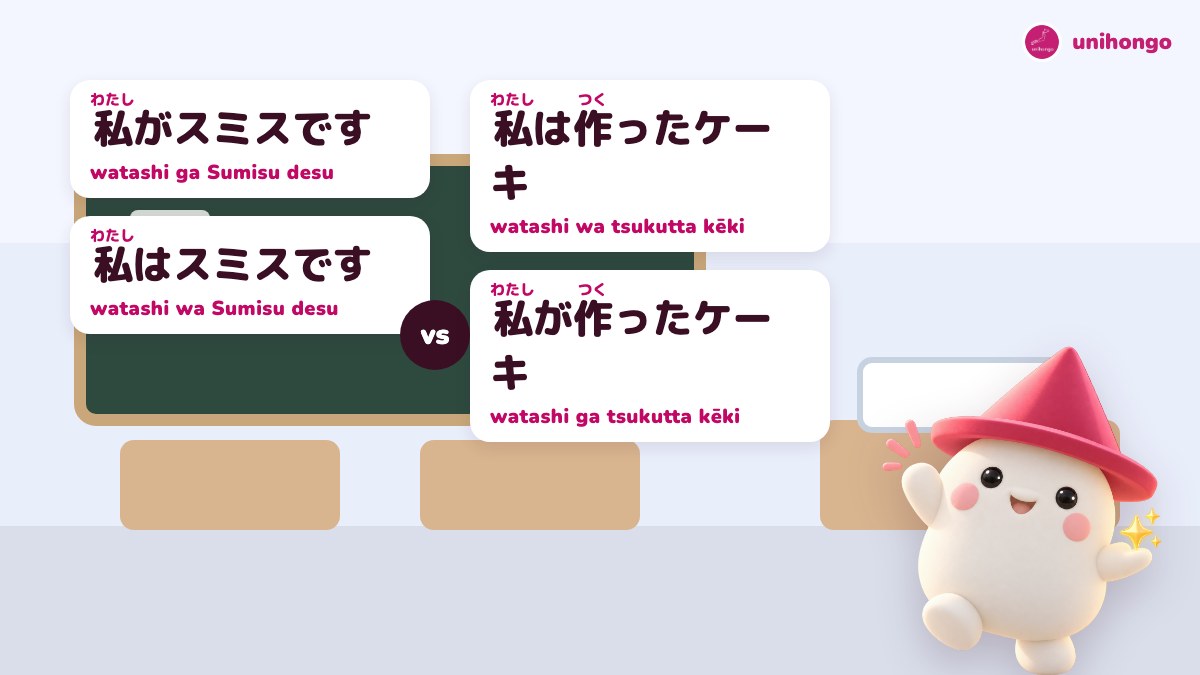
Before you speak or send a message, scan for these points. They take seconds and catch most errors.
| Japanese | Romaji | Meaning |
|---|---|---|
| 私がスミスです | watashi ga Sumisu desu | Sounds like: I'm the one who's Smith |
| 私はスミスです | watashi wa Sumisu desu | Right: I'm Smith (introduction) |
| 私は作ったケーキ | watashi wa tsukutta kēki | Wrong: wa inside a description |
| 私が作ったケーキ | watashi ga tsukutta kēki | Right: the cake I made |
- Is there a question word as the subject? Use ga, in the question and in the answer.
- Is there a description before a noun, or a toki clause? Its subject takes ga.
- Are you introducing yourself? Use wa or nothing, not ga.
- Is it suki, kirai, wakaru, dekiru, hoshii, jōzu or a body part that hurts? The object takes ga.
- Are you reporting something new you just noticed? Use ga.
- Are you contrasting, especially in a negative? Wa is right: niku wa tabemasen, sakana wa tabemasu.
Mini dialogue: who made this?
A short exchange at a party, where almost every wa and ga rule from this guide appears once.
| Japanese | Romaji | Meaning |
|---|---|---|
| このケーキ、誰が作ったんですか。 | Kono kēki, dare ga tsukutta n desu ka. | Guest: Who made this cake? |
| 私が作りました。 | Watashi ga tsukurimashita. | You: I did. (I'm the one) |
| すごい!料理が上手ですね。 | Sugoi! Ryōri ga jōzu desu ne. | Guest: Wow! You're a good cook. |
| ケーキは得意ですが、和食は苦手です。 | Kēki wa tokui desu ga, washoku wa nigate desu. | You: Cakes I'm good at, but Japanese food not so much. |
| あ、雨が降ってきましたね。 | A, ame ga futte kimashita ne. | Guest: Oh, it's started to rain. |
Make the right particle automatic
Knowing the rule is not the same as using it at speaking speed. Ask Mocchi for /grammar wa and ga with question words, then type /quiz and ask for ten sentences with a blank for wa or ga. Mocchi explains every answer briefly, and if one pattern keeps tripping you up, such as descriptions before nouns, it remembers and steers the next review towards it.
For speed, play Sentence Builder on unihongo.com/games: putting the pieces of a sentence in order forces you to notice where each particle sits, and a few rounds a day turn the checklist above into habit.