
Three levels of the same question
Here is one question, will you eat?, at three levels, plus the plain form that hides inside a polite sentence. Notice that the meaning does not change at all; only the relationship does. Choosing a level is choosing how close or how formal you want to be with this person.
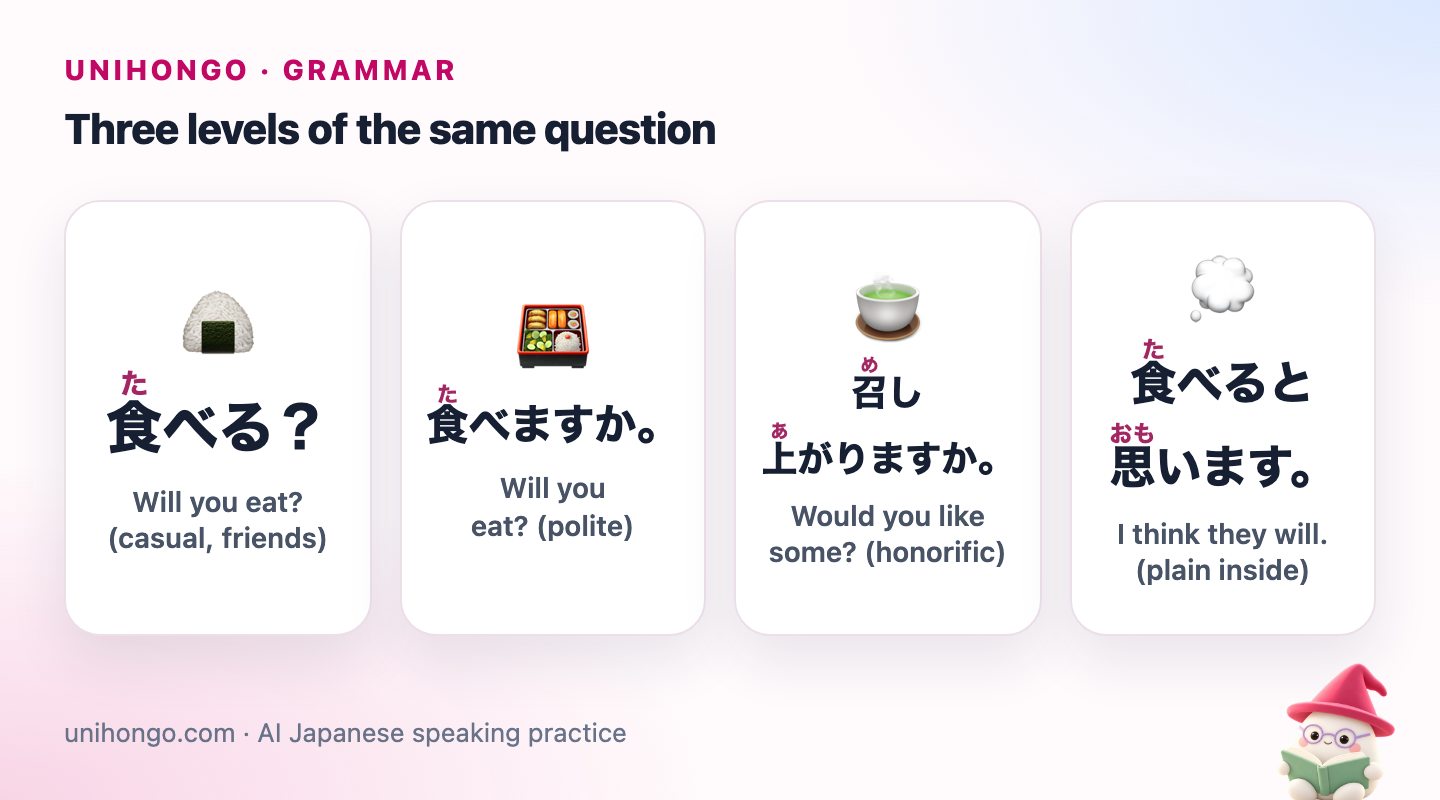
| Japanese | Romaji | Meaning |
|---|---|---|
| 食べる? | Taberu? | Will you eat? (casual, friends) |
| 食べますか。 | Tabemasu ka. | Will you eat? (polite) |
| 召し上がりますか。 | Meshiagarimasu ka. | Would you like some? (honorific) |
| 食べると思います。 | Taberu to omoimasu. | I think they will. (plain inside) |
Mistake 1: desu after a plain verb
Desu makes nouns and adjectives polite. Verbs have their own polite ending, masu. So the polite version of iku is ikimasu, and the polite past of tabeta is tabemashita. Adding desu to a plain verb, as in iku desu or tabeta desu, is one of the most common beginner slips, and it often comes from treating desu as a general politeness sticker.
There is one exception that confuses people. Plain negatives plus desu, such as ikanai desu and wakaranai desu, are common in everyday speech and sound slightly softer than ikimasen. Plain past forms with desu, such as itta desu, are also heard in casual speech, but they sound childish or non-standard to many people, so avoid them.
| Japanese | Romaji | Meaning |
|---|---|---|
| 明日、行きます。 | Ashita, ikimasu. | I'll go tomorrow. |
| もう食べました。 | Mō tabemashita. | I've already eaten. |
| ちょっとわからないです。 | Chotto wakaranai desu. | I'm not quite sure. (soft, spoken) |
| Wrong or risky | Natural polite | Note |
|---|---|---|
| iku desu | ikimasu | Desu never follows a plain verb |
| tabeta desu | tabemashita | Avoid; sounds childish to many |
| dekiru desu | dekimasu | Same rule for potential forms |
| ikanai desu | ikimasen | Both fine in speech; masen in writing |
| wakaranai desu | wakarimasen | Both fine in speech; masen is firmer |
Mistake 2: da with i-adjectives
In plain style, nouns and na-adjectives take da at the end of a statement: gakusei da, kirei da. Learners then add da to i-adjectives too: takai da, oishii da. But an i-adjective is already a complete predicate. Takai alone means it is expensive. The past is takakatta, not takai datta.
In polite style, i-adjectives do take desu, oishii desu, because desu here simply adds politeness. The past polite is oishikatta desu. The pattern is easy to remember if you think of desu as removable: take it off, and what is left must be a correct plain sentence.
| Japanese | Romaji | Meaning |
|---|---|---|
| このラーメン、高い。 | Kono rāmen, takai. | This ramen is expensive. (casual) |
| 高かったね。 | Takakatta ne. | That was expensive, wasn't it. (casual) |
| 静かだね。 | Shizuka da ne. | It's quiet, isn't it. (na-adjective + da) |
| おいしかったです。 | Oishikatta desu. | It was delicious. (polite) |
Mistake 3: masu in the middle of a sentence
Politeness in Japanese is marked at the end of the sentence. Inside the sentence, in clauses before toki, to omoimasu, n desu, kara and before nouns, plain forms are normal even in very polite speech. Learners who make every verb polite produce sentences like ikimasu toki or kaimashita hon, which sound strange.
Some connectors can take a polite form in very formal speech, such as masu kara or mashita ga, and you will hear them in announcements and business. But before nouns and before toki, plain is standard. When in doubt, keep everything plain until the last verb.
| Japanese | Romaji | Meaning |
|---|---|---|
| 日本に行くとき、連絡します。 | Nihon ni iku toki, renraku shimasu. | I'll contact you when I go to Japan. |
| 昨日買った本です。 | Kinō katta hon desu. | It's the book I bought yesterday. |
| 雨が降ると思います。 | Ame ga furu to omoimasu. | I think it will rain. |
| 今日は早く帰るんです。 | Kyō wa hayaku kaeru n desu. | I'm going home early today, you see. |
Mistake 4: switching back and forth
A conversation in which one sentence ends in masu and the next in plain form, for no reason, leaves the listener unsure how you see the relationship. To a Japanese ear it can sound as if you cannot decide whether you are friends.
Native speakers do switch, but with a purpose. In a polite conversation, short reactions and thoughts to oneself are often plain: a, sō ka, oh, I see; sugoi, wow. A senior who wants to sound friendly may drop into plain style. And when a friend says tameguchi de ii yo, you can talk casually, the switch is invited. Keep switches like these, and remove the accidental ones.
| Japanese | Romaji | Meaning |
|---|---|---|
| あ、そうか。じゃあ、明日にしましょう。 | A, sō ka. Jā, ashita ni shimashō. | Oh, I see. Then let's make it tomorrow. |
| すごい!本当に一人で作ったんですか。 | Sugoi! Hontō ni hitori de tsukutta n desu ka. | Wow! Did you really make it yourself? |
| 敬語じゃなくていいですよ。 | Keigo ja nakute ii desu yo. | You don't need to be so formal. |
Mistake 5: the wrong level for the person
The opposite problems both happen. Some learners pick up casual Japanese from anime, friends or dramas and use it with shop staff, receptionists or a new manager, which can sound rude. Others stay in desu and masu with close friends for months, which can sound distant. A simple guide: polite with anyone you do not know, anyone older or senior, and anyone serving you or being served by you; casual with friends, younger family members and people who have clearly switched to casual with you.
At work, the same request often needs three levels. The scene below shows asking for a day off: casual to a friend, polite to a coworker, and with humble keigo to the manager.
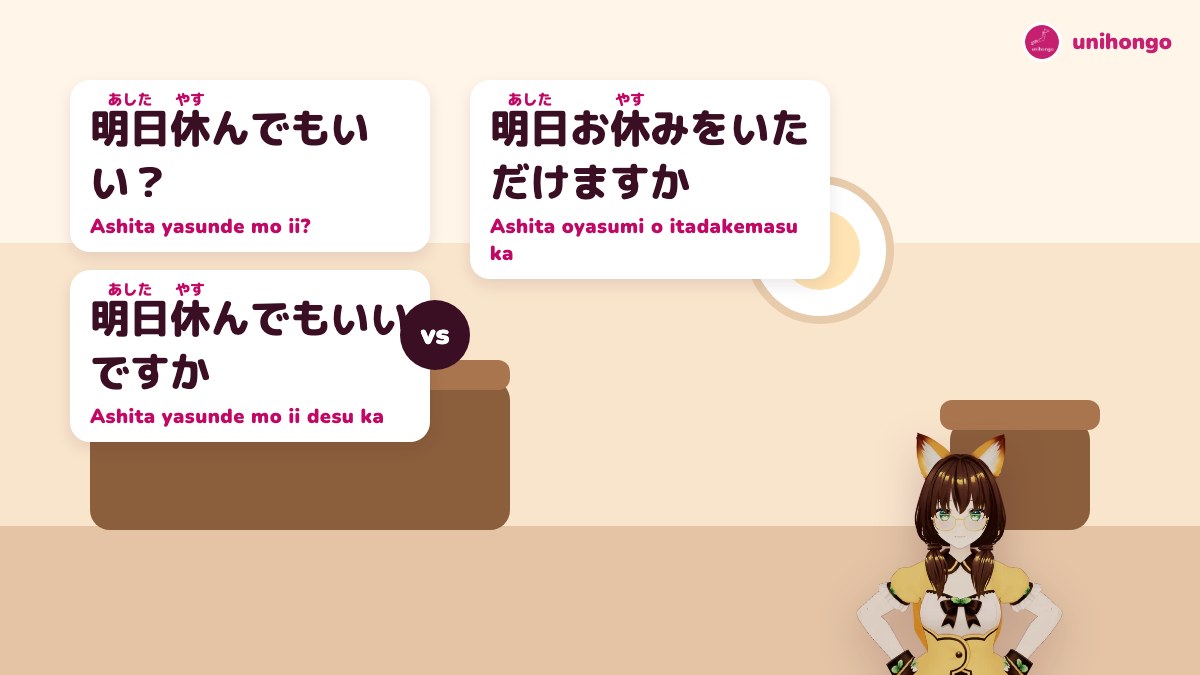
| Japanese | Romaji | Meaning |
|---|---|---|
| 明日休んでもいい? | Ashita yasunde mo ii? | To a friend: Can I take tomorrow off? |
| 明日休んでもいいですか | Ashita yasunde mo ii desu ka | To a coworker: polite |
| 明日お休みをいただけますか | Ashita oyasumi o itadakemasu ka | To the boss: may I have tomorrow off? |
Mistake 6: polite but bossy
Te kudasai is grammatically polite, and it is perfect for asking a shop assistant to wait or a friend's parent to sit down. But it tells the listener to do something. Used with a teacher, a client or your manager, especially for a favour that benefits you, it can sound like an instruction.
For favours from someone senior, ask a question instead. Te itadakemasu ka and te itadakemasen ka, could I have you do…?, leave the other person room to say no, which is exactly what makes them polite. Add sumimasen ga at the start and the request becomes gentle.
| Japanese | Romaji | Meaning |
|---|---|---|
| この資料を見てください。 | Kono shiryō o mite kudasai. | Please look at this document. (can sound like an order) |
| この資料を見ていただけますか。 | Kono shiryō o mite itadakemasu ka. | Could you take a look at this document? |
| すみませんが、少し待っていただけませんか。 | Sumimasen ga, sukoshi matte itadakemasen ka. | Sorry, but could you wait a moment? |
Mini dialogue: a new friend switches to casual
Two people of the same age meet at a language exchange. Notice how the switch is offered, accepted and then kept consistently.
| Japanese | Romaji | Meaning |
|---|---|---|
| マリアさんは何年生ですか。 | Maria san wa nannensei desu ka. | Kenta: What year are you in, Maria? |
| 三年生です。ケンタさんは? | Sannensei desu. Kenta san wa? | Maria: Third year. And you? |
| 同じです!じゃあ、タメ口で話そうよ。 | Onaji desu! Jā, tameguchi de hanasō yo. | Kenta: Same! So let's talk casually. |
| うん、いいよ。ケンタは何を勉強してるの? | Un, ii yo. Kenta wa nani o benkyō shiteru no? | Maria: Sure. Kenta, what do you study? |
| 経済。マリアは? | Keizai. Maria wa? | Kenta: Economics. You? |
| 日本文学だよ。 | Nihon bungaku da yo. | Maria: Japanese literature. |
Rehearse the switch with real people in mind
Write three short messages about the same plan, one to a friend, one to a colleague and one to your manager, and paste them after /correct in Mocchi's chat. Ask Mocchi to label the level of each sentence and fix any that slipped. Mocchi remembers if you keep adding desu after verbs, and will check for it next time without being asked.
Then practise the hardest part, which is switching at speaking speed. In AI Sensei, ask Sakura-sensei to play your manager at a part-time job for the first half and a friendly coworker for the second, and to tell you whenever your level does not fit. Sakura-sensei can also slow down if the polite forms come too fast.