
Four words that do not mean what English says
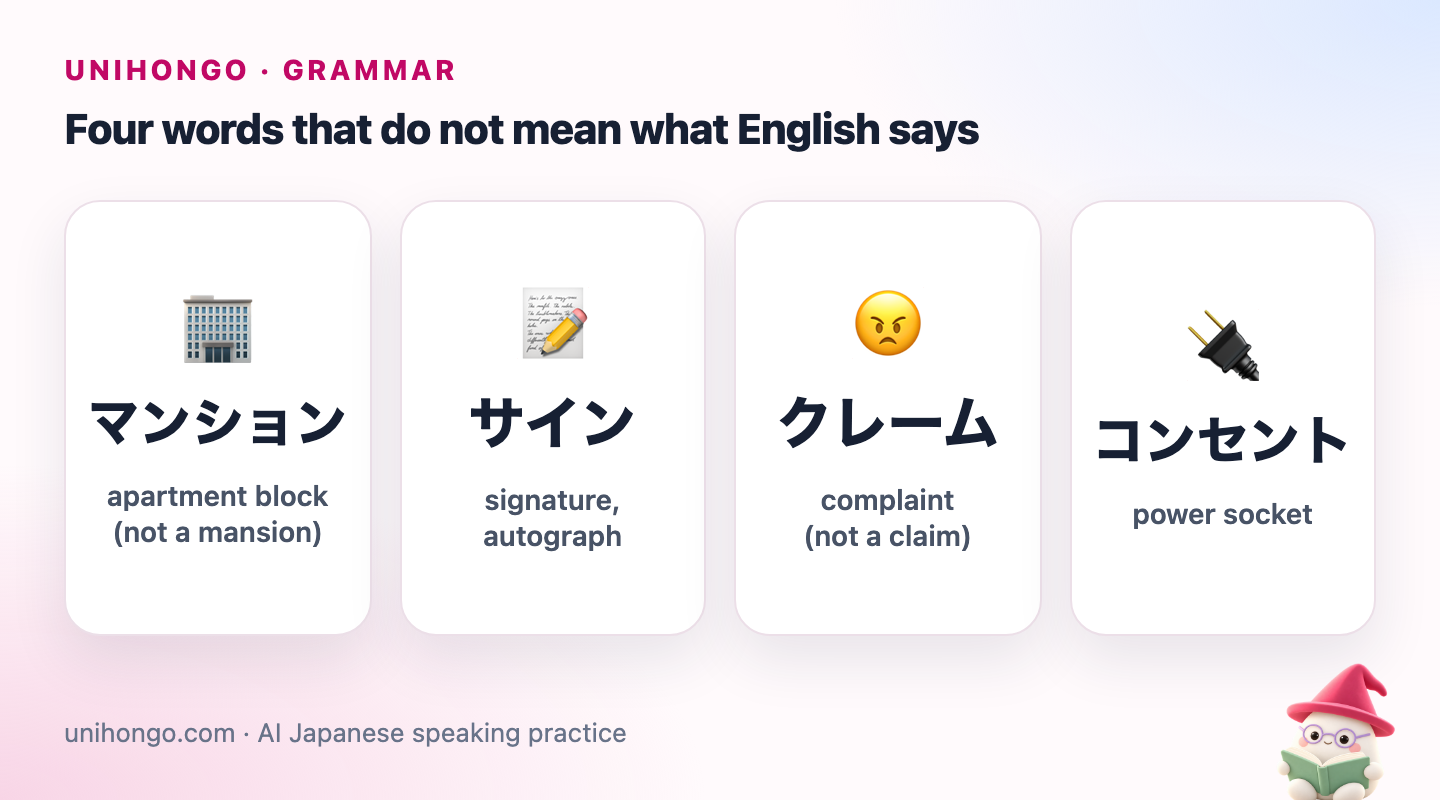
These four loanwords come up constantly in daily life in Japan, and each one leads English speakers astray. A friend who says they live in a manshon is not wealthy; a delivery driver who asks for your sain wants a signature; a kurēmu at work is a complaint; and the konsento is where you plug in your phone.
| Japanese | Romaji | Meaning |
|---|---|---|
| マンション | manshon | apartment block (not a mansion) |
| サイン | sain | signature, autograph |
| クレーム | kurēmu | complaint (not a claim) |
| コンセント | konsento | power socket |
False friends at home and in the city
Many false friends belong to everyday places: your flat, the street, a hotel, a restaurant. They matter because they appear in instructions and on forms, where guessing wrong can cost you time.
| Japanese | Romaji | Meaning |
|---|---|---|
| ここにサインをお願いします。 | Koko ni sain o onegai shimasu. | Courier: Please sign here. |
| お弁当、レンジで温めますか。 | Obentō, renji de atatamemasu ka. | Clerk: Shall I heat your bento in the microwave? |
| フロントに鍵を預けました。 | Furonto ni kagi o azukemashita. | I left the key at the front desk. |
| ホテルの朝ご飯はバイキングです。 | Hoteru no asagohan wa baikingu desu. | Breakfast at the hotel is a buffet. |
| Loanword | Looks like | Means in Japanese |
|---|---|---|
| manshon | Mansion | A flat in a concrete apartment block |
| apāto | Apartment | A flat in a smaller, often wooden building |
| renji | Range | A microwave oven (denshi renji) |
| handoru | Handle | A steering wheel or handlebars |
| furonto | Front | A hotel front desk |
| baikingu | Viking | An all-you-can-eat buffet |
| toranpu | Trump | Playing cards |
False friends about people
Loanwords that describe people are the riskiest, because a wrong guess can turn a compliment into something else. Sumāto usually means slim or stylish, not clever. Naību means sensitive or easily hurt, not naive. Tenshon is energy or mood, so tenshon ga takai means someone is excited or hyper, not stressed. Mai pēsu describes someone who does things at their own pace, sometimes as a gentle criticism.
At work, kurēmu means a customer complaint, and kanningu, from cunning, means cheating in an exam. If you want to say someone is smart in the sense of intelligent, use atama ga ii or kashikoi.
| Japanese | Romaji | Meaning |
|---|---|---|
| 彼はスマートですね。 | Kare wa sumāto desu ne. | He's slim and stylish, isn't he. |
| 田中さんは頭がいいです。 | Tanaka san wa atama ga ii desu. | Mr Tanaka is clever. |
| 今日はテンションが高いね。 | Kyō wa tenshon ga takai ne. | You're in high spirits today. (casual) |
| Loanword | English guess | Usual Japanese meaning |
|---|---|---|
| sumāto | Clever | Slim, stylish |
| naību | Naive | Sensitive, easily hurt |
| tenshon | Tension, stress | Energy, mood, excitement |
| mai pēsu | My pace | Does things at their own pace |
| kanningu | Cunning | Cheating in an exam |
Mistake: saying it the English way
When a learner from an English-speaking background says McDonald's or coffee with English sounds, Japanese listeners often do not recognise the word at first. They know makudonarudo and kōhī. Saying the katakana version is not putting on an accent; it is using the Japanese word.
Length matters as much as sounds. A long vowel or a small tsu can change one loanword into another. Kōhī is coffee, kopī is a photocopy. Baggu is a bag, bagu is a software bug. Biru is a building, bīru is beer. Beddo, bed, is often pronounced and even written betto in casual speech, but beddo is the standard.
| Japanese | Romaji | Meaning |
|---|---|---|
| コーヒー | kōhī | coffee (4 beats) |
| コピー | kopī | photocopy (3 beats) |
| ビル | biru | building |
| ビール | bīru | beer |
| バッグ | baggu | bag |
| バグ | bagu | software bug |
| マクドナルドはどこですか。 | Makudonarudo wa doko desu ka. | Where is McDonald's? |
Mistake: the English word for a made-in-Japan one
Some everyday things are named with wasei eigo, English made in Japan, or with shortened loanwords. If you use the English term, people may understand, but the Japanese word is what you will see on signs and hear in shops. Learn these as Japanese vocabulary: pasokon for a personal computer, nōto pasokon for a laptop, sumaho for a smartphone, eakon for an air conditioner, petto botoru for a plastic bottle, gasorin sutando for a petrol station, and sararīman for an office worker.
A few loanwords come from other languages, which explains odd shapes: arubaito, a part-time job, comes from German, and pan, bread, from Portuguese.
| Japanese | Romaji | Meaning |
|---|---|---|
| ノートパソコンを買いました。 | Nōto pasokon o kaimashita. | I bought a laptop. |
| ペットボトルはこちらに捨ててください。 | Petto botoru wa kochira ni sutete kudasai. | Please throw plastic bottles here. |
| ガソリンスタンドはありますか。 | Gasorin sutando wa arimasu ka. | Is there a petrol station? |
| 週末はアルバイトをしています。 | Shūmatsu wa arubaito o shite imasu. | I work part-time at weekends. |
Loanwords at an apartment viewing
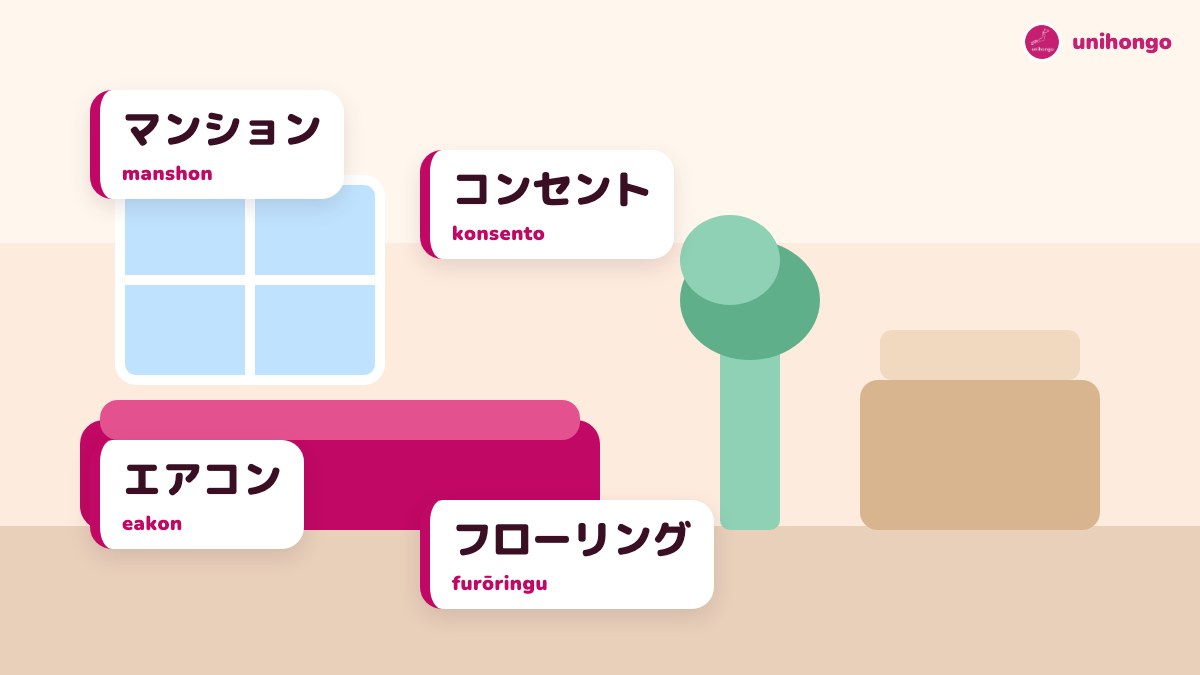
Viewing a flat is where many learners meet a dense cluster of loanwords at once. The agent will talk about the manshon, whether it has an ōto rokku, an entrance that locks automatically, whether the bathroom is a yunitto basu, often a compact unit with the toilet and bath together, whether the floor is furōringu, wooden flooring, and whether eakon is included. Hearing these quickly is half the battle.
| Japanese | Romaji | Meaning |
|---|---|---|
| マンション | manshon | apartment block |
| コンセント | konsento | power socket |
| エアコン | eakon | air conditioner |
| フローリング | furōringu | wooden floor |
| オートロックですか。 | Ōto rokku desu ka. | Does it have a locked entrance? |
| ユニットバスですか。 | Yunitto basu desu ka. | Is the bathroom a combined unit? |
Mistake: a loanword where a Japanese word fits better
Learners who know English sometimes fill every gap with a loanword because it feels easy. Many loanwords are perfectly normal, but in formal situations, with older people or in traditional settings, a native word can sound clearer and more natural. Kaimono is more common than shoppingu in daily talk, and many offices say uchiawase for a small work meeting, while mītingu is common in other workplaces. Opinions differ by company and generation, so listen to how people around you speak and copy them.
| Japanese | Romaji | Meaning |
|---|---|---|
| 明日、打ち合わせがあります。 | Ashita, uchiawase ga arimasu. | I have a meeting tomorrow. |
| 駅前で買い物をしました。 | Ekimae de kaimono o shimashita. | I went shopping near the station. |
| お客様から苦情がありました。 | Okyakusama kara kujō ga arimashita. | We had a complaint from a customer. (formal) |
Mini dialogue: viewing a flat
A short exchange with an estate agent. The loanwords are the ones most likely to appear in a real viewing.
| Japanese | Romaji | Meaning |
|---|---|---|
| こちらのマンションは駅から五分です。 | Kochira no manshon wa eki kara gofun desu. | Agent: This apartment block is five minutes from the station. |
| オートロックですか。 | Ōto rokku desu ka. | You: Does it have a locked entrance? |
| はい。エアコンも付いています。 | Hai. Eakon mo tsuite imasu. | Agent: Yes. It also comes with air conditioning. |
| コンセントはいくつありますか。 | Konsento wa ikutsu arimasu ka. | You: How many power sockets are there? |
| 各部屋に二つずつです。 | Kaku heya ni futatsu zutsu desu. | Agent: Two in each room. |
| じゃあ、ここにサインすればいいですか。 | Jā, koko ni sain sureba ii desu ka. | You: So do I just sign here? |
Learn them as Japanese words
Ask Mocchi for a /vocab set of loanwords that mean something different from English, with an example sentence for each; Mocchi will quiz you on them later and remembers the ones you keep reading the English way.
Then hear them at speed. AI Sensei has a View an Apartment roleplay mission: ask Ibuki-sensei to play the estate agent, listen for manshon, ōto rokku and furōringu, and ask questions using the loanwords yourself. If Ibuki-sensei speaks too fast, ask for a slower pace and try again.