
Four forms that catch almost everyone
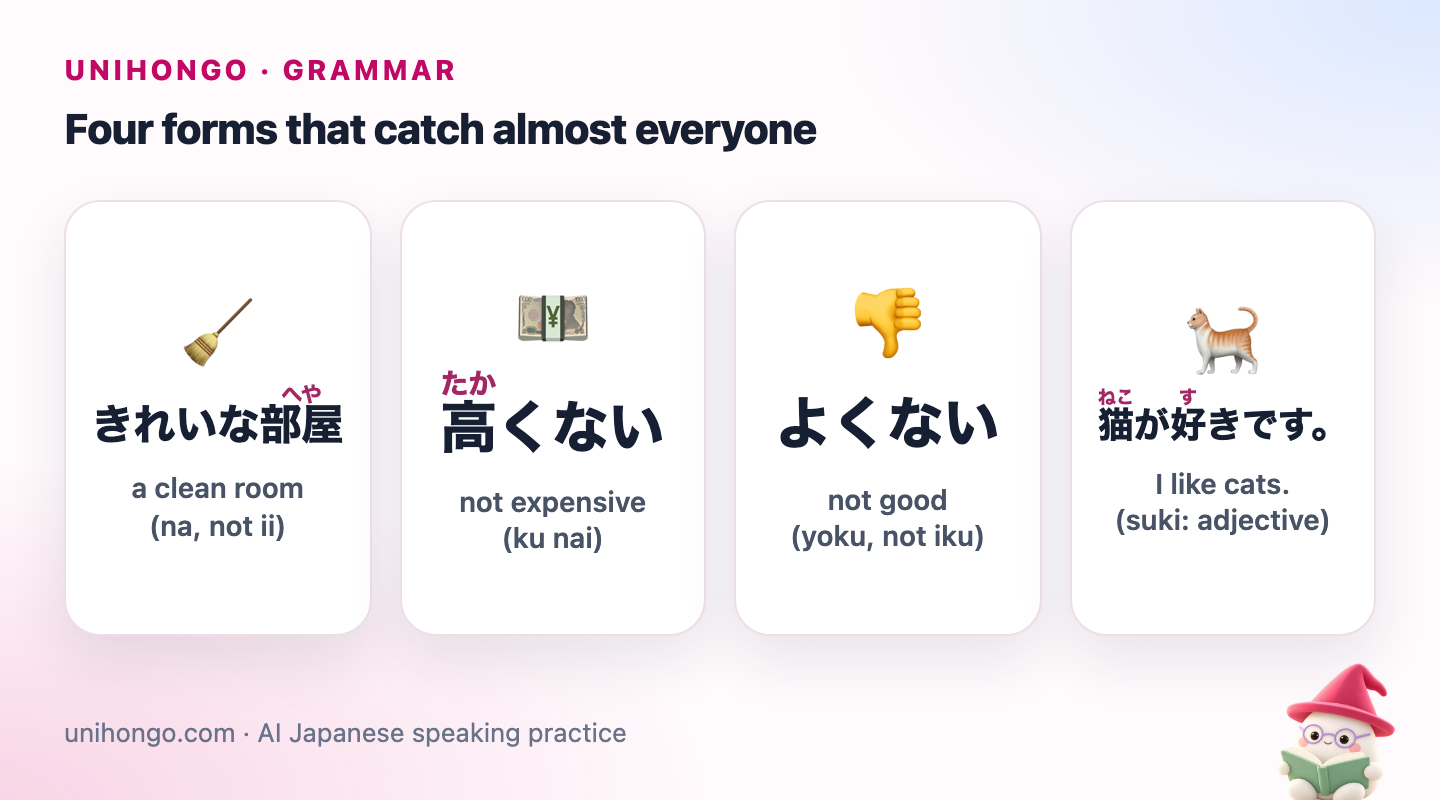
These four corrected forms cover the most frequent adjective errors teachers see: a na-adjective that ends in i, an ordinary negative, the irregular ii, and suki behaving like an adjective. If you can say all four without thinking, you have fixed most of the problem.
| Japanese | Romaji | Meaning |
|---|---|---|
| きれいな部屋 | kirei na heya | a clean room (na, not ii) |
| 高くない | takakunai | not expensive (ku nai) |
| よくない | yokunai | not good (yoku, not iku) |
| 猫が好きです。 | Neko ga suki desu. | I like cats. (suki: adjective) |
Mistake 1: na-adjectives that end in i
Most adjectives ending in i are i-adjectives. A small but very common group are na-adjectives whose last sound just happens to be i. Learners treat them as i-adjectives and produce kireikunai, yūmeikatta or kirai kunai.
Kanji is a useful clue. In a true i-adjective, the final i is written in hiragana after the kanji: 高い, 楽しい. In most na-adjectives ending in i, the i sound is part of the kanji reading: 有名 yūmei, 丁寧 teinei, 失礼 shitsurei. The big exception is 嫌い kirai, which is a na-adjective even though its i is written in hiragana. Kirei is usually written in hiragana, which hides the clue, so just memorise it.
| Japanese | Romaji | Meaning |
|---|---|---|
| この店は有名です。 | Kono mise wa yūmei desu. | This shop is famous. |
| 部屋はきれいじゃないです。 | Heya wa kirei ja nai desu. | The room isn't clean. |
| 料理が得意な人 | ryōri ga tokui na hito | someone who is good at cooking |
| Word | Meaning | Negative | Before a noun |
|---|---|---|---|
| kirei | Clean, pretty | kirei ja nai | kirei na heya |
| kirai | Disliked | kirai ja nai | kirai na tabemono |
| yūmei | Famous | yūmei ja nai | yūmei na mise |
| teinei | Polite, careful | teinei ja nai | teinei na setsumei |
| tokui | Good at | tokui ja nai | tokui na kamoku |
Mistake 2: negatives and the past
The second group of mistakes comes from using one pattern for both types. I-adjectives change their ending: drop the final i and add kunai for the negative, katta for the past, kunakatta for the negative past. Na-adjectives keep their shape and add ja nai, datta or deshita, like nouns.
The most persistent error is the polite past of i-adjectives. Because desu becomes deshita, learners say oishii deshita. But the past belongs to the adjective: oishikatta desu. Similarly, the polite negative is takakunai desu or takaku arimasen, not takai ja nai desu.
| Japanese | Romaji | Meaning |
|---|---|---|
| 昨日のパーティーは楽しかったです。 | Kinō no pātī wa tanoshikatta desu. | Yesterday's party was fun. |
| 思ったより高くなかった。 | Omotta yori takakunakatta. | It wasn't as expensive as I thought. (casual) |
| 図書館は静かでした。 | Toshokan wa shizuka deshita. | The library was quiet. |
| Form | I-adjective (takai) | Na-adjective (shizuka) |
|---|---|---|
| Present | takai (desu) | shizuka da / desu |
| Negative | takakunai (desu) | shizuka ja nai (desu) |
| Past | takakatta (desu) | shizuka datta / deshita |
| Negative past | takakunakatta (desu) | shizuka ja nakatta (desu) |
Mistake 3: ii is irregular
Ii, good, is one of the first adjectives you learn and one of the most irregular. It is a spoken form of the older yoi, and only the plain dictionary form and ii desu use ii. Every other form is built on yo-: yokunai, yokatta, yokunakatta, yokute. So ikunai and ikatta are wrong, even though they follow the normal rule.
The same applies to expressions built on ii, such as kakkoii, cool, and atama ga ii, clever. Kakkoii becomes kakkoyokunai and kakkoyokatta, which surprises many learners, and atama ga ii becomes atama ga yokatta. Kawaii is not part of this group: it is an ordinary i-adjective, so its past is kawaikatta.
| Japanese | Romaji | Meaning |
|---|---|---|
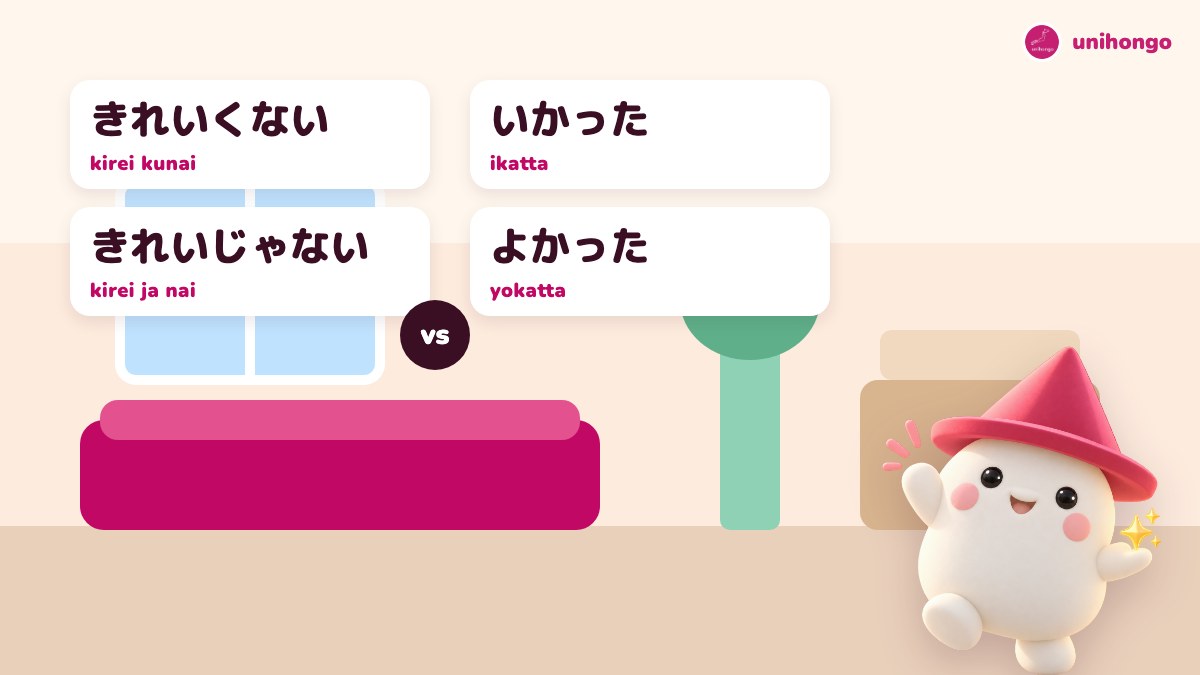
| きれいくない | kirei kunai | Wrong: kirei is a na-adjective |
| きれいじゃない | kirei ja nai | Right: not clean, not pretty |
| いかった | ikatta | Wrong: ii has an irregular past |
| よかった | yokatta | Right: it was good; I'm glad |
| かっこよかったね。 | Kakkoyokatta ne. | That was cool, wasn't it. |
Mistake 4: suki and kirai are not verbs
In English, like and hate are verbs, so learners build sukimasu, suki shimasu or neko o suki. In Japanese, suki and kirai are na-adjectives. Use desu for politeness, ga for the thing you like, and na before a noun: suki na eiga, a film I like. Suki no eiga, with no, is a common error.
Two more points. To say you really like something, add dai: daisuki. And with people, suki usually suggests romantic feelings: Tanaka san ga suki desu can sound like a confession. To say you like a colleague as a person, ii hito desu ne is safer.
| Japanese | Romaji | Meaning |
|---|---|---|
| 日本の映画が大好きです。 | Nihon no eiga ga daisuki desu. | I love Japanese films. |
| 好きな食べ物は何ですか。 | Suki na tabemono wa nan desu ka. | What food do you like? |
| 野菜はあまり好きじゃないです。 | Yasai wa amari suki ja nai desu. | I don't really like vegetables. |
| 虫が嫌いです。 | Mushi ga kirai desu. | I hate insects. |
Mistake 5: before nouns and between adjectives
Before a noun, i-adjectives go straight on, na-adjectives add na, and nouns add no. Learners sometimes add na or no to i-adjectives: takai na kuruma, oishii no ryōri. Both are wrong: takai kuruma, oishii ryōri.
A few words break the pattern. Ōkii and chiisai have alternative forms ōkina and chiisana that work only before nouns: ōkina ie, chiisana mise. Onaji, same, takes nothing before a noun: onaji hon, not onaji na hon. To join two adjectives, use kute for i-adjectives and de for na-adjectives: yasukute oishii, cheap and tasty; shizuka de kirei, quiet and clean. Yasui de and shizuka kute are mistakes.
| Japanese | Romaji | Meaning |
|---|---|---|
| 大きな家に住んでいます。 | Ōkina ie ni sunde imasu. | I live in a big house. |
| 同じ本を持っています。 | Onaji hon o motte imasu. | I have the same book. |
| 安くておいしい店 | yasukute oishii mise | a cheap and tasty restaurant |
| 静かできれいな公園 | shizuka de kirei na kōen | a quiet and clean park |
Mini dialogue: talking about a trip
Two friends talk about a weekend in Kyoto. Look for an i-adjective in the past, a na-adjective in the negative, ii in the past and suki before a noun.
| Japanese | Romaji | Meaning |
|---|---|---|
| 京都、どうだった? | Kyōto, dō datta? | Yui: How was Kyoto? |
| すごくよかったよ。お寺がきれいだった。 | Sugoku yokatta yo. Otera ga kirei datta. | Sam: It was great. The temples were beautiful. |
| 人は多かった? | Hito wa ōkatta? | Yui: Was it crowded? |
| 朝は静かだったけど、昼はにぎやかだった。 | Asa wa shizuka datta kedo, hiru wa nigiyaka datta. | Sam: Quiet in the morning, lively at midday. |
| 好きなお寺はどこ? | Suki na otera wa doko? | Yui: Which temple did you like best? |
| 宿の近くの小さいお寺。有名じゃないけど、いい所だよ。 | Yado no chikaku no chiisai otera. Yūmei ja nai kedo, ii tokoro da yo. | Sam: A small one near my inn. Not famous, but lovely. |
Sort your adjectives once, then drill them
Ask Mocchi to sort the twenty adjectives you use most into i and na types and to mark the tricky ones, then use /review to get short drills on their negatives and past forms. Mocchi remembers which ones still trip you up, such as kirei or ii, and brings them back in later reviews.
For recall at speed, play Vocabulary Dash on unihongo.com/games with a JLPT N5 or N4 word pack: the adjectives come at you quickly, and recognising them fast makes the right ending easier to pick in conversation.