
The questions you will hear about the year ahead
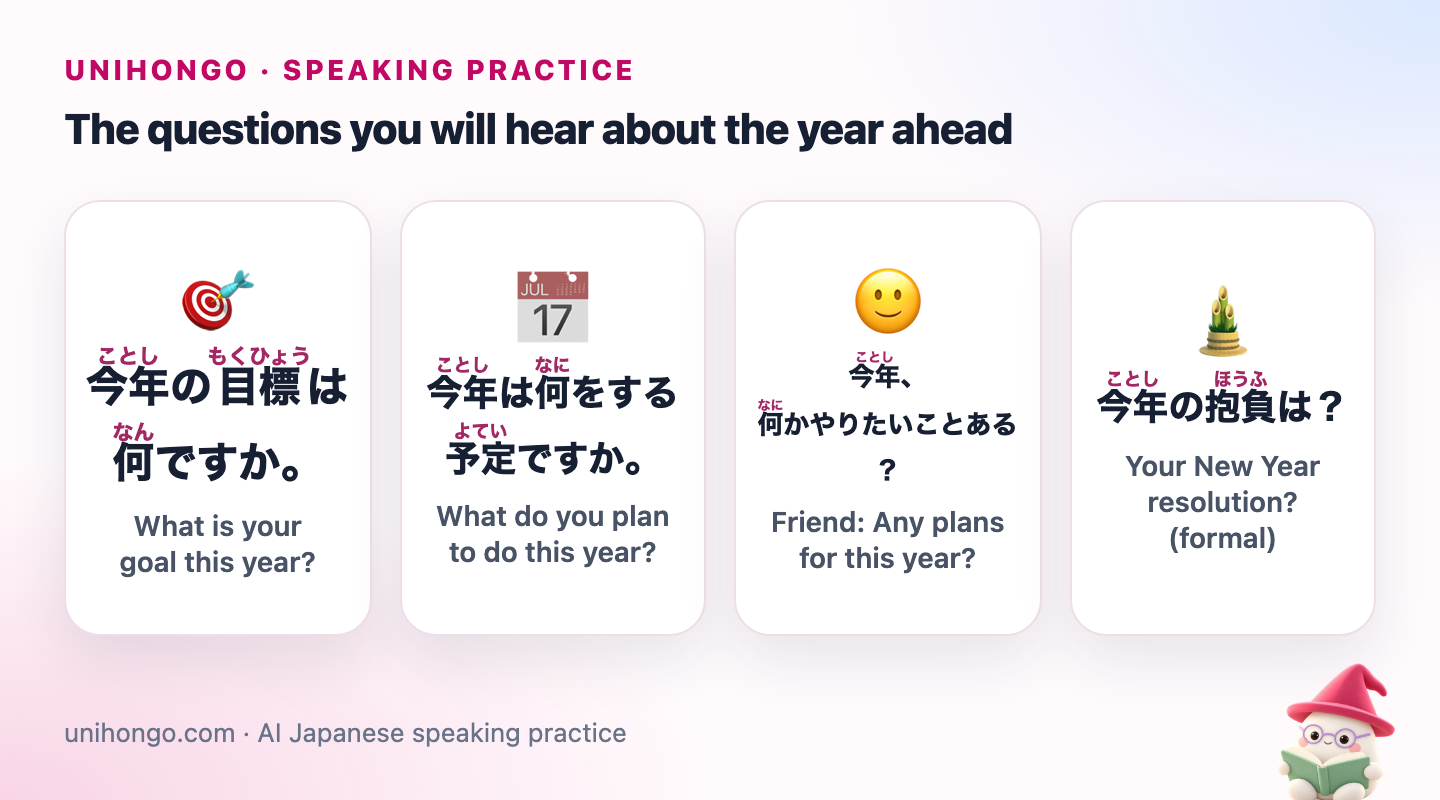
The first two questions belong to January and to any fresh start; the third is how a friend asks, with the particles dropped and aru left plain; the fourth uses hōfu, the slightly formal word for a resolution that you will hear at a New Year gathering at work or in a class. Learn to recognise all four, because the answer shape is the same.
| Japanese | Romaji | Meaning |
|---|---|---|
| 今年の目標は何ですか。 | Kotoshi no mokuhyō wa nan desu ka. | What is your goal this year? |
| 今年は何をする予定ですか。 | Kotoshi wa nani o suru yotei desu ka. | What do you plan to do this year? |
| 今年、何かやりたいことある? | Kotoshi, nanika yaritai koto aru? | Friend: Any plans for this year? |
| 今年の抱負は? | Kotoshi no hōfu wa? | Your New Year resolution? (formal) |
Model answer 1: one goal, one deadline
A beginner's answer is one goal with ~tai desu, one thing you will do for it with ~masu, and one deadline with made ni. Three sentences, and the listener already knows what you are working on and when you hope to get there. Notice that the deadline goes before the verb.
| Japanese | Romaji | Meaning |
|---|---|---|
| 今年は日本に行きたいです。 | Kotoshi wa Nihon ni ikitai desu. | You: This year I want to go to Japan. |
| 日本語を毎日勉強します。 | Nihongo o mainichi benkyō shimasu. | You: I will study Japanese every day. |
| 十二月までに試験を受けます。 | Jūnigatsu made ni shiken o ukemasu. | You: I will take the exam by December. |
Shiken o ukeru is to sit an exam; ukaru, with no o, is to pass it. Jūnigatsu made ni ukemasu is a plan; jūnigatsu made ni ukaritai desu is the hope behind it.
Model answer 2: a calendar and an intention
The second level separates what is scheduled from what is only decided. Yotei desu goes on the trip that is booked, tsumori desu on the job change you have made up your mind about, and ~yō to omotte imasu on the gym habit you are still negotiating with yourself. Shū ni sankai, three times a week, is the frequency pattern that makes a habit sound measurable.
| Japanese | Romaji | Meaning |
|---|---|---|
| 三月に京都に行く予定です。 | Sangatsu ni Kyōto ni iku yotei desu. | You: I am going to Kyoto in March. (booked) |
| 夏までに仕事を変えるつもりです。 | Natsu made ni shigoto o kaeru tsumori desu. | You: I intend to change jobs by summer. |
| 週に三回ジムに行こうと思っています。 | Shū ni sankai jimu ni ikō to omotte imasu. | You: I'm thinking of going to the gym three times a week. |
| あと、本を十二冊読みたいです。 | Ato, hon o jūnisatsu yomitai desu. | You: Also, I want to read twelve books. |
Ato at the start of a sentence means and also, and is how people add one more item to a list without a connector. In writing it would be sore kara; in speech ato is what you will hear.
Model answer 3: last year's failure and this year's smaller goal
The intermediate answer tells a story: a resolution that did not survive, a lesson, and a smaller, more honest goal. The grammar is ~mashita ga, I did but, tsuzukimasen deshita, it did not last, ~koto ni shimashita, I decided to, and a conditional with ~tara for the reward. Japanese listeners enjoy this version because it is modest; a big confident goal can sound like boasting.
| Japanese | Romaji | Meaning |
|---|---|---|
| 去年は目標を立てましたが、続きませんでした。 | Kyonen wa mokuhyō o tatemashita ga, tsuzukimasen deshita. | You: Last year I set a goal, but it didn't last. |
| だから今年は小さい目標にしました。 | Dakara kotoshi wa chiisai mokuhyō ni shimashita. | You: So this year I went for a small goal. |
| 毎日十分だけ日本語を話すことにしました。 | Mainichi juppun dake Nihongo o hanasu koto ni shimashita. | You: I decided to speak Japanese for just ten minutes a day. |
| 十二月まで続いたら、自分にご褒美をあげます。 | Jūnigatsu made tsuzuitara, jibun ni gohōbi o agemasu. | You: If I keep it up until December, I'll give myself a reward. |
The grammar this topic needs: the ladder of certainty and made ni
Plans for a year run on two pieces of grammar. The first is the ladder from a wish to a fixed schedule; pick the rung that matches how sure you are, because Japanese listeners hear the difference. The second is the deadline: made ni means by, made means until, and the two are not interchangeable. The table shows the ladder; the phrase rows after it show made ni, made and the two words for sometime this year.
| Japanese | Romaji | Meaning |
|---|---|---|
| 十二月までに終わらせます。 | Jūnigatsu made ni owarasemasu. | I will get it finished by December. (deadline) |
| 三月まで東京にいます。 | Sangatsu made Tōkyō ni imasu. | I will be in Tokyo until March. (duration) |
| 年内に引っ越したいです。 | Nennai ni hikkoshitai desu. | I want to move house within the year. |
| 今年中に車の免許を取るつもりです。 | Kotoshijū ni kuruma no menkyo o toru tsumori desu. | I intend to get my driving licence sometime this year. |
| 半年で五キロ痩せたいと思っています。 | Hantoshi de gokiro yasetai to omotte imasu. | I'm hoping to lose five kilos in six months. |
| Pattern | How sure it sounds | When to use it |
|---|---|---|
| ~tai desu | A wish | Things you want but have not planned |
| ~tai to omotte imasu | A wish you are serious about | Goals you are working towards; the safest choice |
| ~yō to omotte imasu | Leaning towards it | Habits and plans you are still deciding |
| ~tsumori desu | Decided | A firm intention, nothing booked yet |
| ~koto ni shimashita | Decided, and you want to say so | A resolution you have just made |
| ~yotei desu | Scheduled | Trips, exams, moves with a date |
Nennai ni and kotoshijū ni both mean within this year and are interchangeable; nennai is a touch more formal and common at work. De after a length of time, hantoshi de, in six months, marks how long something takes, not a deadline.
Follow-up questions and the reactions you will hear
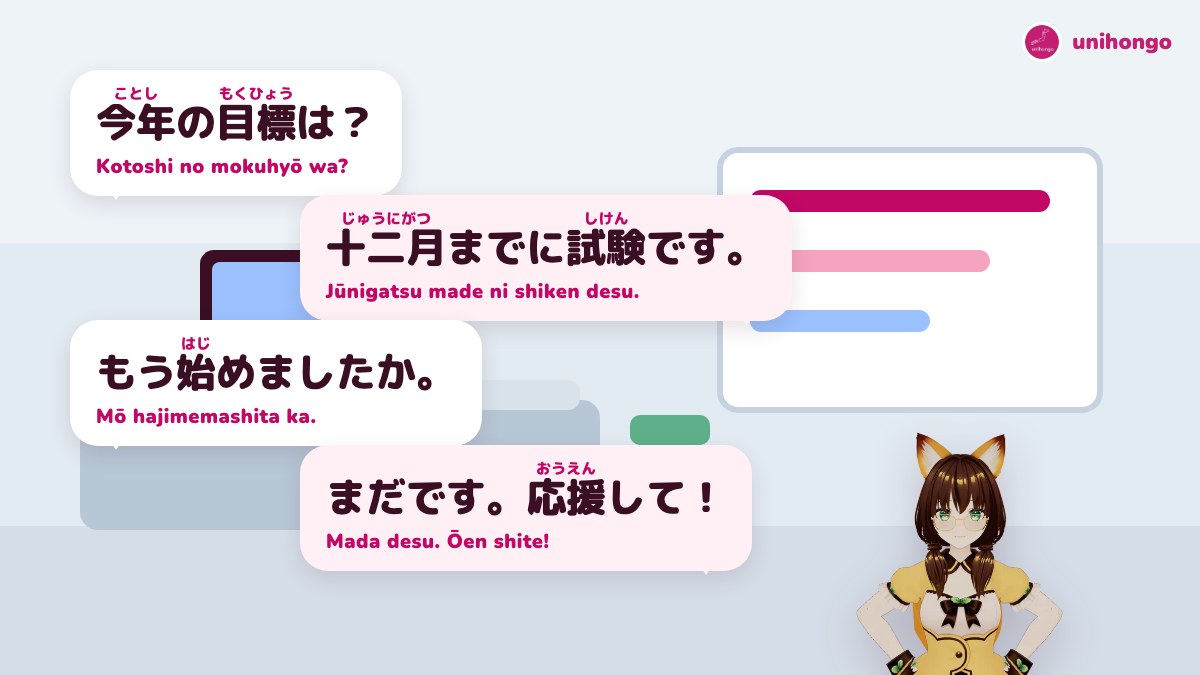
After you state a goal, the first reaction is almost always ii desu ne, and the second is a question about whether you have started. Mō, already, and mada, not yet, do most of the work in your reply. Ganbatte kudasai and ōen shite imasu are the encouragement phrases; both are warm, and neither implies they doubt you. The last two rows are how you return the question.
| Japanese | Romaji | Meaning |
|---|---|---|
| いいですね。もう始めましたか。 | Ii desu ne. Mō hajimemashita ka. | Coworker: Nice. Have you started already? |
| まだです。来月から始めます。 | Mada desu. Raigetsu kara hajimemasu. | You: Not yet. I'm starting next month. |
| どうしてそれにしたんですか。 | Dōshite sore ni shita n desu ka. | Coworker: Why did you choose that one? |
| 頑張ってください。応援しています。 | Ganbatte kudasai. Ōen shite imasu. | Coworker: Good luck. I'm rooting for you. |
| 去年と同じ目標です。 | Kyonen to onaji mokuhyō desu. | You: It's the same goal as last year. (honest) |
| 田中さんは?今年の目標はありますか。 | Tanaka-san wa? Kotoshi no mokuhyō wa arimasu ka. | You: What about you, Tanaka-san? Any goal this year? |
Sore ni shita n desu ka, with n desu, asks for the reason behind a choice and invites a story; dōshite desu ka alone can sound abrupt. Kyonen to onaji, the same as last year, is a self-deprecating line that Japanese speakers use about their own resolutions too.
Mistakes and register notes
- Using tsumori for a vague wish. Nihon ni sumu tsumori desu tells the listener you have decided to live in Japan; if it is a dream, say sumitai to omotte imasu. Tsumori on something you then never start sounds odd in hindsight.
- Using tsumori about someone else's plans as a statement. Tanaka-san wa yameru tsumori desu claims to know their mind; in a question it is fine, as a statement use yotei or sō desu, I hear that.
- Made where you mean made ni. Jūnigatsu made benkyō shimasu means you will study continuously until December; jūnigatsu made ni is the deadline for a result. Deadlines take ni.
- Putting ni after kotoshi. Kotoshi takes no particle, or wa to set it up as the topic: kotoshi wa, this year, as opposed to last year. Kotoshi ni is a learner's tell.
- Answering ganbatte kudasai with arigatō alone. Hai, ganbarimasu, yes, I'll do my best, is the expected reply; arigatō gozaimasu can follow it.
- Replying to a casual nanika yaritai koto aru? in full masu form. Among friends, use the plain form: Nihon ni ikitai, mainichi benkyō suru tsumori. Keep masu for coworkers and teachers.
Put the year's goals somewhere they get checked
A goal said once in January is a sentence; a goal said every week is a habit. The useful trick is to tell someone who will ask you about it again. Mocchi, Unihongo's study assistant, is built for exactly this: type /plan and tell it your goal for the year in your own words, for example that you want to hold a ten-minute conversation by December, and it turns the goal into a personal plan of small daily tasks that fit the time you have. It keeps notes on what you finish and what you skip, so when you say /adjust-plan in March it starts from what actually happened, not from what you promised.
To practise saying the goal out loud, open AI Sensei and ask Hana-sensei to play a classmate at a New Year gathering who asks everyone their mokuhyō, reacts, and asks whether you have started. Ask her to use kotoshi no hōfu wa the second time, so you hear both versions of the question. Everything here starts with a free account at unihongo.com/login; the plan itself takes a minute to set up.
Your turn: say your year aloud
- Kotoshi no mokuhyō wa nan desu ka. Answer with one goal and one deadline using made ni.
- Name three plans at three strengths: one ~tai to omotte imasu, one ~tsumori desu, one ~yotei desu, each with a month.
- Kyonen no mokuhyō wa dō deshita ka. Say what happened last year with ~mashita ga.
- Mō hajimemashita ka. Answer with mō or mada and say when you start.
- Ask someone back: kotoshi no yotei wa arimasu ka, then react to their answer with ii desu ne and one follow-up question.