
The questions you will hear about food
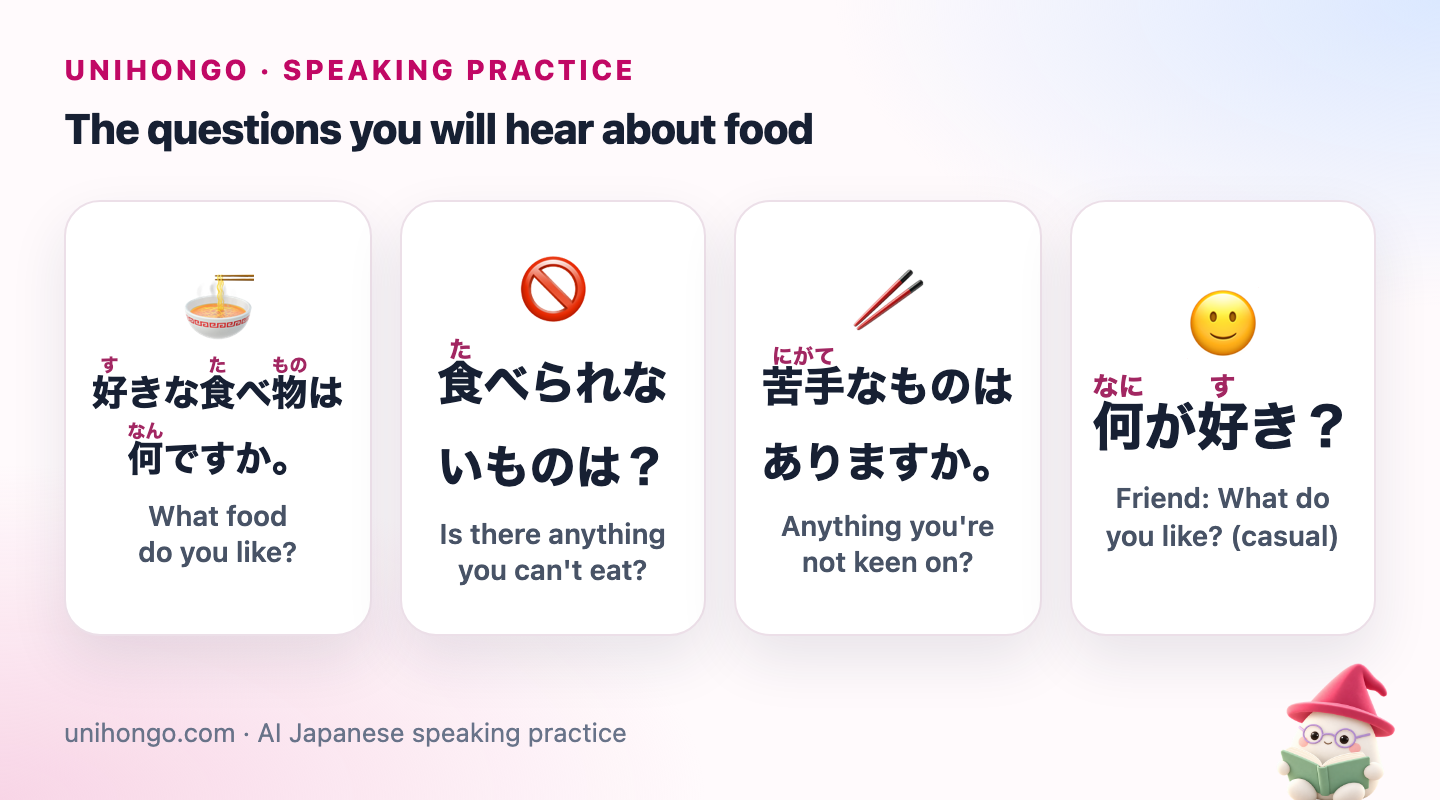
The first question is the classic; the second and third are what a host asks before cooking for you or booking a restaurant, and they are the kindest questions in the language because they let you say no in advance. The fourth is how a friend asks, with everything except the core dropped. Note that nigate na mono, things you are not good with, is the polite way to ask about dislikes; nobody asks kirai na mono wa in a first conversation.
| Japanese | Romaji | Meaning |
|---|---|---|
| 好きな食べ物は何ですか。 | Suki na tabemono wa nan desu ka. | What food do you like? |
| 食べられないものは? | Taberarenai mono wa? | Is there anything you can't eat? |
| 苦手なものはありますか。 | Nigate na mono wa arimasu ka. | Anything you're not keen on? |
| 何が好き? | Nani ga suki? | Friend: What do you like? (casual) |
Model answer 1: a like, a soft dislike, a sweet tooth
At the start, three sentences with three different strengths are a complete and honest answer: suki for a dish, nigate with chotto for one you avoid, daisuki for a category. Using all three in one answer shows the listener you know the ladder, and that is worth more than vocabulary.
| Japanese | Romaji | Meaning |
|---|---|---|
| ラーメンが好きです。 | Rāmen ga suki desu. | You: I like ramen. |
| 魚はちょっと苦手です。 | Sakana wa chotto nigate desu. | You: I'm not really into fish. |
| 甘いものが大好きです。 | Amai mono ga daisuki desu. | You: I love sweet things. |
Amai mono, sweet things, is the everyday word for desserts and snacks; dezāto is a course at the end of a meal. Karai mono, spicy things, works the same way.
Model answer 2: a favourite with a history, and one thing you cannot eat
The second level names a single favourite with ichiban, gives it a history with kodomo no koro kara and ~te kuremashita, someone made it for me, contrasts a like and a dislike in one sentence with ga, and states an allergy with node and taberaremasen. That last sentence is the most useful one in the post if you have a real allergy; learn it exactly.
| Japanese | Romaji | Meaning |
|---|---|---|
| 一番好きな食べ物はカレーです。 | Ichiban suki na tabemono wa karē desu. | You: My favourite food is curry. |
| 子どものころから、母がよく作ってくれました。 | Kodomo no koro kara, haha ga yoku tsukutte kuremashita. | You: My mother often made it for me when I was a child. |
| 辛いものも好きですが、納豆は苦手です。 | Karai mono mo suki desu ga, nattō wa nigate desu. | You: I like spicy food too, but nattō isn't for me. |
| 卵アレルギーがあるので、卵は食べられません。 | Tamago arerugī ga aru node, tamago wa taberaremasen. | You: I have an egg allergy, so I can't eat eggs. |
Haha, my mother, is the humble word you use about your own family to outsiders; okāsan is for someone else's mother or when speaking to your own. Tsukutte kureru, to make for me, adds the warmth that tsukutta alone lacks.
Model answer 3: a set meal, home cooking, and a surprise
An intermediate answer narrows the field with ~no naka de wa, among, prefers one thing over another with ~yori ~hō ga suki desu, admits a single absolute no with dake wa dame, and tells a small story with ~tara, when I tried, and igai to, unexpectedly. Hosts love the last one, because it means you will try things.
| Japanese | Romaji | Meaning |
|---|---|---|
| 和食の中では、焼き魚の定食が一番好きです。 | Washoku no naka de wa, yakizakana no teishoku ga ichiban suki desu. | You: Of Japanese food, a grilled-fish set meal is my favourite. |
| 外食より、家で作る方が好きです。 | Gaishoku yori, ie de tsukuru hō ga suki desu. | You: I prefer cooking at home to eating out. |
| 嫌いなものはほとんどありませんが、パクチーだけはだめです。 | Kirai na mono wa hotondo arimasen ga, pakuchī dake wa dame desu. | You: There's almost nothing I dislike, but coriander is the one thing I can't do. |
| 日本で初めてうにを食べたら、意外とおいしかったです。 | Nihon de hajimete uni o tabetara, igai to oishikatta desu. | You: When I first tried sea urchin in Japan, it was surprisingly good. |
The grammar this topic needs: the ladder of taste and I can't eat
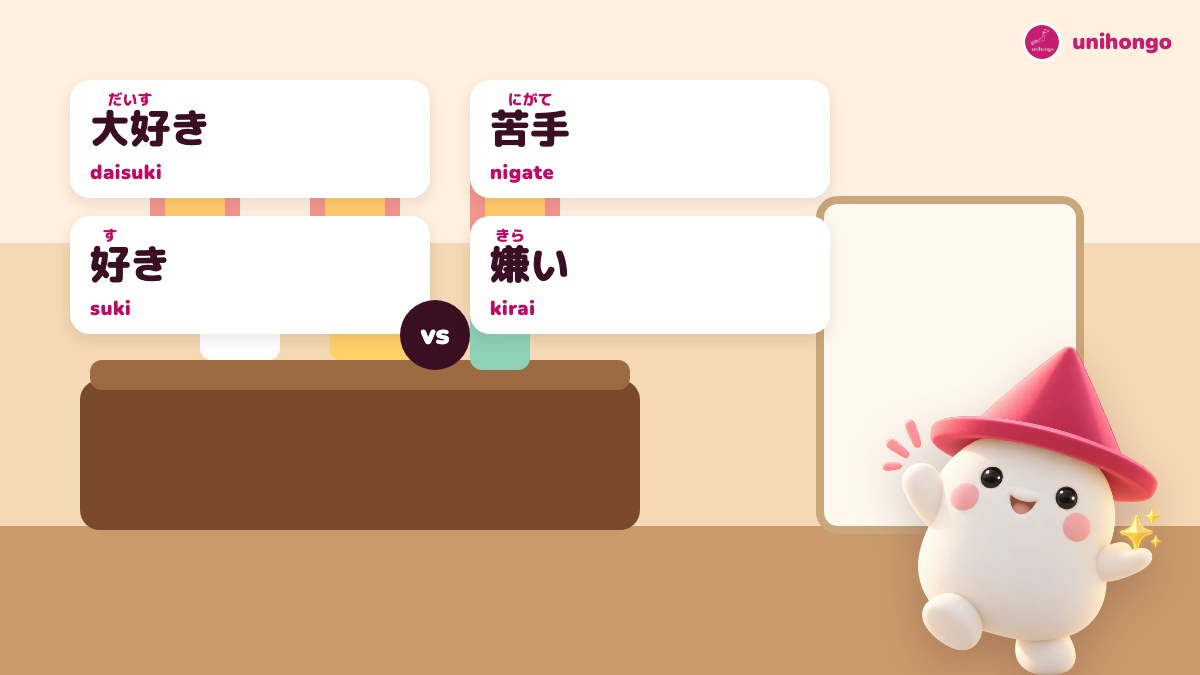
Two things carry this topic. The first is the strength of your feeling, from daisuki to daikirai, and which rungs are safe in polite company; the picture and the table show the ladder. The second is the difference between tabemasen, I don't eat it, a choice, and taberaremasen, I can't eat it, an inability, with the reason attached by node. The phrase rows after the table give the sentences for allergies, vegetarian and religious needs, and the polite decline at the table.
| Japanese | Romaji | Meaning |
|---|---|---|
| 肉は食べません。 | Niku wa tabemasen. | I don't eat meat. (a choice) |
| ベジタリアンなので、肉は食べられません。 | Bejitarian na node, niku wa taberaremasen. | I'm vegetarian, so I can't eat meat. |
| 宗教の関係で、豚肉は食べられません。 | Shūkyō no kankei de, butaniku wa taberaremasen. | For religious reasons, I can't eat pork. |
| えびのアレルギーがあります。 | Ebi no arerugī ga arimasu. | I have a shrimp allergy. |
| すみません、これは遠慮しておきます。 | Sumimasen, kore wa enryo shite okimasu. | Sorry, I'll pass on this one. (polite decline) |
| Word | Strength | Register and when to use it |
|---|---|---|
| 大好き daisuki | I love it | Natural for food; use for two or three favourites |
| 好き suki | I like it | The default; already warm |
| まあまあ māmā | It's okay | Honest and neutral; fine with friends |
| あまり好きじゃない amari suki ja nai | I don't like it much | Soft; safe in polite company |
| 苦手 nigate | It doesn't agree with me | The polite dislike; what adults say |
| 嫌い kirai | I dislike it | Strong; for friends, or with dake wa |
| 大嫌い daikirai | I hate it | Very strong; almost never about food in company |
Na node after a noun, bejitarian na node, is the polite reason form; dakara is the casual one. Enryo shite okimasu, I'll hold back on this, is the set phrase for declining a dish at someone's table without saying why.
Follow-up questions and the reactions you will hear
Once you name a favourite, the follow-ups are predictable and friendly: what kind of dishes, what Japanese food do you like, do you cook. The nattō question comes to almost every foreigner, so it is in the rows. The reactions are igai desu ne when your taste surprises them and watashi mo when it matches; both are good signs.
| Japanese | Romaji | Meaning |
|---|---|---|
| 日本の食べ物で何が好きですか。 | Nihon no tabemono de nani ga suki desu ka. | Host: What Japanese food do you like? |
| 自分でも作りますか。 | Jibun demo tsukurimasu ka. | Host: Do you cook it yourself too? |
| 納豆は食べられますか。 | Nattō wa taberaremasu ka. | Host: Can you eat nattō? |
| はい、大丈夫です。むしろ好きです。 | Hai, daijōbu desu. Mushiro suki desu. | You: Yes, no problem. I actually like it. |
| へえ、意外ですね! | Hee, igai desu ne! | Host: Oh, that's a surprise! |
| 私も!今度一緒に食べに行きましょう。 | Watashi mo! Kondo issho ni tabe ni ikimashō. | You: Me too! Let's go and eat it together sometime. |
Mushiro, if anything or actually, flips an expected answer and makes people laugh when it comes after the nattō question. Tabe ni iku, to go to eat, is the verb for going out for a specific food: rāmen o tabe ni ikimashō.
Mistakes and register notes
- Using o after suki or nigate. Suki and nigate are adjectives, not verbs, so the thing you like takes ga, or wa when you contrast: sakana ga suki desu, niku wa nigate desu. Sakana o suki desu is the error that marks a learner fastest.
- Saying kirai desu to a host about a dish. Even if you truly dislike it, nigate desu or amari suki ja nai desu is what a Japanese adult would say. Keep kirai for conversations with friends and for dake wa dame.
- Confusing tabemasen with taberaremasen. Niku wa tabemasen is a choice and can sound curt; niku wa taberaremasen with a reason explains itself and nobody will press you.
- Dropping ra in taberaremasen. Tabere nai and taberemasen, without ra, are common in casual speech, especially among younger speakers, and you will hear them everywhere; in polite conversation and in writing, keep taberaremasen.
- Saying oishii desu about a dish you have not eaten yet. Oishii is a verdict after tasting; before, say oishisō desu, it looks delicious. Umai is the casual, slightly rough version of oishii and is common among friends, especially men.
- Answering a casual nani ga suki? in full masu form. Among friends: rāmen kana, sakana wa chotto, amai mono daisuki. Keep desu and masu for hosts, coworkers and teachers.
Make the next three meals your practice
- Every meal is a prompt. Before you eat, say one sentence about the dish aloud: suki, nigate, or hajimete, first time, and a reason. Three meals a day is twenty-one sentences a week.
- Photograph your favourite dishes and send them to Mocchi, Unihongo's study assistant, with /create-flashcards; it makes a card from each photo with the dish's name and a sentence about it. /review-flashcards brings the cards back with spaced repetition, and because Mocchi keeps track of the particles you miss, the cards for the dishes you keep saying o suki about will come round more often.
- When you can say your three columns without hesitating, say them to a host: in AI Sensei, ask Sakura-sensei to play a Japanese host preparing dinner who asks what you like, what you cannot eat and whether nattō is all right, and who reacts to your answers. Ask her to offer you one dish you have to decline politely.
- A free account at unihongo.com/login covers the flashcards and the dinner conversation; the dishes come from your own phone.
Your turn: talk about food you like aloud
- Suki na tabemono wa nan desu ka. Name one dish with ichiban and give a reason with kara.
- Nigate na mono wa arimasu ka. Name one food with chotto nigate desu and one you cannot eat with node and taberaremasen.
- Say three foods on three rungs of the ladder: daisuki, suki, amari suki ja nai.
- Nattō wa taberaremasu ka. Answer both ways, once with mushiro suki desu and once with chotto nigate desu.
- Nihon no tabemono de nani ga suki desu ka. Answer with ~no naka de wa and a teishoku or a dish, then invite someone with tabe ni ikimashō.