
The questions you will hear about the sports you watch
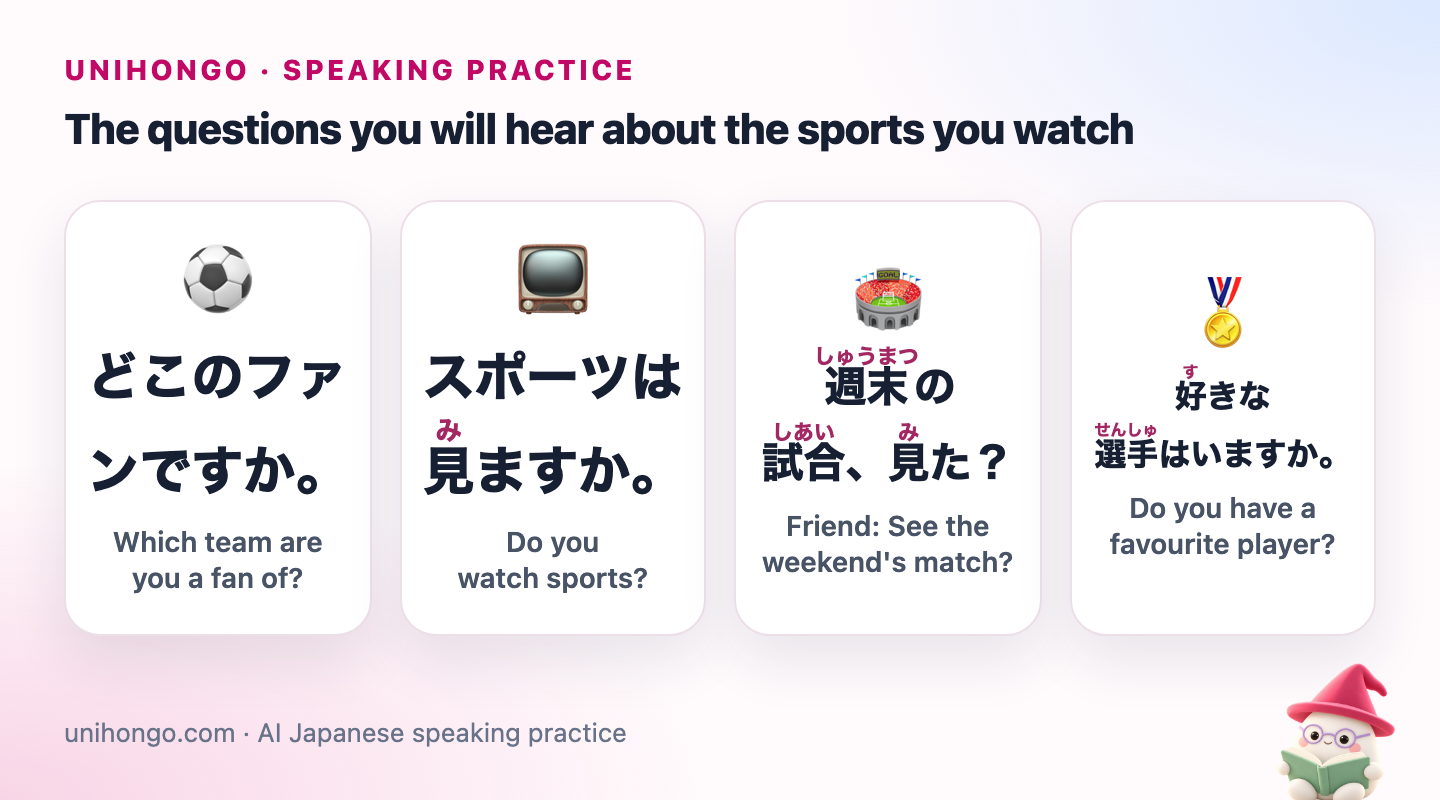
The first question is the one that defines a fan in Japan: doko no fan desu ka, literally a fan of where, asks which team, and it is the one to have an answer ready for. The others open the topic or follow it: whether you watch sport at all, whether you saw the weekend's match, and whether you have a favourite player. The third is casual, with the o and ka dropped.
| Japanese | Romaji | Meaning |
|---|---|---|
| どこのファンですか。 | Doko no fan desu ka. | Which team are you a fan of? |
| スポーツは見ますか。 | Supōtsu wa mimasu ka. | Do you watch sports? |
| 週末の試合、見た? | Shūmatsu no shiai, mita? | Friend: See the weekend's match? |
| 好きな選手はいますか。 | Suki na senshu wa imasu ka. | Do you have a favourite player? |
Model answer 1: a sport, a team, a habit
Three sentences cover it at the start: the sport with ~o yoku mimasu, the team with ~no fan desu, and when and how you watch. Terebi de, on television, is the natural phrase; a streaming service is still terebi de or sumaho de in casual talk.
| Japanese | Romaji | Meaning |
|---|---|---|
| サッカーをよく見ます。 | Sakkā o yoku mimasu. | You: I watch a lot of football. |
| イギリスのチームのファンです。 | Igirisu no chīmu no fan desu. | You: I'm a fan of an English team. |
| 週末はテレビで試合を見ます。 | Shūmatsu wa terebi de shiai o mimasu. | You: At the weekend I watch matches on TV. |
If your team's name is hard to say in Japanese, say the city or the country first and the name after: Rondon no chīmu de, Āsenaru desu. Japanese listeners are used to katakana team names and will meet you halfway.
Model answer 2: since when, and what happened last weekend
The second level adds history with kodomo no koro kara, since childhood, active support with ~o ōen shite imasu, and a match story in the past tense: gyakuten, a comeback, is the single most useful match noun. The last sentence admits what losing does to you, and it is the line that turns a report into a conversation.
| Japanese | Romaji | Meaning |
|---|---|---|
| 子どものころからバスケのファンです。 | Kodomo no koro kara basuke no fan desu. | You: I've been a basketball fan since I was a kid. |
| 地元のチームを応援しています。 | Jimoto no chīmu o ōen shite imasu. | You: I support my hometown team. |
| 先週の試合は、最後に逆転して勝ちました。 | Senshū no shiai wa, saigo ni gyakuten shite kachimashita. | You: In last week's match we came from behind at the end and won. |
| 負けると、一日中落ち込みます。 | Makeru to, ichinichijū ochikomimasu. | You: When we lose, I'm down all day. |
Basuke is the everyday short form of basukettobōru; nobody says the full word in conversation. Jimoto, your home area, is a warm word in Japanese and jimoto no chīmu says more than my city's team.
Model answer 3: more than one sport, a near miss and a plan
An intermediate answer ranks sports with ichiban atsuku naru no wa, the one I get most worked up about, uses kanarazu, without fail, for the matches you never miss, reacts to a recent result with oshikatta, it was so close, and makes a plan to watch the final with ~yotei desu. Nihon daihyō, the Japan national team, is a phrase worth knowing because it is what most Japanese people watch first.
| Japanese | Romaji | Meaning |
|---|---|---|
| 野球もサッカーも見ますが、一番熱くなるのはラグビーです。 | Yakyū mo sakkā mo mimasu ga, ichiban atsuku naru no wa ragubī desu. | You: I watch baseball and football, but rugby is what gets me most worked up. |
| 日本代表の試合は必ず見ます。 | Nihon daihyō no shiai wa kanarazu mimasu. | You: I never miss a Japan national team match. |
| この前の試合は惜しかったですね。 | Kono mae no shiai wa oshikatta desu ne. | You: The last match was so close, wasn't it. |
| 来週の決勝は、友達とスポーツバーで見る予定です。 | Raishū no kesshō wa, tomodachi to supōtsu bā de miru yotei desu. | You: I'm planning to watch next week's final with friends at a sports bar. |
The words this topic needs: results, scores and the match
A match story needs about a dozen words, and most of them are native Japanese rather than loanwords, which surprises learners who expect everything about football to be katakana. The table gives the result and match words; the phrase rows after it are the reactions you will hear shouted at a screen and can shout yourself. They are all casual, because nobody shouts in masu form.
| Japanese | Romaji | Meaning |
|---|---|---|
| 入った! | Haitta! | It's in! (a goal, a basket, a shot) |
| 惜しい! | Oshii! | So close! |
| やった! | Yatta! | Yes! We did it! |
| うそでしょ! | Uso desho! | No way! (casual) |
| 頑張れ! | Ganbare! | Come on! (shouted at the team) |
| いい試合でしたね。 | Ii shiai deshita ne. | That was a good match, wasn't it. (polite, after) |
| Japanese | Romaji | Meaning |
|---|---|---|
| 試合 | shiai | a match or game; gēmu is rarer and mostly for video games |
| 勝つ / 負ける / 引き分け | katsu / makeru / hikiwake | to win / to lose / a draw |
| 三対一 | san tai ichi | three to one; the score is read with tai |
| 逆転 | gyakuten | a comeback, turning the match around |
| 延長戦 | enchōsen | extra time, overtime, extra innings |
| 決勝 / 準決勝 | kesshō / junkesshō | the final / the semi-final |
| 応援する | ōen suru | to support, to cheer for |
| 選手 / 監督 | senshu / kantoku | a player / the manager or head coach |
| 代表 | daihyō | the national team, as in Nihon daihyō |
Haitta, it went in, is what Japanese fans shout for a goal in football, a basket, a home run and a serve that lands; it is the universal scoring shout. Ganbare is the plain imperative and is normal when shouting at a team; to a person in front of you, ganbatte is kinder.
Follow-up questions and the rivalry you will meet
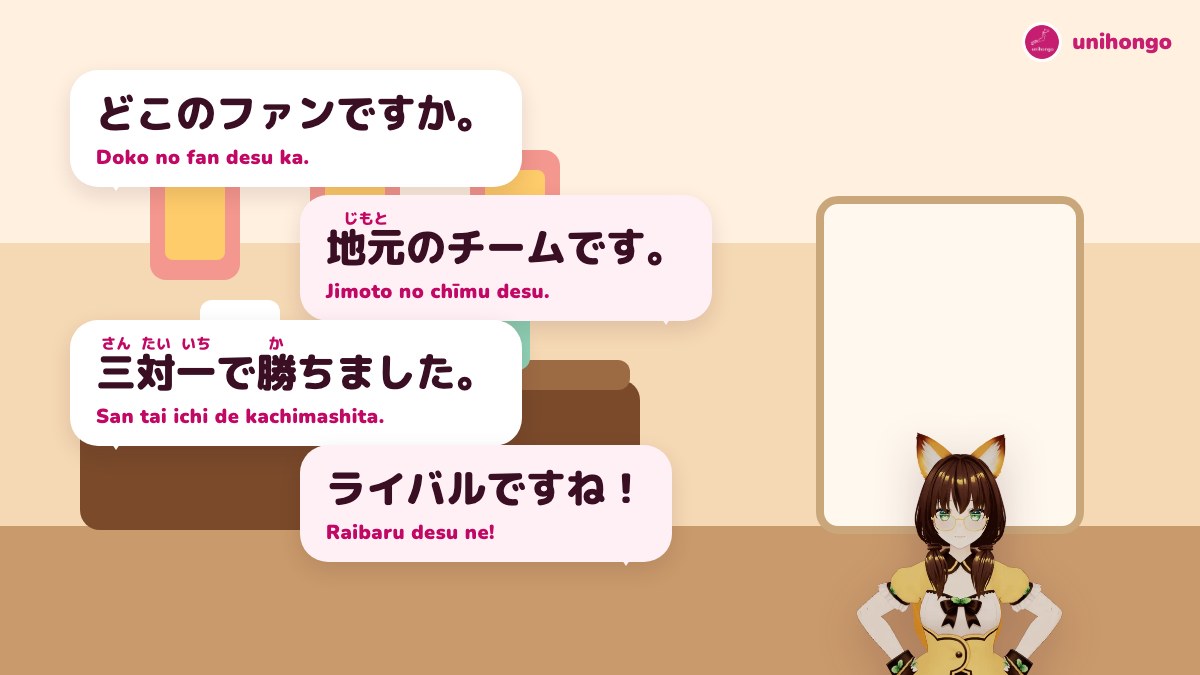
After you name a team, the follow-ups come fast: do you go to matches, do you know any Japanese teams, who do you rate. A Japanese fan will often declare their own camp with ~ha desu, I'm a baseball person, and if your teams clash they will say raibaru desu ne with a grin. These rows show the exchange at an izakaya with the match on the screen above the counter, the place where most of these conversations actually happen.
| Japanese | Romaji | Meaning |
|---|---|---|
| 試合は見に行きますか。 | Shiai wa mi ni ikimasu ka. | Coworker: Do you go to watch matches? |
| 日本のチームは知っていますか。 | Nihon no chīmu wa shitte imasu ka. | Coworker: Do you know any Japanese teams? |
| 誰が一番うまいと思いますか。 | Dare ga ichiban umai to omoimasu ka. | Coworker: Who do you think is the best player? |
| 私は野球派です。 | Watashi wa yakyūha desu. | Coworker: I'm a baseball person myself. |
| じゃあ、ライバルですね! | Jā, raibaru desu ne! | You: So we're rivals, then! |
| 今度一緒に見ましょう。 | Kondo issho ni mimashō. | You: Let's watch one together sometime. |
~ha after a noun, yakyūha, sakkāha, means the camp you belong to and is a light, friendly way to state a preference. Umai for a player means skilful; jōzu works too but umai is what fans say.
Mistakes and register notes
- Saying supōtsu o shimasu when you only watch. Suru means you play; the question supōtsu wa mimasu ka is about watching, so answer with mimasu. Playing and watching are separate topics in Japanese.
- Using futtobōru for football. In Japan sakkā is football or soccer; futtobōru usually means American football, which is also amefuto. Say sakkā.
- Saying ōen desu instead of ōen shite imasu. Ōen is a noun; the verb is ōen suru, and the state of supporting a team is ōen shite imasu.
- Reading the score with to or wa. San to ichi sounds like a list. Scores take tai: san tai ichi.
- Translating I'm gutted as kanashii desu. Kuyashii, frustrated at a loss you feel you deserved to avoid, is the fan's word; kanashii is sadness at bad news. Kuyashikatta desu after a defeat is exactly right.
- Answering a casual shūmatsu no shiai, mita? with masu. Among friends: mita! gyakuten de katta! or mitenai, dō datta? Keep mimashita for coworkers and people you have just met.
Use the next match as the lesson
The best thing about this topic is that new material arrives every weekend. Before the next match, learn the names of both teams in katakana and the words for the two or three things that might happen. During it, shout the reactions in Japanese. Afterwards, tell the match in five sentences, and you have done a complete speaking cycle without opening a textbook.
For the shouting and the story, a partner who talks back helps. In AI Sensei, ask Haru-sensei to play a friend at an izakaya with the match on, who asks which team you support, teases you a little and asks what happened in the last game you watched; ask Haru-sensei to stay casual, because that is the register sport is talked about in. The session report afterwards lists the past-tense forms and match words you used and the ones she corrected. Mocchi, Unihongo's study assistant, can prepare you the day before: ask it for a /quiz on the match words above, or to /explain the difference between oshii and kuyashii with examples from sport, and it will remember which ones you missed for next week. The whole routine runs on a free account at unihongo.com/login, and your first opponent can be a fan of the other side.
Your turn: tell a match aloud
- Doko no fan desu ka. Answer with the sport, the team and since when with ~kara.
- Shūmatsu no shiai wa dō deshita ka. Tell the result with the score using tai, and one turning point.
- Say the same match story in plain form for a friend, with one shouted reaction in it.
- Suki na senshu wa imasu ka. Name a player and say why with ~kara, using umai or hayai.
- Declare your camp with ~ha desu, then ask someone back and react with raibaru desu ne or watashi mo desu.