
The questions you will hear about a purchase
The topic usually starts when someone notices the thing. Sore, atarashii? is the casual opener from a friend, and the polite questions follow: where, how much, and the general saikin nani ka kaimashita ka, bought anything lately, which is a classic small-talk starter in itself.
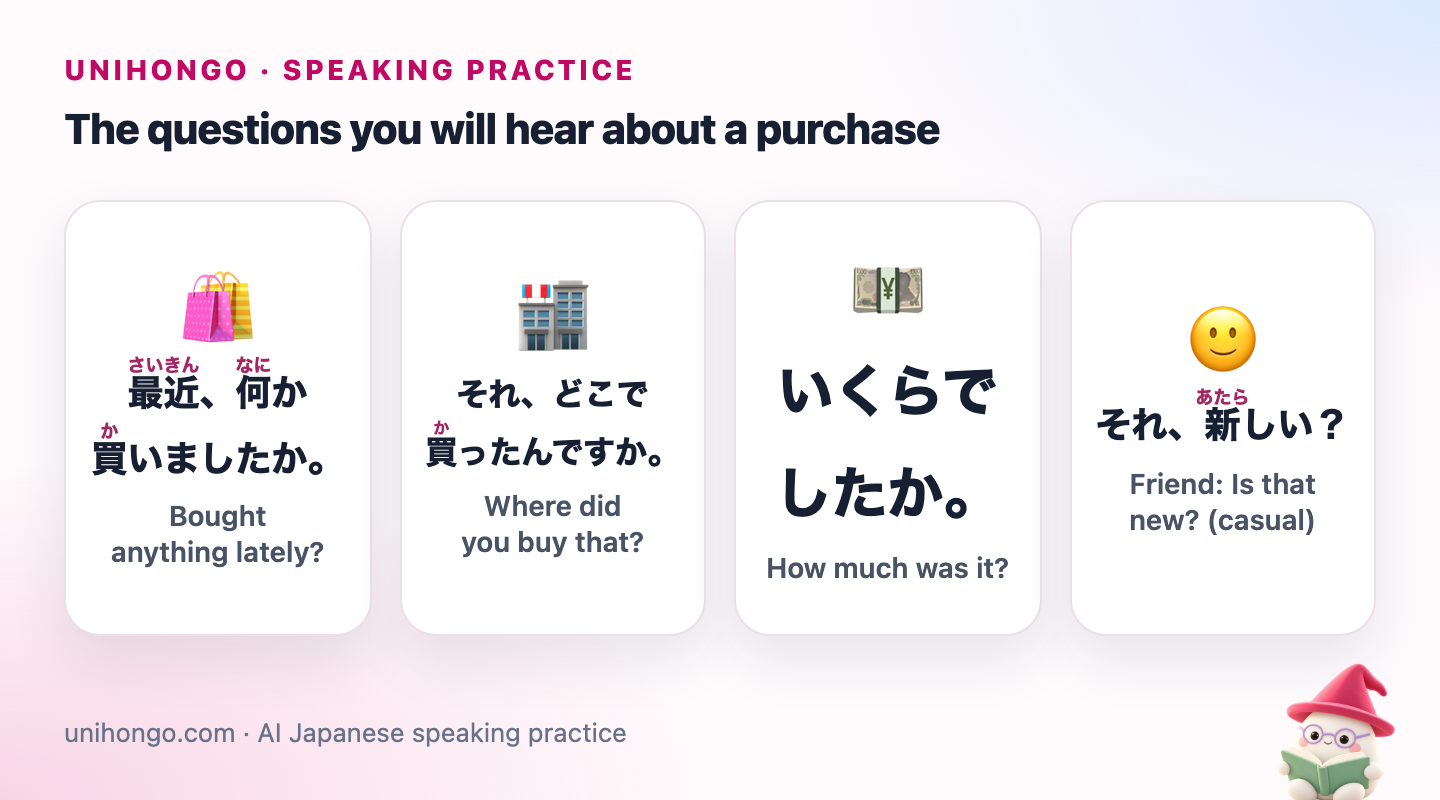
| Japanese | Romaji | Meaning |
|---|---|---|
| 最近、何か買いましたか。 | Saikin, nani ka kaimashita ka. | Bought anything lately? |
| それ、どこで買ったんですか。 | Sore, doko de katta n desu ka. | Where did you buy that? |
| いくらでしたか。 | Ikura deshita ka. | How much was it? |
| それ、新しい? | Sore, atarashii? | Friend: Is that new? (casual) |
Model answer 1: what, where, one adjective in the past
Three sentences give a beginner answer: the thing with o kaimashita and a time word, the place with de, and one adjective in the past tense. The past adjective is the point of the exercise: yasukatta, it was cheap, not yasui deshita.
| Japanese | Romaji | Meaning |
|---|---|---|
| 先週、靴を買いました。 | Senshū, kutsu o kaimashita. | You: I bought shoes last week. |
| デパートで買いました。 | Depāto de kaimashita. | You: I bought them at a department store. |
| 安かったです。 | Yasukatta desu. | You: They were cheap. |
Time words like senshū, kinō and kyonen take no particle and sit at the front. Senshū ni kaimashita is a learner habit; drop the ni.
Model answer 2: why, and whether you are happy with it
The second level gives the reason with node, uses kaikaeru for replacing an old one with a new one, says you are pleased with ki ni itte imasu, and balances price against the verdict with ga (but). Netto de, online, is the place word for most purchases now.
| Japanese | Romaji | Meaning |
|---|---|---|
| 昨日、ネットで新しいイヤホンを買いました。 | Kinō, netto de atarashii iyahon o kaimashita. | You: Yesterday I bought new earphones online. |
| 前のが壊れたので、買い替えました。 | Mae no ga kowareta node, kaikaemashita. | You: The old ones broke, so I replaced them. |
| 音がよくて、気に入っています。 | Oto ga yokute, ki ni itte imasu. | You: The sound is good and I'm happy with them. |
| 少し高かったですが、買ってよかったです。 | Sukoshi takakatta desu ga, katte yokatta desu. | You: They were a bit pricey, but I'm glad I bought them. |
Mae no, the previous one, uses no to stand in for the noun; you do not need to say iyahon again. Ki ni itte iru, to be pleased with, is the verb for liking something you own; suki works, but ki ni itte imasu sounds like an owner talking.
Model answer 3: the purchase you dithered over
An intermediate answer has a small arc: hesitation (zutto mayotte ita, had been hesitating), a trigger (the sale), the decision with omoikitte, taking the plunge, the result with ~ te, and a verdict with ~ba yokatta, should have. This is the shape of most real purchase stories, and the regret-free version of ba yokatta, motto hayaku kaeba yokatta, I should have bought it sooner, is a very natural ending.
| Japanese | Romaji | Meaning |
|---|---|---|
| ずっと迷っていたんですが、ついに自転車を買いました。 | Zutto mayotte ita n desu ga, tsui ni jitensha o kaimashita. | You: I'd been hesitating for ages, but I finally bought a bicycle. |
| セールで三割引きだったので、思い切って決めました。 | Sēru de sanwaribiki datta node, omoikitte kimemashita. | You: It was thirty percent off in the sale, so I took the plunge. |
| 通勤が楽になって、電車代も節約できています。 | Tsūkin ga raku ni natte, denshadai mo setsuyaku dekite imasu. | You: My commute is easier, and I'm saving on train fares too. |
| 正直、もっと早く買えばよかったです。 | Shōjiki, motto hayaku kaeba yokatta desu. | You: Honestly, I should have bought it sooner. |
The grammar this topic needs: past tense and verdicts
Two things carry the topic: the past tense of adjectives, which learners get wrong far more often than the past tense of verbs, and a set of verdict phrases that tell the listener whether the purchase was a good idea. The table gives the verdicts from best to worst; the phrase rows after it show the past-tense adjectives in sentences.
| Japanese | Romaji | Meaning |
|---|---|---|
| 安かったです。 | Yasukatta desu. | It was cheap. |
| 思ったより高かったです。 | Omotta yori takakatta desu. | It was more expensive than I expected. |
| 使いやすかったです。 | Tsukaiyasukatta desu. | It was easy to use. |
| 便利でした。 | Benri deshita. | It was convenient. (na-adjective: deshita) |
| 買ってよかったです。 | Katte yokatta desu. | I'm glad I bought it. |
| 買わなければよかったです。 | Kawanakereba yokatta desu. | I shouldn't have bought it. |
| Verdict | Romaji | Feels like |
|---|---|---|
| I'm glad I bought it | katte yokatta desu | the warm, standard positive |
| Good for the price | nedan no wari ni ii desu | measured approval |
| I got my money's worth | moto wa toremashita | it paid for itself |
| It was a bit of a mistake | chotto shippai deshita | mild regret, self-deprecating |
| I shouldn't have bought it | kawanakereba yokatta desu | clear regret |
| What a waste | mottainakatta desu | regret about money or the object |
Omotta yori, than I expected, is the comparison learners use most about prices. Yokatta is the past of ii, so ~te yokatta is literally it was good that I did ~, and it works with any verb: itte yokatta, I'm glad I went.
Where and why: the words behind the purchase
Where you bought it takes de; why you bought it takes node, kara, or a passive with ni when someone recommended it. Chūko, second-hand, and shōdōgai, impulse buy, are the two words that get a laugh and a follow-up question.
| Japanese | Romaji | Meaning |
|---|---|---|
| 中古で買いました。 | Chūko de kaimashita. | I bought it second-hand. |
| 友達にすすめられて買いました。 | Tomodachi ni susumerarete kaimashita. | A friend recommended it, so I bought it. |
| 前から欲しかったんです。 | Mae kara hoshikatta n desu. | I'd wanted it for a while. |
| 衝動買いです。 | Shōdōgai desu. | It was an impulse buy. |
| ポイントがたまっていたので。 | Pointo ga tamatte ita node. | Because I had points saved up. |
| 誕生日に自分へのご褒美で。 | Tanjōbi ni jibun e no gohōbi de. | As a birthday treat for myself. |
Jibun e no gohōbi, a reward for myself, is a very common and slightly joking justification for a treat. Hoshikatta is the past of hoshii, wanted; it is an i-adjective, so no deshita.
Follow-up questions and the reactions you will hear
A coworker who notices something new will ask to see it, ask which brand, and ask whether it is easy to use; a friend will just say takasō, looks expensive. The exchange below is at an office desk. The reaction to learn is watashi mo hoshiku natte kimashita, now I want one too, which is the highest compliment a purchase can get.
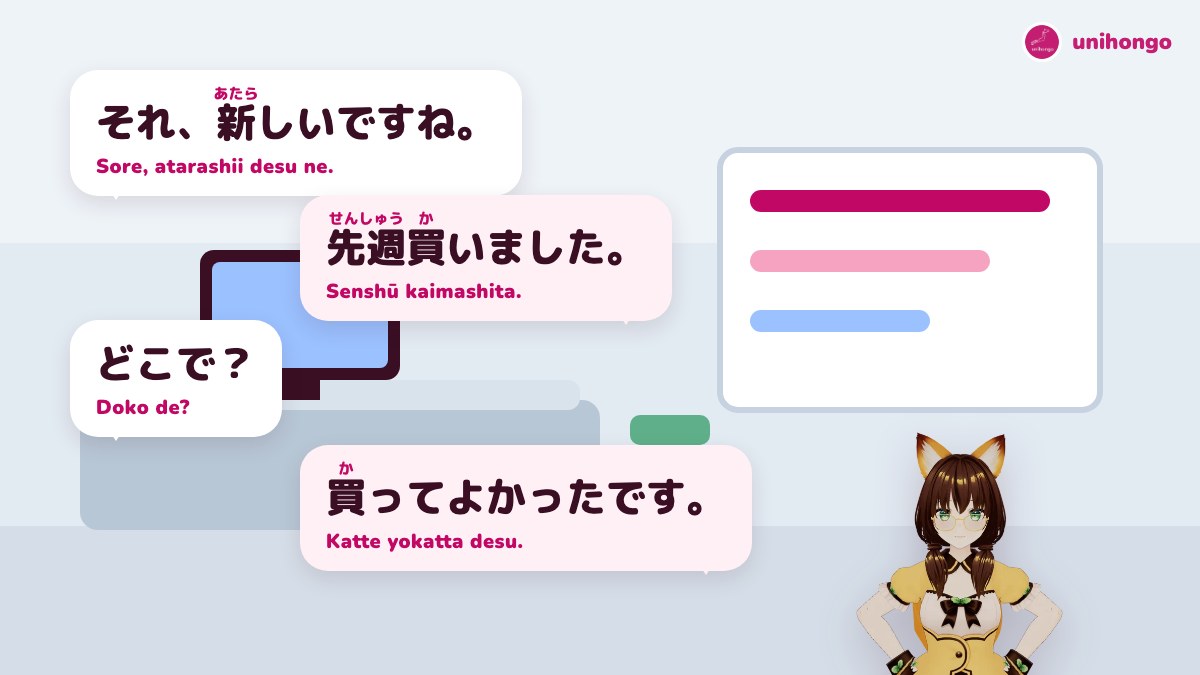
| Japanese | Romaji | Meaning |
|---|---|---|
| 見せてください。 | Misete kudasai. | Coworker: Show me. |
| いいですね、どこのですか。 | Ii desu ne, doko no desu ka. | Coworker: Nice, which brand is it? |
| 使いやすいですか。 | Tsukaiyasui desu ka. | Coworker: Is it easy to use? |
| 私も欲しくなってきました。 | Watashi mo hoshiku natte kimashita. | Coworker: Now I want one too. |
| 高そう! | Takasō! | Friend: Looks expensive! (casual) |
| そんなに高くなかったですよ。 | Sonna ni takakunakatta desu yo. | You: It wasn't that expensive. |
Doko no, from where, is how people ask the brand or the shop without saying either. Takakunakatta, the past negative of takai, is one more form worth getting right before the conversation happens.
Mistakes and register notes
- Takai deshita, yasui deshita, ii deshita. Past tense goes inside the i-adjective: takakatta, yasukatta, yokatta, then desu.
- Senshū ni, kinō ni. Relative time words take no particle before kaimashita.
- Asking ikura deshita ka to a senior coworker about a watch or a suit. Add kiite mo ii desu ka first, or skip the price and ask doko no desu ka instead.
- Saying kaimashita in a casual story to a friend. With friends, katta: kinō netto de iyahon katta n da kedo. With coworkers, teachers and shop staff, stay with masu.
- Translating it was worth it as kachi ga arimashita in every sentence. Katte yokatta is what people say; save kachi ga aru for a serious recommendation.
A purchase a week as speaking practice
Everyone buys something every week, which makes this a topic you can rehearse endlessly without inventing anything. Tell the story of one purchase to Mocchi, Unihongo's study assistant, with /correct, and ask it to check your past-tense adjectives and to add one verdict phrase you have not used yet; Mocchi keeps track of the adjective forms you miss and brings them back in a quick /review later.
The conversation itself needs a partner who notices things. In AI Sensei, pick Sakura-sensei, ask Sakura-sensei to play a coworker who spots something new on your desk and asks where you got it, how much it was and whether you recommend it, and then to play a friend who asks the same thing casually. The report at the end shows every past tense you used. Free sign-up is at unihongo.com/login, and the first conversation can be about whatever you bought today.
Your turn: tell the story of a purchase
- Saikin nani ka kaimashita ka. Name the thing, the time and the place.
- Dōshite kaimashita ka. A reason with node.
- Takakatta desu ka. One past-tense adjective about the price and one about the quality.
- Katte yokatta desu ka. A verdict from the table.
- Tell the story of something you regret buying, ending with kawanakereba yokatta.