
The questions you will hear about your friend
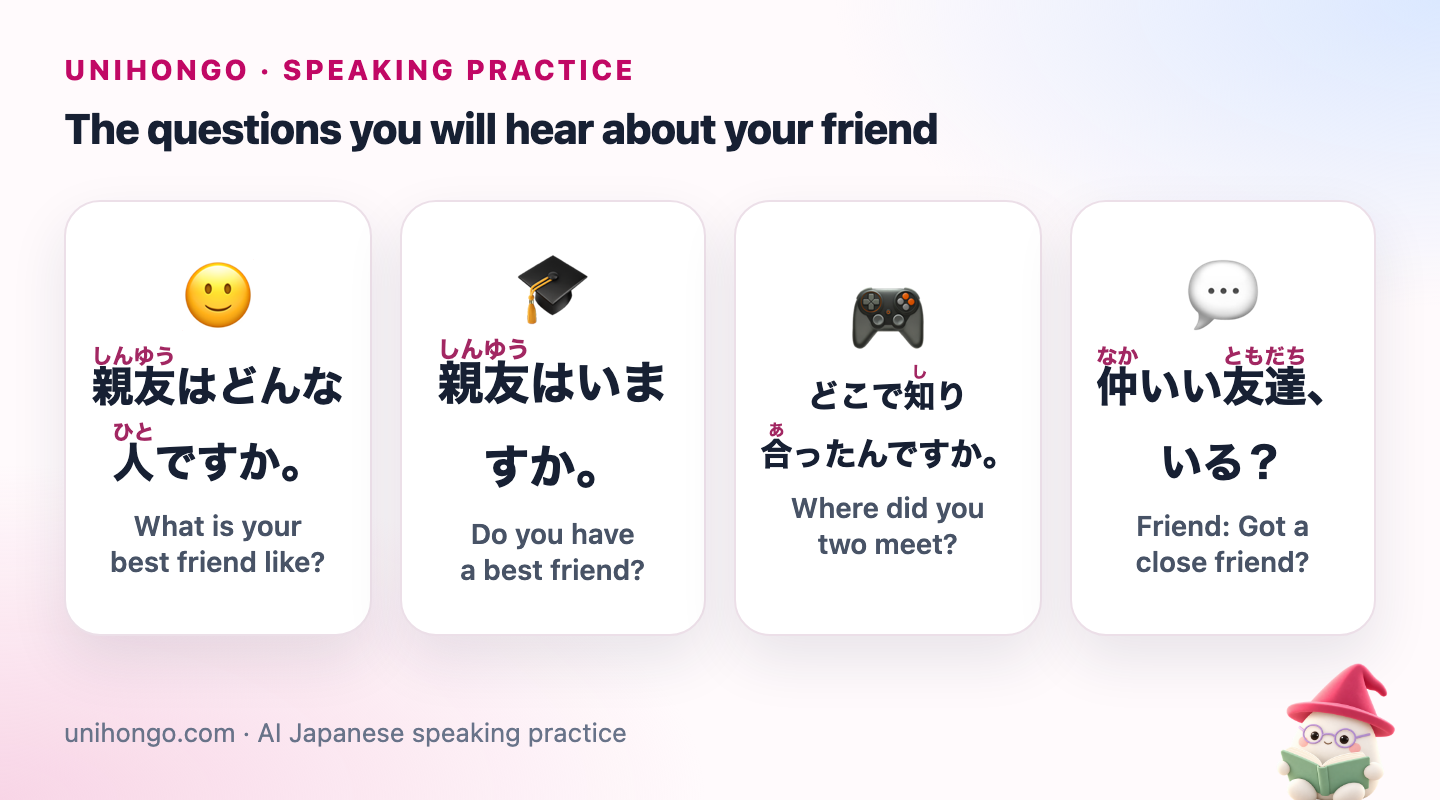
Friends come up when you mention a trip, a photo or a weekend. The questions below are the ones you will hear: whether you have a best friend, what they are like, and how you met. The last line is a friend's casual version, with naka ga ii, close, shortened to naka ii.
| Japanese | Romaji | Meaning |
|---|---|---|
| 親友はどんな人ですか。 | Shin'yū wa donna hito desu ka. | What is your best friend like? |
| 親友はいますか。 | Shin'yū wa imasu ka. | Do you have a best friend? |
| どこで知り合ったんですか。 | Doko de shiriatta n desu ka. | Where did you two meet? |
| 仲いい友達、いる? | Naka ii tomodachi, iru? | Friend: Got a close friend? |
Model answer 1: name, two adjectives, where you met
At the first level you need a name with the pattern ~ no namae wa ~ desu, two adjectives joined by kute, and a place with de aimashita. Three sentences; the join between the adjectives is what makes it sound like Japanese rather than a list.
| Japanese | Romaji | Meaning |
|---|---|---|
| 親友の名前はアナです。 | Shin'yū no namae wa Ana desu. | You: My best friend's name is Ana. |
| 明るくて、優しいです。 | Akarukute, yasashii desu. | You: She's cheerful and kind. |
| 高校で会いました。 | Kōkō de aimashita. | You: We met in high school. |
Akarui, bright, is the everyday word for a cheerful personality, and it is the first adjective most Japanese speakers use about a friend they like. Akarukute yasashii is a compliment you will hear often.
Model answer 2: how you met, what they are like, what you do
The second level uses shiriau for getting to know someone, itsumo ~te iru for a habit that defines them, yoku issho ni for what you do together, and ga (but) to admit you now live apart. The name is repeated instead of kanojo or kare, which is how Japanese speakers avoid the boyfriend-girlfriend reading.
| Japanese | Romaji | Meaning |
|---|---|---|
| 親友のマルコとは大学で知り合いました。 | Shin'yū no Maruko to wa daigaku de shiriaimashita. | You: I got to know my best friend Marco at university. |
| マルコはおもしろくて、いつも冗談を言っています。 | Maruko wa omoshirokute, itsumo jōdan o itte imasu. | You: Marco is funny and always making jokes. |
| 週末によく一緒にサッカーを見ます。 | Shūmatsu ni yoku issho ni sakkā o mimasu. | You: We often watch football together at weekends. |
| 今は違う町に住んでいますが、毎週電話します。 | Ima wa chigau machi ni sunde imasu ga, maishū denwa shimasu. | You: We live in different cities now, but we talk on the phone every week. |
~ to shiriau, to get to know someone, takes to: Maruko to shiriaimashita. With wa added, Maruko to wa, the friend becomes the topic of the sentence, which is natural when you are introducing them.
Model answer 3: a long friendship with a contrast
An intermediate answer carries a history (kodomo no koro kara no tsukiai, a relationship since childhood), balances a quiet trait against a strong one with ~n desu ga, and uses noni to express the small wonder of getting along despite being opposites. The last sentence, nan demo hanaseru aite, someone I can tell anything to, is the phrase Japanese speakers use to define a best friend.
| Japanese | Romaji | Meaning |
|---|---|---|
| 親友とは子どもの頃からの付き合いで、もう二十年になります。 | Shin'yū to wa kodomo no koro kara no tsukiai de, mō nijūnen ni narimasu. | You: My best friend and I go back to childhood; it's been twenty years now. |
| 口数は少ないんですが、困ったときに必ず助けてくれます。 | Kuchikazu wa sukunai n desu ga, komatta toki ni kanarazu tasukete kuremasu. | You: She doesn't say much, but she always helps me when I'm in trouble. |
| 性格は正反対なのに、なぜか気が合うんです。 | Seikaku wa seihantai na noni, naze ka ki ga au n desu. | You: Our personalities are opposites, yet somehow we get along. |
| 何でも話せる相手です。 | Nan demo hanaseru aite desu. | You: She's someone I can tell anything to. |
Personality words real people use
Textbooks hand you shinsetsu, kind, and omoshiroi, interesting, and stop. The words Japanese speakers actually use about friends are a little different, and several are nouns or set phrases rather than adjectives. Below are the ones worth owning, followed by a table on softening a trait that is not entirely a compliment.
| Japanese | Romaji | Meaning |
|---|---|---|
| 明るい | akarui | cheerful, upbeat |
| 優しい | yasashii | kind, gentle |
| まじめ | majime | serious, conscientious |
| しっかりしている | shikkari shite iru | reliable, has it together |
| マイペース | maipēsu | goes at their own pace |
| 人見知り | hitomishiri | shy with strangers |
| 頼りになる | tayori ni naru | dependable |
| ノリがいい | nori ga ii | up for anything, fun to be with (casual) |
| Trait you want to mention | Blunt word to avoid | Softer way to say it |
|---|---|---|
| talks a lot | urusai (noisy) | oshaberi (chatty), yoku shaberu |
| stubborn | ganko | ishi ga tsuyoi (strong-willed) |
| late, disorganised | darashinai | chotto nonbiri shite iru (a bit laid-back) |
| blunt | kitsui | hakkiri itte kureru (tells you straight) |
| quiet | kurai (gloomy) | otonashii, kuchikazu ga sukunai |
Maipēsu, from my pace, is a compliment or a complaint depending on tone; between friends it is affectionate. Majime is a strong compliment in Japan, not a dull one.
How you met and what you do together
Two grammar points carry this part. Shiriau with de names the place or route of meeting, including through a friend's introduction. ~tari ~tari shimasu lists activities as examples, which is more natural than a complete list; add gurai with a frequency to say how often you see each other.
| Japanese | Romaji | Meaning |
|---|---|---|
| 職場で知り合いました。 | Shokuba de shiriaimashita. | We got to know each other at work. |
| 同じクラスでした。 | Onaji kurasu deshita. | We were in the same class. |
| 友達の紹介で会いました。 | Tomodachi no shōkai de aimashita. | We met through a friend's introduction. |
| 一緒に旅行に行ったり、料理をしたりします。 | Issho ni ryokō ni ittari, ryōri o shitari shimasu. | We do things like travel and cook together. |
| 月に一回ぐらい会います。 | Tsuki ni ikkai gurai aimasu. | We meet about once a month. |
| 最近は会えていません。 | Saikin wa aete imasen. | We haven't been able to meet lately. |
Aete imasen, the potential form in the negative, says you have not managed to meet, which sounds gentler than atte imasen, we are not meeting. Japanese speakers use the potential form for things that circumstances prevent.
Follow-up questions and the reactions you will hear
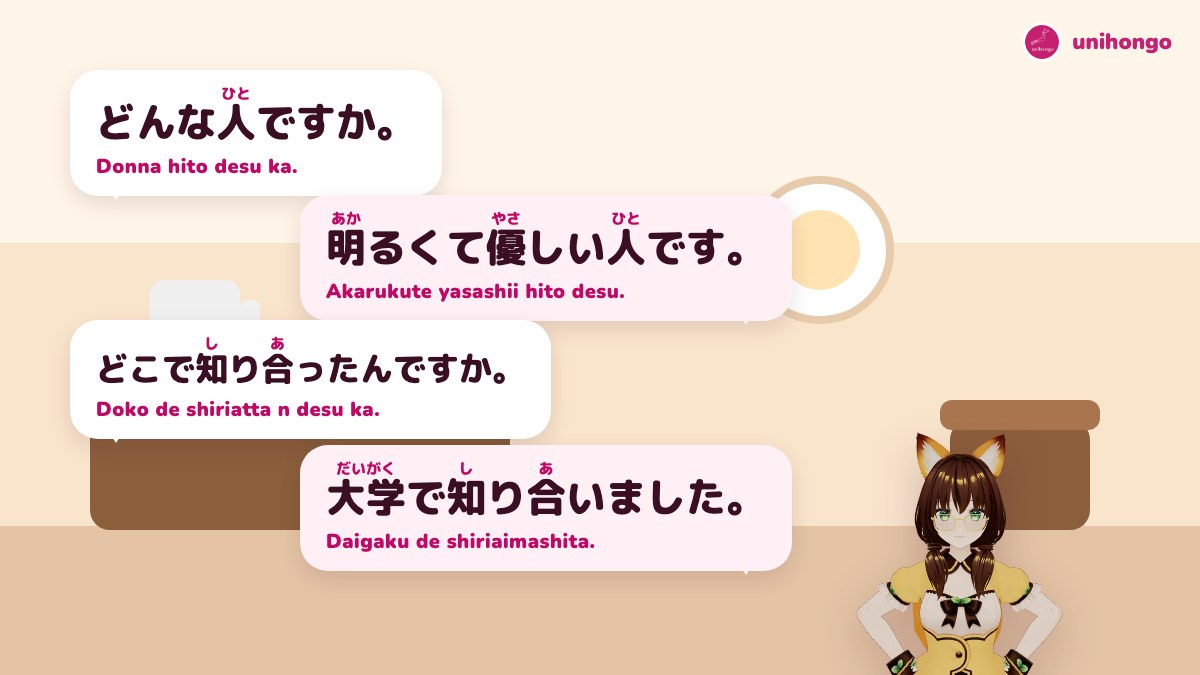
When you describe a friend, the listener will ask whether you are still in touch, what you like about them, and may say they would like to meet them. Urayamashii, I'm envious, is a warm reaction in Japanese, not a sour one. The exchange below is a café conversation between you and a Japanese friend looking at a photo.
| Japanese | Romaji | Meaning |
|---|---|---|
| 今も連絡を取っていますか。 | Ima mo renraku o totte imasu ka. | Friend: Are you still in touch? |
| どんなところが好きですか。 | Donna tokoro ga suki desu ka. | Friend: What do you like about them? |
| いい友達ですね。 | Ii tomodachi desu ne. | Friend: That's a good friend. |
| うらやましいです。 | Urayamashii desu. | Friend: I'm envious, in a nice way. |
| 会ってみたいです。 | Atte mitai desu. | Friend: I'd like to meet them. |
| 今度紹介しますね。 | Kondo shōkai shimasu ne. | You: I'll introduce you sometime. |
Renraku o toru, to keep in contact, is the set phrase; renraku suru is a single act of contacting. Donna tokoro ga suki desu ka, which aspects do you like, is also how people ask about a partner, so expect it.
Mistakes and register notes
- Kanojo wa yasashii desu about a female friend. Listeners may hear my girlfriend is kind. Repeat the name: Ana wa yasashii desu.
- Stating a friend's feelings directly: tomodachi wa sabishii desu. Japanese reports other people's inner states with ~gatte imasu or sō desu: sabishigatte imasu, or sabishii sō desu.
- Calling every friend shin'yū. The word is reserved for one or two people; for others say naka no ii tomodachi, a close friend.
- Using shinsetsu for a friend. It is correct but sounds like a description of a helpful stranger; yasashii is the friend word.
- Describing a friend in full polite form to another close friend. In casual talk, drop desu: akarukute yasashii. Keep desu with a teacher, host family or coworker.
Practise describing people you actually know
The fastest way to own this vocabulary is to describe three real people, not one imaginary friend, because the adjectives change with the person. Ask Mocchi, Unihongo's study assistant, for a short list of personality words with one example sentence each, then try them on your own friends and send the sentences back with /correct; the request below starts that exchange, and Mocchi keeps a note of the adjectives you learn so they come up again in a later /quiz.
When the sentences are right, tell someone: in AI Sensei, ask Hana-sensei to play a new acquaintance who asks about your closest friend, how you met and what you do together, and who reacts with the follow-ups above. Ask her to switch to casual speech halfway through so you hear both registers. Signing up at unihongo.com/login is free and takes a minute.
Your turn: describe your best friend aloud
- Shin'yū wa donna hito desu ka. Two adjectives joined with kute or de.
- Dō yatte shiriatta n desu ka. A place with de shiriaimashita, and roughly when.
- Issho ni nani o shimasu ka. Two activities with tari, and how often with gurai.
- Donna tokoro ga suki desu ka. One trait and one example of it.
- Describe a second friend who is the opposite, using noni.