
Eight friendship proverbs at a glance
The list moves from how friends find each other, through influence and manners, to old friends and former rivals.
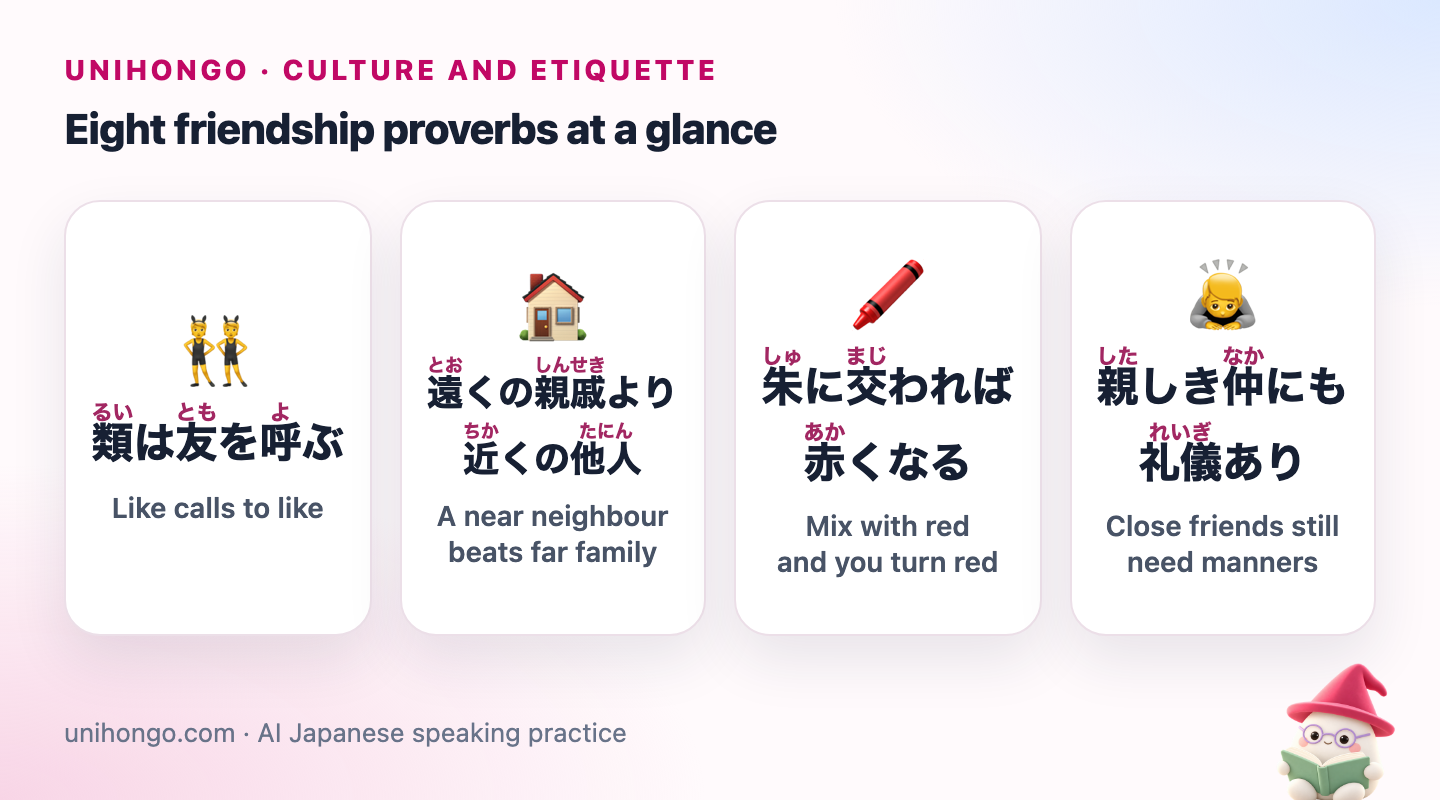
| Japanese | Romaji | Meaning |
|---|---|---|
| 類は友を呼ぶ | Rui wa tomo o yobu | Like calls to like |
| 遠くの親戚より近くの他人 | Tōku no shinseki yori chikaku no tanin | A near neighbour beats far family |
| 朱に交われば赤くなる | Shu ni majiwareba akaku naru | Mix with red and you turn red |
| 親しき仲にも礼儀あり | Shitashiki naka ni mo reigi ari | Close friends still need manners |
| 持つべきものは友 | Motsu beki mono wa tomo | Friends are what you should have |
| 竹馬の友 | chikuba no tomo | A bamboo-stilt friend: childhood friend |
| 昨日の敵は今日の友 | Kinō no teki wa kyō no tomo | Yesterday's enemy, today's friend |
| 魚心あれば水心 | Uogokoro areba mizugokoro | Be kind, and kindness comes back |
類は友を呼ぶ: compliment or dig?
類 means a kind or type, so 類は友を呼ぶ says that a type calls its friends. A group of people who all love trains, all stay up late or all laugh at the same jokes is a perfect example. The proverb itself is neutral; the tone comes from what you are describing.
Said about a group of hard-working, kind people, it is a compliment to everyone in it. Said about a group that is always late, it is a joke at their expense, and if you are part of the group, you are including yourself. Many people use it self-deprecatingly: we are all hopeless at mornings, like calls to like. A related word is 類友 (ruitomo), a casual short form you may see on social media.
| Japanese | Romaji | Meaning |
|---|---|---|
| 類は友を呼ぶって本当だね。 | Rui wa tomo o yobu tte hontō da ne. | It's true that like attracts like. |
| みんなアニメ好きだね。類は友を呼ぶだ。 | Minna anime zuki da ne. Rui wa tomo o yobu da. | Everyone loves anime. Birds of a feather! |
| 私たち、みんな朝が弱いね。 | Watashitachi, minna asa ga yowai ne. | We're all terrible at mornings, aren't we. |
遠くの親戚より近くの他人: neighbours who help
Literally, a stranger nearby is better than a relative far away. When you are sick, locked out or caught in a storm, the neighbour next door can help in minutes, while family in another city or country cannot. People say it after a neighbour has helped them, and in talks about community and disaster preparation, where knowing the people around you can matter a lot.
For anyone who has moved to Japan from abroad, this proverb tends to land with real feeling. It is also a natural, warm thing to say when thanking a neighbour, colleague or local friend for help. The 他人 here is not cold; it simply means someone who is not family.
| Japanese | Romaji | Meaning |
|---|---|---|
| 本当に助かりました。遠くの親戚より近くの他人ですね。 | Hontō ni tasukarimashita. Tōku no shinseki yori chikaku no tanin desu ne. | You really saved me. Neighbours beat far-off family. |
| 何かあったら、いつでも言ってくださいね。 | Nanika attara, itsu demo itte kudasai ne. | Neighbour: If anything happens, just let me know. |
Influence and manners: 朱に交われば赤くなる and 親しき仲にも礼儀あり
朱 is vermilion, the red of shrine gates and ink seals. If you mix with it, you turn red: people take on the habits of the company they keep. Parents and teachers use it as a warning about bad friends, and it often sounds serious. It is less common as praise, though you can use it about a good influence if the context is clear.
親しき仲にも礼儀あり is one of the most practical proverbs in this list. Even among close friends, there is courtesy. It covers returning borrowed things, thanking a friend who treated you, not reading someone's messages over their shoulder and turning up on time. Japanese friendships often keep small courtesies that some cultures drop once people are close, so this is worth remembering.
| Japanese | Romaji | Meaning |
|---|---|---|
| 朱に交われば赤くなるって言うでしょう。 | Shu ni majiwareba akaku naru tte iu deshō. | You know, the company you keep rubs off. |
| 親しき仲にも礼儀ありだよ。ちゃんとお礼を言おう。 | Shitashiki naka ni mo reigi ari da yo. Chanto orei o iō. | Manners matter even with friends. Let's thank them. |
Old friends, true friends and former rivals
持つべきものは友, often followed by だ or だね, means a friend is what you should have. People say it right after a friend has helped them out of a jam: lending a charger, covering a shift, explaining homework. It is warm and slightly playful.
竹馬の友 refers to the bamboo stilts children once played on, so it means a friend from early childhood. In conversation most people say 幼なじみ; 竹馬の友 appears in speeches, wedding toasts and writing. 昨日の敵は今日の友, yesterday's enemy is today's friend, describes rivals who become allies, such as two competing teams merging or two classmates who used to argue and are now close. 魚心あれば水心 means if the fish is friendly to the water, the water will be friendly to the fish: treat people well and they will respond in kind. It can also hint at a give-and-take deal, so the tone depends on context.
| Japanese | Romaji | Meaning |
|---|---|---|
| 持つべきものは友だね。ありがとう! | Motsu beki mono wa tomo da ne. Arigatō! | What would I do without friends? Thanks! |
| 彼とは竹馬の友です。 | Kare to wa chikuba no tomo desu. | He and I have been friends since childhood. (formal) |
| 昨日の敵は今日の友だね。 | Kinō no teki wa kyō no tomo da ne. | Yesterday's rival, today's friend. |
Mini dialogue: meeting a school friend after ten years
At a class reunion, a learner who studied in Japan meets an old classmate. Note the casual register and how the proverb comes as a light comment.
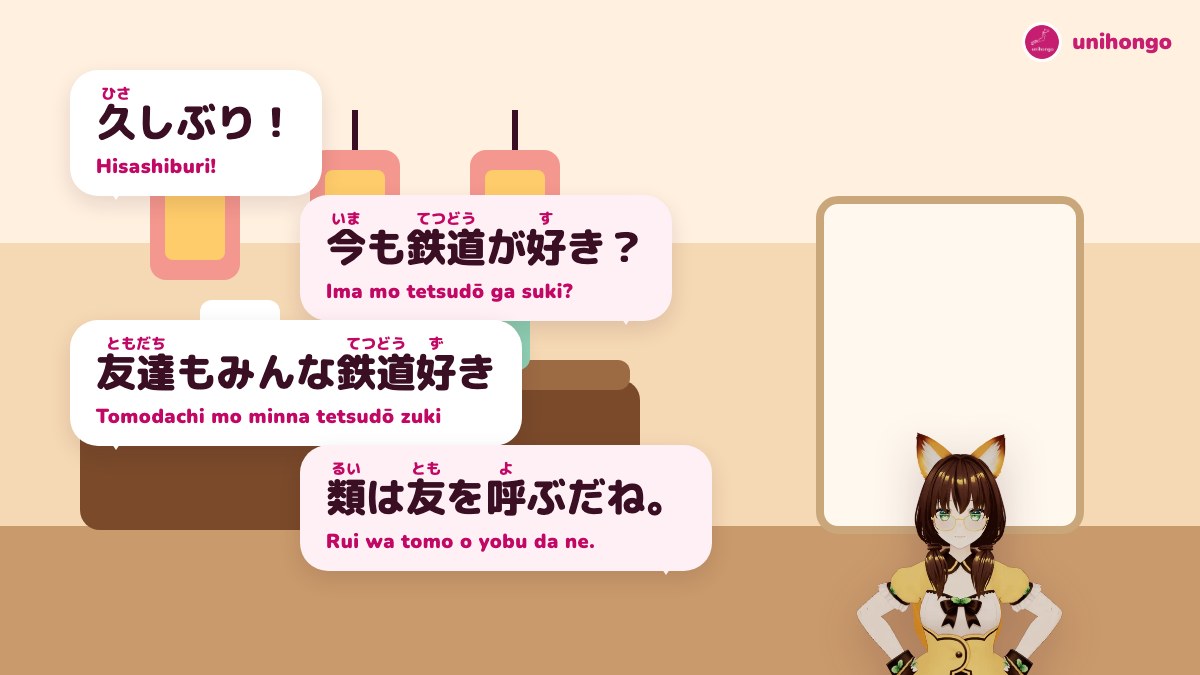
| Japanese | Romaji | Meaning |
|---|---|---|
| 久しぶり!全然変わらないね。 | Hisashiburi! Zenzen kawaranai ne. | Friend: Long time no see! You haven't changed at all. |
| そっちこそ!今も鉄道が好き? | Sotchi koso! Ima mo tetsudō ga suki? | You: Neither have you! Still into trains? |
| うん。友達もみんな鉄道好きになっちゃった。 | Un. Tomodachi mo minna tetsudō zuki ni natchatta. | Friend: Yeah. All my friends are train fans now too. |
| 類は友を呼ぶだね。 | Rui wa tomo o yobu da ne. | You: Birds of a feather, huh. |
| そうそう。また連絡するね。 | Sō sō. Mata renraku suru ne. | Friend: Exactly. I'll get in touch again. |
Which friendship proverb fits?
| Situation | Proverb | Register |
|---|---|---|
| Your friends share your odd hobby | 類は友を呼ぶ | Casual, often playful |
| A neighbour helped you when you were ill | 遠くの親戚より近くの他人 | Warm, any register |
| Warning someone about bad company | 朱に交われば赤くなる | Serious |
| A close friend forgot to say thanks | 親しき仲にも礼儀あり | Gentle reminder |
| A friend just got you out of trouble | 持つべきものは友 | Casual, grateful |
| Speech about a lifelong friend | 竹馬の友 | Formal, written |
A common learner mistake is using 竹馬の友 in casual chat. It is correct but sounds like a speech; say 幼なじみ with friends.
Friendship words you will use more than proverbs
Proverbs describe friendship from the outside. To talk about your own friends, you need the everyday words, and some of them carry nuances that English lacks.
親友 is a best or very close friend; Japanese speakers tend to use it for one or two people, so calling a new acquaintance 親友 can feel too much. 幼なじみ is a childhood friend, the spoken version of 竹馬の友. 仲がいい means getting on well, and 気が合う means your personalities click, which is often the first step towards 類は友を呼ぶ. 腐れ縁, literally a rotten bond, is a humorous word for a relationship you cannot seem to escape: a friend you have argued with for twenty years and still see every month. It sounds negative but is usually said with affection.
Finally, 友達 can be pluralised with たち, but for a group of friends people also say 仲間, companions or teammates, which suggests a shared activity or goal. 同じ釜の飯を食った仲間, comrades who ate from the same pot, joins the two ideas.
| Japanese | Romaji | Meaning |
|---|---|---|
| 彼女は大学時代からの親友です。 | Kanojo wa daigaku jidai kara no shin'yū desu. | She's been my best friend since university. |
| 私たち、なんか気が合うね。 | Watashitachi, nanka ki ga au ne. | We just click, don't we. |
| あいつとは腐れ縁なんだ。 | Aitsu to wa kusareen nan da. | He and I just can't shake each other off. (affectionate) |
| サークルの仲間と旅行に行きます。 | Sākuru no nakama to ryokō ni ikimasu. | I'm going on a trip with my club friends. |
Bring these proverbs to a reunion
Proverbs about friends shine in small talk, so practise them as small talk. Ask Mocchi to explain the difference between 幼なじみ and 竹馬の友 with /explain, then have Mocchi turn the table above into flashcards with /create-flashcards so you review them with spaced repetition.
For the speaking side, choose Hana-sensei in AI Sensei and ask Hana-sensei to play an old classmate at a reunion, in casual Japanese. Catch up on ten years of news, use one proverb when it fits, and read the session report for any slips in register.