
Kyoto speech in four phrases
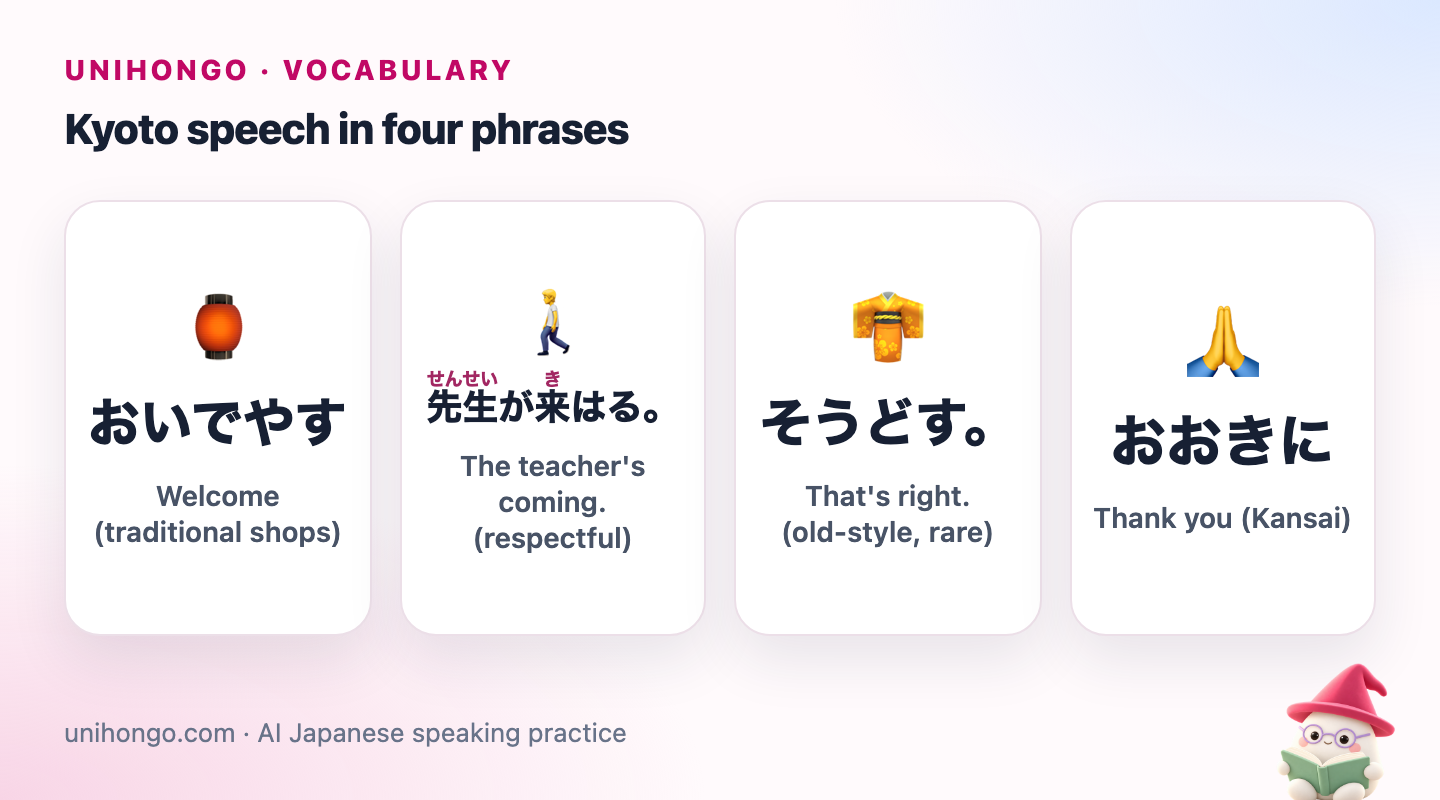
These four lines cover what a visitor or new resident notices first. Oide yasu greets you at the door of a traditional shop. Kiharu shows the soft honorific haru, which you will hear constantly. Sō dosu is the old-style that's right, now rare outside the geiko districts. Ōkini, thank you, is shared with Osaka.
| Japanese | Romaji | Meaning |
|---|---|---|
| おいでやす | oide yasu | Welcome (traditional shops) |
| 先生が来はる。 | Sensei ga kiharu. | The teacher's coming. (respectful) |
| そうどす。 | Sō dosu. | That's right. (old-style, rare) |
| おおきに | ōkini | Thank you (Kansai) |
| Kyoto | Standard | Today |
|---|---|---|
| oide yasu (おいでやす) | irasshaimase (いらっしゃいませ) | Traditional shops, inns, signs |
| kiharu (来はる) | korareru / irassharu (来られる / いらっしゃる) | Everyday, all ages |
| sō dosu (そうどす) | sō desu (そうです) | Rare: geiko, maiko, older people, period dramas |
| ōkini (おおきに) | arigatō (ありがとう) | Older speakers and shops |
Welcomes and replies at a traditional shop
Old Kyoto businesses, such as sweet shops, tea merchants, pickle shops and inns, sometimes greet customers in Kyō kotoba. Large chains and department stores normally use standard service Japanese. Whatever greeting you hear, a polite standard reply is always right; you do not need to answer in dialect.
| Japanese | Romaji | Meaning |
|---|---|---|
| おいでやす。 | Oide yasu. | Staff: Welcome. (standard: irasshaimase) |
| おこしやす。 | Okoshi yasu. | Staff: Welcome, thank you for coming. (more respectful; standard: yōkoso irasshaimashita) |
| こんにちは。見せてもらってもいいですか。 | Konnichiwa. Misete moratte mo ii desu ka. | You: Hello. May I have a look around? |
| どうぞ、ゆっくり見ておくれやす。 | Dōzo, yukkuri mite okure yasu. | Staff: Please, take your time. (traditional; standard: yukkuri goran kudasai) |
| おおきに。またおこしやす。 | Ōkini. Mata okoshi yasu. | Staff: Thank you. Please come again. (standard: mata okoshi kudasai) |
The everyday star: the honorific haru
If you learn only one Kyoto feature, make it haru. It attaches to verbs to show light respect for the person doing the action, a little like the -rareru honorific in standard Japanese, but much more common and much less stiff. Kyoto speakers often use it for teachers, customers, neighbours, strangers, family members when talking to outsiders and, half-jokingly, even for animals. They never use it about themselves.
Kyoto speakers usually attach haru to the -masu stem: iki-haru, they go; ii-haru, they say. In Osaka you also hear the a-form, ika-haru. The negative and past are simple: ikiharahen, they don't go; ittehatta, they went or they were going.
| Japanese | Romaji | Meaning |
|---|---|---|
| 先生、もう帰りはった? | Sensei, mō kaerihatta? | Has the teacher gone home yet? (standard: sensei wa mō kaerareta?) |
| お隣さんがそう言うてはったわ。 | Otonari san ga sō yūte hatta wa. | The neighbour was saying so. (standard: otonari san ga sō itte ita yo) |
| お客さん、何人来はるの? | Okyakusan, nannin kiharu no? | How many guests are coming? (standard: okyakusan wa nannin irassharu no?) |
| あの人、いつも笑ってはるね。 | Ano hito, itsumo waratte haru ne. | That person is always smiling. (standard: itsumo waratte iru ne) |
Notice the last example: haru here adds softness rather than formal respect. That is why textbook keigo rules do not fit it neatly. For a learner, the main thing is to recognise that kiharu, ittehatta and so on are about someone else, not about the speaker.
Negatives, apologies and soft words
Kyoto shares the Kansai negative -hen, but a few verbs have their own shape. The best-known contrast is with kuru, to come: Kyoto speakers tend to say kiihin, Osaka speakers keehen, while both understand each other perfectly. Apologies and requests often sound gentle and drawn out.
| Japanese | Romaji | Meaning |
|---|---|---|
| 今日は来いひんの? | Kyō wa kiihin no? | Aren't you coming today? (Kyoto; standard: kyō wa konai no?) |
| 今日はけえへんの? | Kyō wa keehen no? | Aren't you coming today? (Osaka; standard: kyō wa konai no?) |
| かんにんな。 | Kannin na. | Sorry, forgive me. (soft, somewhat older; standard: gomen ne) |
| ほな、おきばりやす。 | Hona, okibari yasu. | Well then, do your best. (traditional; standard: jā, ganbatte kudasai) |
| はんなりした色やね。 | Hannari shita iro ya ne. | What an elegant, gentle colour. (standard: jōhin de yawarakai iro da ne) |
Food words with -san
Kyoto speakers, especially older ones, are known for adding the polite -san or o- to familiar foods and things, which gives everyday speech a warm, homely feel. You will not need to use these, but you may hear them in a home, a cooking class or from an older shopkeeper.
| Japanese | Romaji | Meaning |
|---|---|---|
| お豆さん | omame san | Beans (affectionate; standard: mame) |
| おいもさん | oimo san | Potatoes or sweet potatoes (affectionate; standard: imo) |
| おかいさん | okai san | Rice porridge (older Kyoto; standard: okayu) |
| お揚げさん | oage san | Fried tofu (affectionate; standard: abura age) |
Everyday, older or mainly on stage?
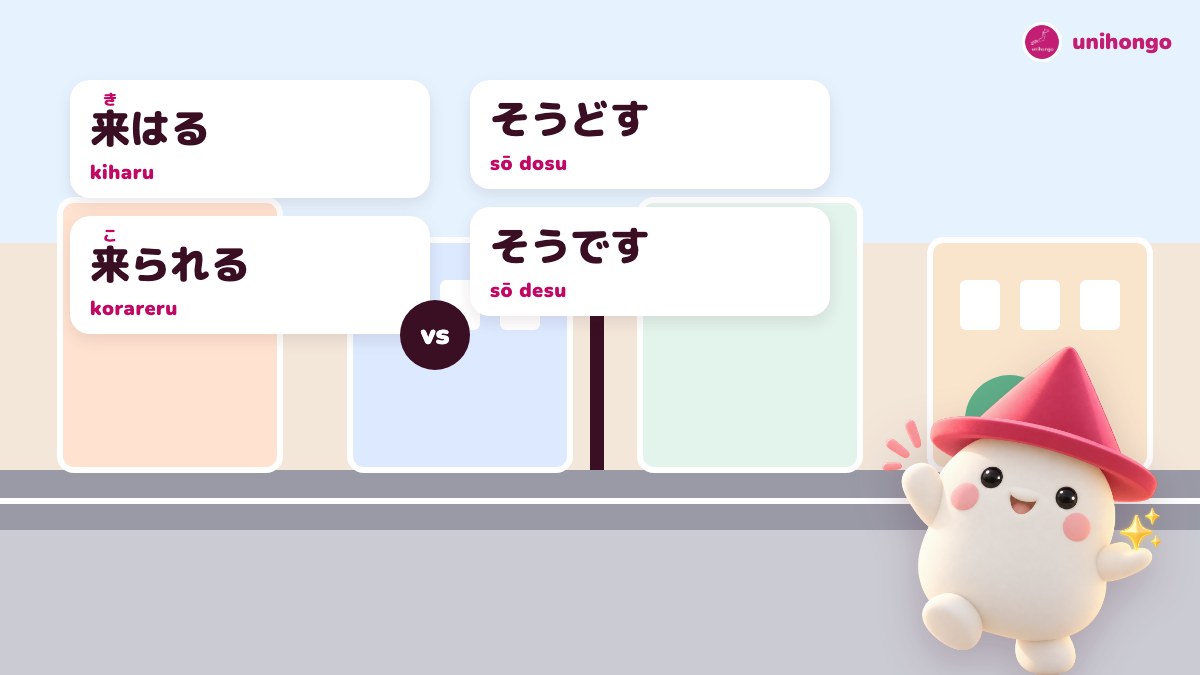
Learners often meet Kyoto dialect first in manga or historical dramas, where it is written in its most traditional form. Real speech today is much closer to general Kansai-ben. Use this comparison to place what you hear.
| Japanese | Romaji | Meaning |
|---|---|---|
| ええどすえ。 | Ee dosu e. | That's fine, you know. (stage Kyoto, very rare; standard: ii desu yo) |
| ええよ。 | Ee yo. | That's fine. (everyday Kansai; standard: ii yo) |
| Form | Standard | How common today |
|---|---|---|
| -haru (来はる) | korareru (来られる) | Very common, all ages |
| -hen / -hin (行かへん, 来いひん) | -nai (行かない, 来ない) | Very common |
| ōkini (おおきに) | arigatō (ありがとう) | Older speakers, shops |
| oide yasu (おいでやす) | irasshaimase (いらっしゃいませ) | Traditional businesses, signs |
| kannin na (かんにんな) | gomen ne (ごめんね) | Older, soft; some younger speakers |
| dosu (どす) | desu (です) | Rare: geiko and maiko, period dramas |
| -dosu e (どすえ) | desu yo (ですよ) | Very rare outside the stage |
Kyoto indirectness: the jokes and the reality
Japanese people often joke that Kyoto speech hides meanings. The most famous example is bubuzuke: a host who says won't you have some rice with tea? supposedly means it is time you went home. Other jokes claim that praising a neighbour's piano playing means it is too loud. These stories are widely told, including by Kyoto people about themselves, but they are humour and stereotype, not a rulebook. Real Kyoto people differ as much as people anywhere.
What is true is that Kyoto speech often prefers soft, roundabout ways of saying no, which is common in Japanese generally. If a reply sounds vague, it may simply be polite hesitation. As a guest, read the situation, thank your host and leave at a natural time, as you would anywhere.
| Japanese | Romaji | Meaning |
|---|---|---|
| ぶぶ漬けでもどうどす? | Bubuzuke demo dō dosu? | How about some rice with tea? (the famous joke line; standard: ochazuke demo dō desu ka) |
| そろそろ失礼します。 | Sorosoro shitsurei shimasu. | I'd better be going soon. (polite standard) |
Keep the Kyoto forms straight
The tricky part of Kyoto speech is not vocabulary but placing each form: is it everyday, older or something from a period drama? Ask Mocchi to explain the haru honorific with /grammar はる and then to quiz you on five sentences, telling you each time whether the person is the speaker or someone else. Mocchi keeps a note of the forms you mixed up and brings them back in later reviews.
For words such as oide yasu, kannin na and omame san, type /create-flashcards with a photo you choose for each, then play Flashcard Flip on the games page using your own cards, so the Kyoto words and their standard equivalents sit side by side in your memory.