
How to run the check
You need someone to read the lines below, or audio you have not seen the text of. Your partner reads each line once at natural speed. You say what you understood in English, and only then ask for a repeat if needed. Count how many repeats you needed in each stage.
Natural speed matters. A partner who is trying to help will often slow down and pronounce every syllable, which turns the check into a test of slow, clear Japanese. Ask them to speak as they would to a Japanese friend or a customer. If they find that hard, ask them to read each line twice silently first, then once aloud without slowing down.
Keep a simple score sheet: the stage number, the line, a tick if you caught it first time, and a mark for each repeat. You will reuse it in two or three months to compare.
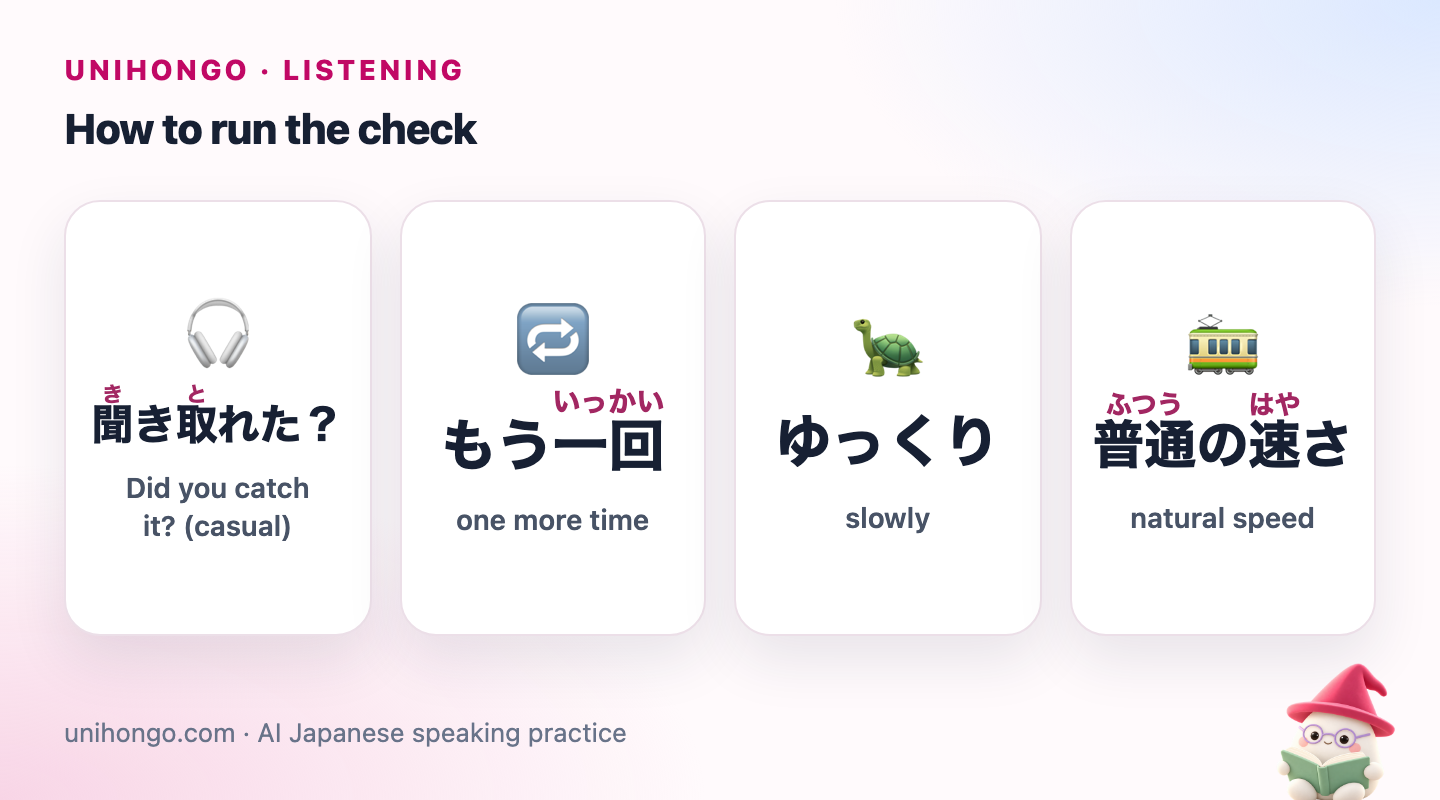
The four expressions below are the whole toolkit: the question you are answering, how to ask for one more time, how to ask for it slowly, and the speed you are aiming for.
| Japanese | Romaji | Meaning |
|---|---|---|
| 聞き取れた? | Kikitoreta? | Did you catch it? (casual) |
| もう一回 | mō ikkai | one more time |
| ゆっくり | yukkuri | slowly |
| 普通の速さ | futsū no hayasa | natural speed |
| もう一回お願いします。 | Mō ikkai onegai shimasu. | Once more, please. |
| もう少しゆっくりお願いします。 | Mō sukoshi yukkuri onegai shimasu. | A little more slowly, please. |
Stages 1 and 2: polite questions, numbers and times
Stage 1 is slow, clear, polite Japanese with words every beginner knows. If you miss these, focus on basic vocabulary by ear before anything else. Stage 2 adds numbers and times at natural speed, which is where a surprising number of learners stall even at intermediate level.
| Japanese | Romaji | Meaning |
|---|---|---|
| すみません、今何時ですか。 | Sumimasen, ima nanji desu ka. | Stage 1: Excuse me, what time is it now? |
| これはいくらですか。 | Kore wa ikura desu ka. | Stage 1: How much is this? |
| トイレはあちらです。 | Toire wa achira desu. | Stage 1: The toilet is over there. |
| 次の電車は八時十五分発です。 | Tsugi no densha wa hachiji jūgofun hatsu desu. | Stage 2: The next train leaves at 8:15. |
| 全部で二千八百円です。 | Zenbu de nisen happyaku en desu. | Stage 2: That's 2,800 yen altogether. |
| 予約は六日の三時でよろしいですか。 | Yoyaku wa muika no sanji de yoroshii desu ka. | Stage 2: Is your booking for three o'clock on the sixth correct? |
Stage 3: casual speech and contractions
Stage 3 is how friends talk: plain forms, dropped particles and contractions. Te shimatta becomes chatta, te iru becomes teru, and to itte ita becomes tte. Many learners who studied only polite Japanese hit their first wall here.
| Japanese | Romaji | Meaning |
|---|---|---|
| 昨日、財布忘れちゃってさ。 | Kinō, saifu wasurechatte sa. | Friend: I forgot my wallet yesterday, you see. |
| もう食べてる? | Mō tabeteru? | Friend: Are you eating already? |
| 明日は行けないって。 | Ashita wa ikenai tte. | Friend: They say they can't come tomorrow. |
| それ、どこで買ったの? | Sore, doko de katta no? | Friend: Where did you buy that? |
Notice the dropped particle in saifu wasurechatte: saifu o has lost its o. In casual speech this is normal, and if you wait for the particle you will lose the sentence.
Sentence-final particles are another stage 3 marker. Sa, ne, yo and no carry feeling rather than meaning: sa softens and invites the listener to keep listening, and a rising no turns a statement into a casual question. If you catch the words but miss whether the line was a question, listen again for the final sound and its intonation.
Stage 4: announcements and polite service language
Stage 4 is the Japanese you hear in stations, shops and offices: fixed announcement phrases and respectful or humble verbs such as mairimasu (comes, humble style used in announcements) and itadakemasu ka. The words are often long, but the phrases repeat, so learning them as whole blocks helps more than parsing them.
Real announcements add noise, echo and a fast, even delivery, which is why many learners who pass stage 3 in a quiet room still struggle on a platform. If you live in Japan, use your commute as practice: pick one announcement a week, write down what you hear, and check it with a Japanese friend or by looking up the standard wording.
| Japanese | Romaji | Meaning |
|---|---|---|
| まもなく二番線に電車がまいります。 | Mamonaku nibansen ni densha ga mairimasu. | Stage 4: A train will soon arrive at platform 2. |
| 黄色い線の内側までお下がりください。 | Kiiroi sen no uchigawa made osagari kudasai. | Stage 4: Please stand behind the yellow line. |
| 少々お待ちいただけますか。 | Shōshō omachi itadakemasu ka. | Stage 4: Could you wait a moment, please? |
| ポイントカードはお持ちですか。 | Pointo kādo wa omochi desu ka. | Stage 4: Do you have a points card? |
Stage 5: what people mean, not just what they say
The last stage is not about speed but about meaning. Japanese speakers often avoid a direct no, and a sentence that sounds positive can be a polite refusal. Understanding these depends on context and tone, and usage varies between people, so treat the meanings below as common readings, not rules.
| Japanese | Romaji | Meaning |
|---|---|---|
| 行けたら行くね。 | Iketara iku ne. | Stage 5: I'll come if I can. (often means probably not) |
| 今日はちょっと… | Kyō wa chotto… | Stage 5: Today's a bit… (a soft no) |
| ちょっと考えさせてください。 | Chotto kangaesasete kudasai. | Stage 5: Let me think about it. (can be a polite no) |
| 検討させていただきます。 | Kentō sasete itadakimasu. | Stage 5: We will consider it. (business; often not a yes) |
Scoring your check and what to do next
Count the repeats you needed in each stage. Your listening level is the last stage you passed with no more than one repeat; your edge is the next one.
| Edge stage | What to practise for the next month |
|---|---|
| Stage 1 | Basic words by ear: greetings, numbers to 100, common questions, with audio every day |
| Stage 2 | Prices, times and dates read at speed; write digits as you listen |
| Stage 3 | Conversations between friends; learn chau, teru, tte and dropped particles |
| Stage 4 | Station announcements and shop phrases; shadow them as whole blocks |
| Stage 5 | Long natural conversations, dramas and podcasts; discuss what speakers meant |
Common listening-check mistakes
- Reading the lines before the test. Once you have seen the text, you are testing memory, not listening.
- Letting the partner slow down. The check is at natural speed; use slow speech for practice afterwards.
- Counting a line as caught when you got the topic but not the detail. If the line was a time, you need the time.
- Skipping stage 2 because the words are easy. Numbers at speed are a separate skill.
- Testing only with one voice. Male and female voices, young and older speakers and different speeds all sound different; vary them when you can.
Run the check again with Unihongo
Ask Mocchi for new test lines at your edge, for example: write ten casual lines with contractions for a stage 3 listening check, with a transcript I can hide. Mocchi writes them at your level and can explain any line you missed afterwards with /explain.
If you have no one to read the lines, use AI Sensei as your partner. Ask Sakura-sensei to chat with you in casual Japanese about your weekend at natural speed, and to repeat a line more slowly only when you ask. You hear real stage 3 speech, and the session report lists the vocabulary you met.