
Four lines every first meeting uses
Most first conversations in Japanese pass through these four lines. Two are greetings that open and close, and two are the questions people ask almost every time.
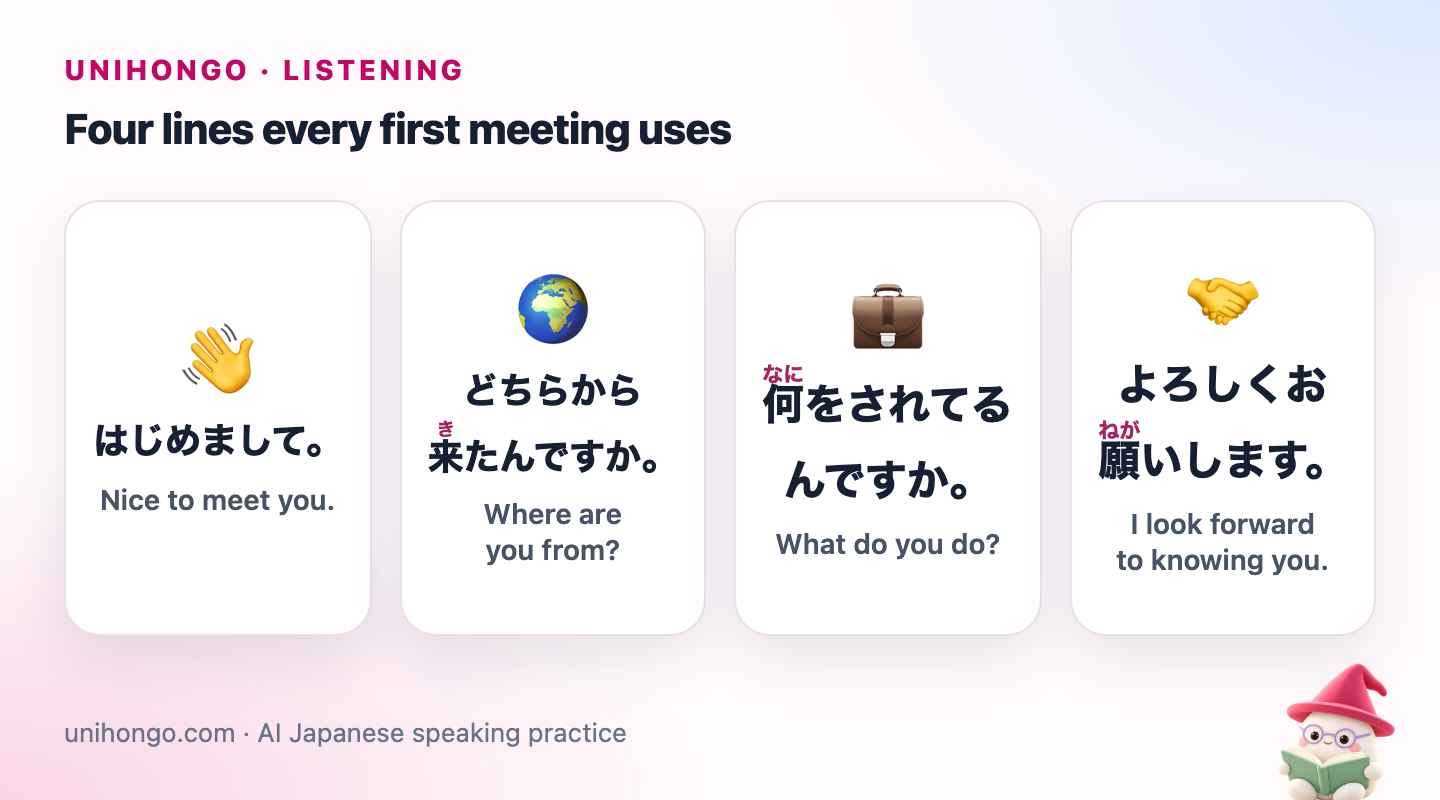
| Japanese | Romaji | Meaning |
|---|---|---|
| はじめまして。 | Hajimemashite. | Nice to meet you. |
| どちらから来たんですか。 | Dochira kara kita n desu ka. | Where are you from? |
| 何をされてるんですか。 | Nani o sareteru n desu ka. | What do you do? |
| よろしくお願いします。 | Yoroshiku onegai shimasu. | I look forward to knowing you. |
よろしくお願いします has no neat English equivalent. At a first meeting it means roughly I hope we get along, and it is the natural way to close an introduction.
The script: at Yūta's house party
Alex, a learner from Canada, meets Mika at a friend's party. They are of similar age, so they speak polite Japanese with casual touches. Read it through once, then read Mika's lines only and answer as yourself.
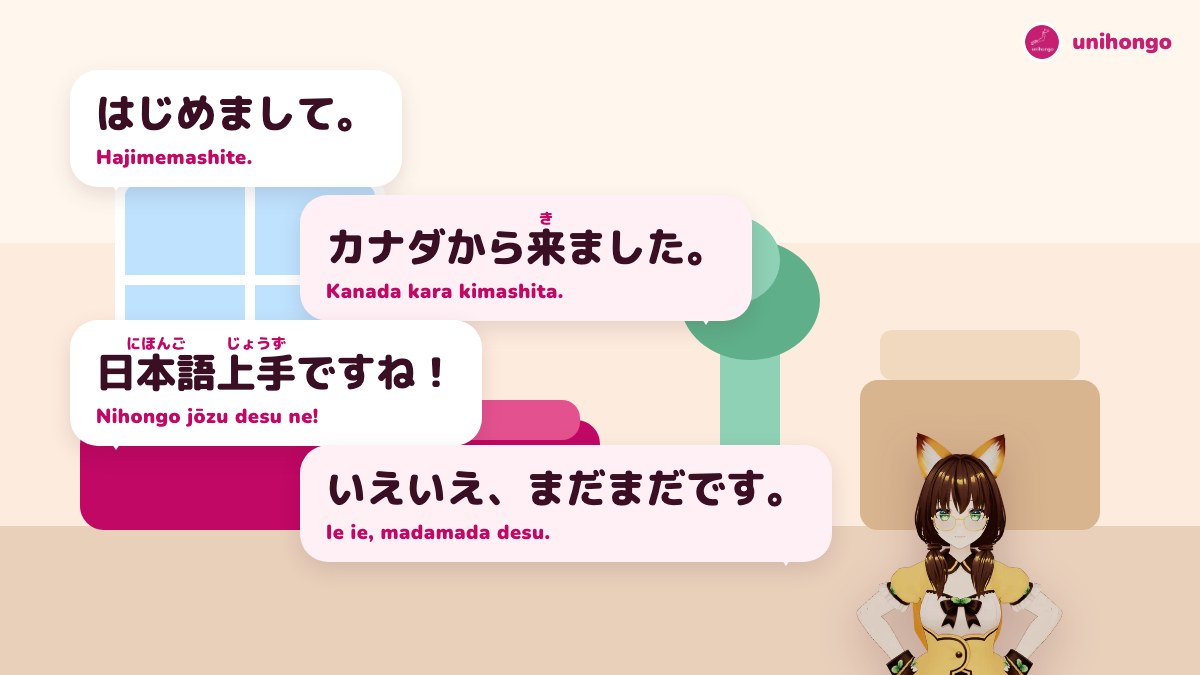
| Japanese | Romaji | Meaning |
|---|---|---|
| こんばんは。はじめまして、みかです。 | Konbanwa. Hajimemashite, Mika desu. | Mika: Good evening. Nice to meet you, I'm Mika. |
| はじめまして、アレックスです。 | Hajimemashite, Arekkusu desu. | You: Nice to meet you, I'm Alex. |
| ゆうたくんのお友達ですか。 | Yūta kun no otomodachi desu ka. | Mika: Are you a friend of Yūta's? |
| はい、大学の時の友達なんです。みかさんは? | Hai, daigaku no toki no tomodachi nan desu. Mika san wa? | You: Yes, we were friends at university. And you, Mika? |
| 私はゆうたくんと同じ会社で働いてます。 | Watashi wa Yūta kun to onaji kaisha de hataraitemasu. | Mika: I work at the same company as Yūta. |
| アレックスさんは、どちらから来たんですか。 | Arekkusu san wa, dochira kara kita n desu ka. | Mika: Where are you from, Alex? |
| カナダから来ました。日本に来て、まだ半年なんです。 | Kanada kara kimashita. Nihon ni kite, mada hantoshi nan desu. | You: I'm from Canada. I've only been in Japan six months. |
| えー、日本語上手ですね! | Ē, nihongo jōzu desu ne! | Mika: Wow, your Japanese is good! |
| いえいえ、まだまだです。 | Ie ie, madamada desu. | You: Oh no, I've still got a long way to go. |
| 今は何をされてるんですか。 | Ima wa nani o sareteru n desu ka. | Mika: What are you doing now? |
| 英語の先生をしています。週末はよく山に登ってます。 | Eigo no sensei o shite imasu. Shūmatsu wa yoku yama ni nobottemasu. | You: I teach English. At weekends I often go hiking in the mountains. |
| へえ、いいですね。私も最近、高尾山に行きました。 | Hē, ii desu ne. Watashi mo saikin, Takaosan ni ikimashita. | Mika: Oh, nice. I went to Mount Takao recently too. |
| 本当ですか。じゃあ今度、一緒に行きましょうよ。 | Hontō desu ka. Jā kondo, issho ni ikimashō yo. | You: Really? Then let's go together sometime. |
| ぜひぜひ。あ、LINE交換しませんか。 | Zehi zehi. A, rain kōkan shimasen ka. | Mika: I'd love to. Oh, shall we swap LINE? |
| はい、ぜひ。よろしくお願いします。 | Hai, zehi. Yoroshiku onegai shimasu. | You: Yes, sure. Great to meet you. |
What to listen for
First meetings are full of explanation. Both speakers keep adding background, and Japanese marks that background with んです and なんです. 友達なんです is not just we are friends; it is the explanation, we are friends, you see. Hearing ん before です tells you the speaker is giving context or asking for it.
The questions use soft honorific forms. されてる is the honorific される with the casual ending てる, a common mix in friendly polite speech. どちらから is a softer どこから. Both show respect without stiffness.
- Aizuchi carry feeling: へえ shows interest, えー shows surprise, ぜひぜひ shows real enthusiasm. A long, rising えー is surprise, not hesitation.
- 働いてます and 登ってます drop the い of います. This is normal in polite speech at the speed of conversation.
- Name endings matter: ゆうたくん is friendly and used for men and boys you know well; みかさん is the safe default. Use さん for anyone you have just met.
- 日本に来て、まだ半年 uses the て-form to mean since I came. Listen for the time word after it: 半年, 一年, 三か月.
- Notice that people rarely say あなた. They use the person's name plus さん, as in アレックスさんは.
Common first-meeting mistakes
| Japanese | Romaji | Meaning |
|---|---|---|
| ありがとうございます。頑張っています。 | Arigatō gozaimasu. Ganbatte imasu. | You: Thank you. I'm working on it. |
| みかさんは、どちらにお住まいですか。 | Mika san wa, dochira ni osumai desu ka. | You: Where do you live, Mika? (polite) |
| 日本は何がきっかけで? | Nihon wa nani ga kikkake de? | Mika: What got you interested in Japan? |
- Calling yourself さん: アレックスさんです sounds odd. Never add さん to your own name.
- Using あなた to address someone. It can sound distant or even cold; use the name with さん instead.
- Accepting a compliment with a flat はい. It can sound as if you agree that you are great. Go with いえいえ or a thank-you plus 頑張っています.
- Answering only with facts. One fact plus one short question back, such as みかさんは?, keeps the conversation balanced.
- Jumping to casual speech too soon. Follow the other person: if they switch to casual Japanese, you can switch too.
A three-pass listening routine
- Pass 1, the profile: listen without the text and fill in a profile card for each person: name, link to the host, home, work, hobby.
- Pass 2, the aizuchi: listen again and note every reaction word (えー, へえ, ぜひぜひ) and what triggered it.
- Pass 3, the explanation forms: read along and underline every んです and なんです. Ask yourself what background each one adds.
- Next day, listen to Mika's lines only and answer with your own real details, not Alex's.
Any natural recording works for this routine. If a Japanese-speaking friend can read Mika's part, ask them to add their own aizuchi; real speakers rarely read lines exactly as written, and that is good practice.
Another useful variation is to listen with a specific goal for each speaker: in one pass follow only Mika, in the next only Alex. Following one voice at a time is how you will listen in a noisy room, where you can only catch the person in front of you.
Shadowing the rhythm of a conversation
Shadow your own lines first, especially the answer and question back pattern: 大学の時の友達なんです。みかさんは? The second part rises and is short. Practise it until the switch from answer to question feels natural.
Then shadow Mika's reactions. えー and へえ are easy to say but hard to say naturally; copy their length and pitch. A flat へえ can sound bored, while a warm, rising one shows interest.
Finally, shadow the compliment exchange as a pair: えー、日本語上手ですね! followed at once by いえいえ、まだまだです. The reply should come quickly and lightly, with a small smile in the voice; a long pause before it can sound as if you are taking the compliment too seriously. Repeat the pair until the reply feels automatic, because you are likely to hear this compliment at almost every party.
Variations: more formal, more casual
At a work event or with someone clearly older, the same conversation becomes more formal. With other students or younger people, it often turns casual within a few minutes.
| Japanese | Romaji | Meaning |
|---|---|---|
| はじめまして。カナダから参りました、アレックスと申します。 | Hajimemashite. Kanada kara mairimashita, Arekkusu to mōshimasu. | You: How do you do. I'm Alex, from Canada. (formal, humble) |
| どうぞよろしくお願いいたします。 | Dōzo yoroshiku onegai itashimasu. | You: I look forward to working with you. (formal) |
| ゆうたの友達? | Yūta no tomodachi? | Student: You're Yūta's friend? (casual) |
| うん、大学の時の。よろしくね。 | Un, daigaku no toki no. Yoroshiku ne. | You: Yeah, from university. Nice to meet you. (casual) |
Rehearse your introduction with a partner
Write your own fifteen-line version of this party conversation and give it to Mocchi with /correct. Mocchi corrects it, explains why a line sounds stiff or too casual, and remembers your details, such as where you live and what you do, so later practice builds on them.
Then try it with a live voice: in AI Sensei, ask Yamada-sensei to play a guest at a house party who asks follow-up questions and compliments your Japanese, so you practise the modest replies too.