
Four lines at any office reception
One line is yours and three are the receptionist's. Together they make up the core of most company visits, whether the reception has a person, a phone or a tablet.
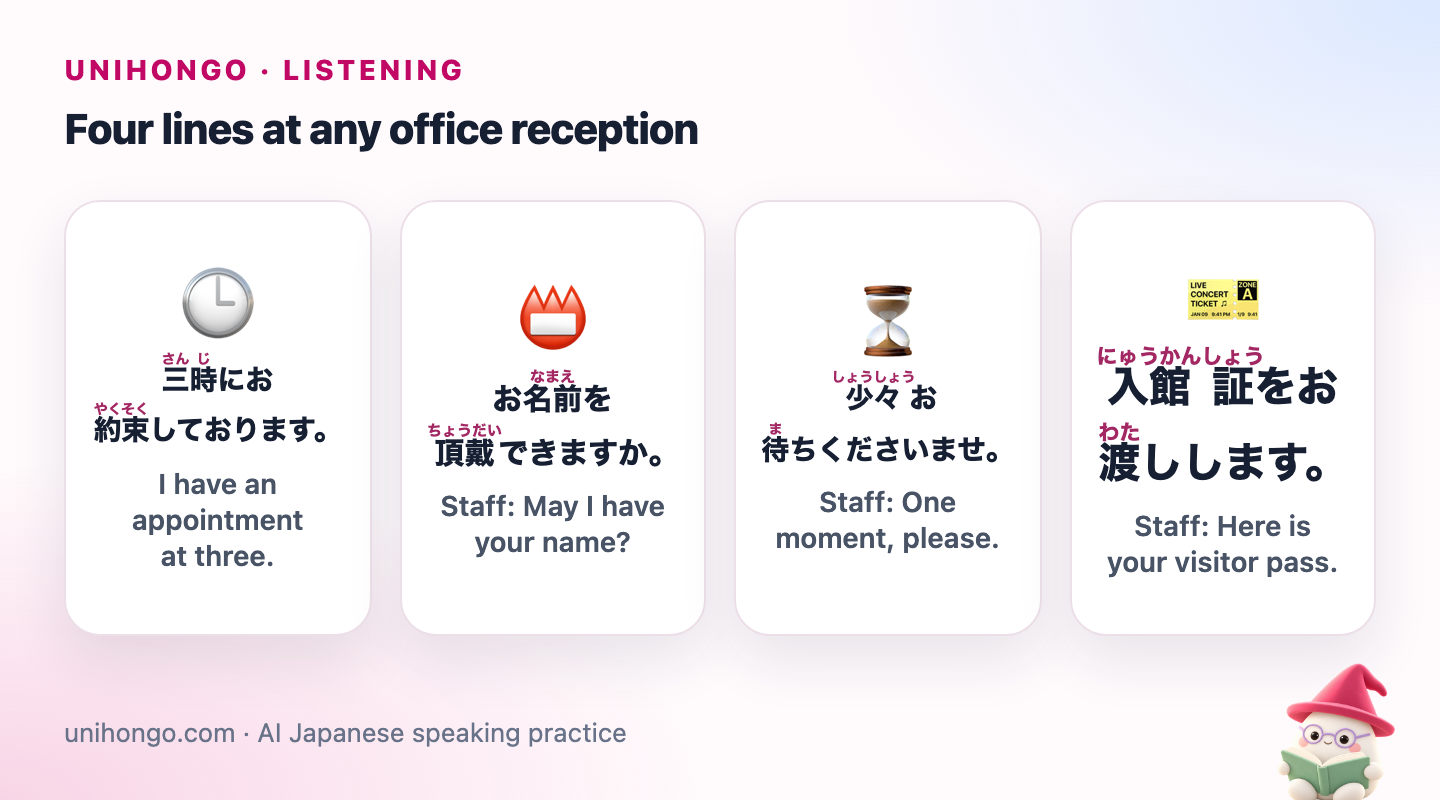
| Japanese | Romaji | Meaning |
|---|---|---|
| 三時にお約束しております。 | Sanji ni oyakusoku shite orimasu. | I have an appointment at three. |
| お名前を頂戴できますか。 | Onamae o chōdai dekimasu ka. | Staff: May I have your name? |
| 少々お待ちくださいませ。 | Shōshō omachi kudasaimase. | Staff: One moment, please. |
| 入館証をお渡しします。 | Nyūkanshō o owatashi shimasu. | Staff: Here is your visitor pass. |
The script: a three o'clock meeting
Ms Lee from Sakura Trading, a fictional company, arrives for a meeting with Mr Satō in the sales department. The receptionist follows a typical routine, and Mr Satō comes down to collect her. Read the script once, then reread the receptionist's lines and turn each into plain Japanese.
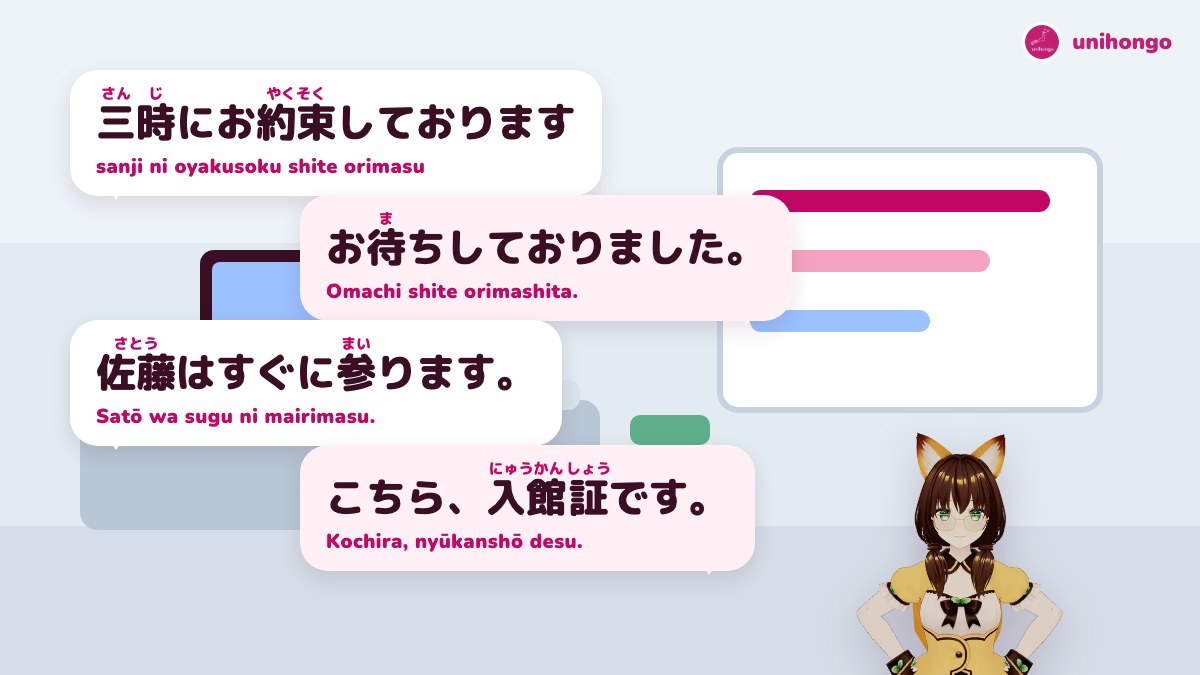
| Japanese | Romaji | Meaning |
|---|---|---|
| いらっしゃいませ。 | Irasshaimase. | Receptionist: Welcome. |
| お世話になっております。さくら商事のリーと申します。 | Osewa ni natte orimasu. Sakura shōji no Rī to mōshimasu. | You: Thank you for your support. I'm Lee from Sakura Trading. |
| 営業部の佐藤様と、三時にお約束をしております。 | Eigyōbu no Satō sama to, sanji ni oyakusoku o shite orimasu. | You: I have a three o'clock appointment with Mr Satō in Sales. |
| さくら商事のリー様ですね。お待ちしておりました。 | Sakura shōji no Rī sama desu ne. Omachi shite orimashita. | Receptionist: Ms Lee from Sakura Trading. We've been expecting you. |
| 恐れ入りますが、こちらにお名前とご所属をご記入いただけますか。 | Osoreirimasu ga, kochira ni onamae to goshozoku o gokinyū itadakemasu ka. | Receptionist: Sorry to trouble you, could you write your name and company here? |
| はい、わかりました。 | Hai, wakarimashita. | You: Yes, of course. |
| ありがとうございます。ただいま佐藤に確認いたしますので、少々お待ちくださいませ。 | Arigatō gozaimasu. Tadaima Satō ni kakunin itashimasu node, shōshō omachi kudasaimase. | Receptionist: Thank you. I'll check with Satō now, so please wait a moment. |
| 受付です。さくら商事のリー様がお見えです。 | Uketsuke desu. Sakura shōji no Rī sama ga omie desu. | Receptionist (on the phone): Reception here. Ms Lee from Sakura Trading has arrived. |
| お待たせいたしました。佐藤はすぐに参ります。 | Omatase itashimashita. Satō wa sugu ni mairimasu. | Receptionist: Thank you for waiting. Satō will be right down. |
| こちら、入館証です。お帰りの際にご返却ください。 | Kochira, nyūkanshō desu. Okaeri no sai ni gohenkyaku kudasai. | Receptionist: Here is your visitor pass. Please return it when you leave. |
| あちらのソファにおかけになってお待ちください。 | Achira no sofa ni okake ni natte omachi kudasai. | Receptionist: Please have a seat on the sofa over there. |
| ありがとうございます。 | Arigatō gozaimasu. | You: Thank you. |
| リーさん、お待たせしました。本日はお越しいただき、ありがとうございます。 | Rī san, omatase shimashita. Honjitsu wa okoshi itadaki, arigatō gozaimasu. | Mr Satō: Ms Lee, sorry to keep you waiting. Thank you for coming today. |
| こちらこそ、お時間をいただき、ありがとうございます。 | Kochira koso, ojikan o itadaki, arigatō gozaimasu. | You: Thank you for your time. |
| では、会議室へご案内します。 | Dewa, kaigishitsu e goannai shimasu. | Mr Satō: Let me show you to the meeting room. |
What to listen for
Receptionists speak the most polished business keigo you are likely to hear, but the content is simple. Every line either asks you to do something (write, wait, sit, return the pass) or tells you what is happening (I'll check, he is coming). Listen for the verb at the end and you know which.
The most interesting detail is uchi-soto. To you, the visitor, the receptionist says 佐藤に確認いたします and 佐藤はすぐに参ります: no さん, and humble verbs, because Mr Satō is on her side. When she speaks about you, she uses 様 and honorific verbs: リー様がお見えです. The visitor does the opposite: 佐藤様, and humble 申します for herself.
| You hear | Plain Japanese | Who it is about |
|---|---|---|
| お待ちしておりました | 待っていました | The company (humble) |
| ご記入いただけますか | 書いてもらえますか | You (honorific request) |
| 確認いたします | 確認します | The receptionist (humble) |
| お見えです | 来ました | You (honorific) |
| 参ります | 来ます | Satō, an insider (humble) |
| おかけになって | 座って | You (honorific) |
- 恐れ入りますが softens a request, like I'm sorry to trouble you, but. It tells you that a request is coming.
- くださいませ is a slightly more formal ください, typical of receptionists and department stores.
- お帰りの際に means when you leave. 際 is a formal word for time or occasion, common in signs and service speech.
- In fast speech, お世話になっております often sounds like one smooth phrase with the final す nearly silent.
Common visitor mistakes
| Japanese | Romaji | Meaning |
|---|---|---|
| 少し早く着いてしまいました。 | Sukoshi hayaku tsuite shimaimashita. | You: I've arrived a little early. |
| お約束はしていないのですが、 | Oyakusoku wa shite inai no desu ga, | You: I don't have an appointment, but... |
| こちら、お返しします。 | Kochira, okaeshi shimasu. | You: I'm returning this. (handing back the pass) |
- Saying 佐藤さんに会いに来ました. It is understood, but 佐藤様とお約束をしております sounds more fitting at a company reception.
- Using さん for yourself or your own colleague. Introduce yourself with 申します, and refer to your own boss without さん when speaking to the other company.
- Arriving too early. Many people aim to arrive at the reception about five minutes before the appointment; much earlier can put pressure on your contact. Customs vary by company.
- Forgetting the visitor pass. Returning it is part of leaving; many buildings will not let you through the gates without it.
A three-pass listening routine
- Pass 1, the actions: listen without the text and list everything the visitor is asked to do, in order: write, wait, take the pass, sit.
- Pass 2, the keigo: listen again and, after each receptionist line, say whether it is about the company, the visitor or Mr Satō.
- Pass 3, the details: read along and mark 佐藤 with and without 様. Explain to yourself why each version is used.
- Later, play only the receptionist lines and answer with your own name, company and appointment.
A colleague or tutor who has worked in a Japanese company is ideal for reading the receptionist part, because the rhythm of business keigo is hard to fake. If you record it yourself, keep it slow, even and bright.
Pay attention to the moment of the phone call in the middle of the script. The receptionist speaks to a colleague, not to you, and her register changes slightly: 受付です is short and plain. Learning to notice when a speaker turns away from you, and stops talking to you, is a real listening skill in offices and shops.
Shadowing your opener
Your opener is three short blocks: the greeting, your name, the appointment. Shadow each block separately, then together, with a small pause between them. It should sound calm and steady, not rushed: receptionists hear it many times a day, and a clear, unhurried version is easier for them to act on.
Watch the long vowels: 営業部 has two (eigyōbu), and 佐藤 is Satō, not Sato. 少々, which you will hear constantly, is shōshō with two long vowels; learners often shorten it to shosho.
Once your opener is smooth, shadow Mr Satō's welcome and your reply as a pair: 本日はお越しいただき、ありがとうございます followed by こちらこそ、お時間をいただき、ありがとうございます. This exchange of thanks happens at almost every business visit, and the こちらこそ reply should come without hesitation. A small bow as you say it is natural, and the bow often sets the pace of the words.
Make the keigo transparent
Paste the line ただいま佐藤に確認いたしますので、少々お待ちくださいませ into the Mocchi chat with /explain. Mocchi breaks it into parts, shows the plain form of each verb, and explains why the receptionist drops さん; then it keeps track of the keigo you find hard for a later /review.
To hear it at speed, ask AI Sensei to play a company receptionist, with Ibuki-sensei in the role, and have the Sensei add one surprise: your contact is in another meeting.