
The four lines that carry every café order
Before the full script, learn the four lines that do most of the work. One is yours and three belong to the staff. If you can hear the staff's three questions, everything else at the counter is decoration.
Notice that the staff questions are long and polite while the customer line is short. That imbalance is normal: staff use service keigo, and customers use plain polite Japanese.
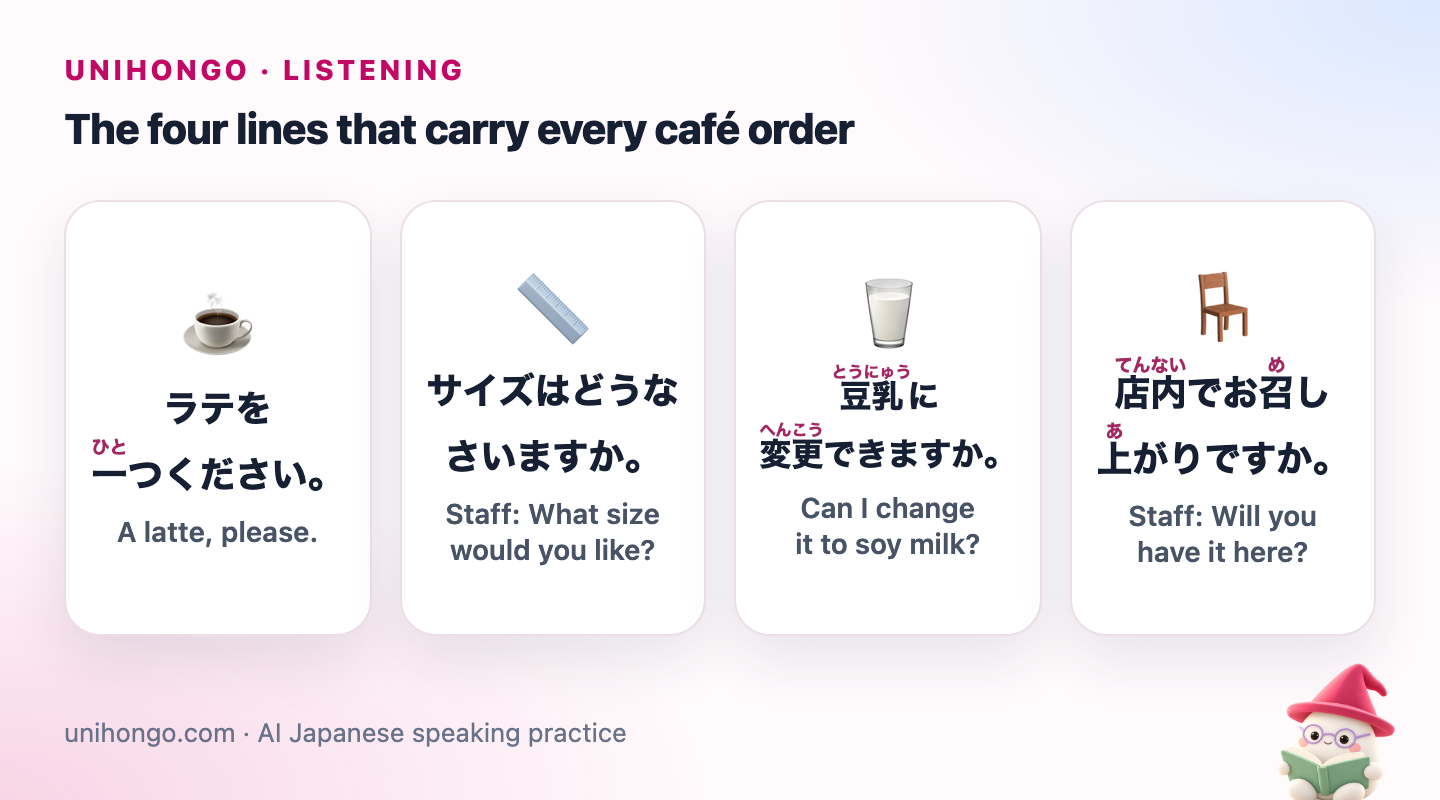
| Japanese | Romaji | Meaning |
|---|---|---|
| ラテを一つください。 | Rate o hitotsu kudasai. | A latte, please. |
| サイズはどうなさいますか。 | Saizu wa dō nasaimasu ka. | Staff: What size would you like? |
| 豆乳に変更できますか。 | Tōnyū ni henkō dekimasu ka. | Can I change it to soy milk? |
| 店内でお召し上がりですか。 | Tennai de omeshiagari desu ka. | Staff: Will you have it here? |
The script: ordering a café latte
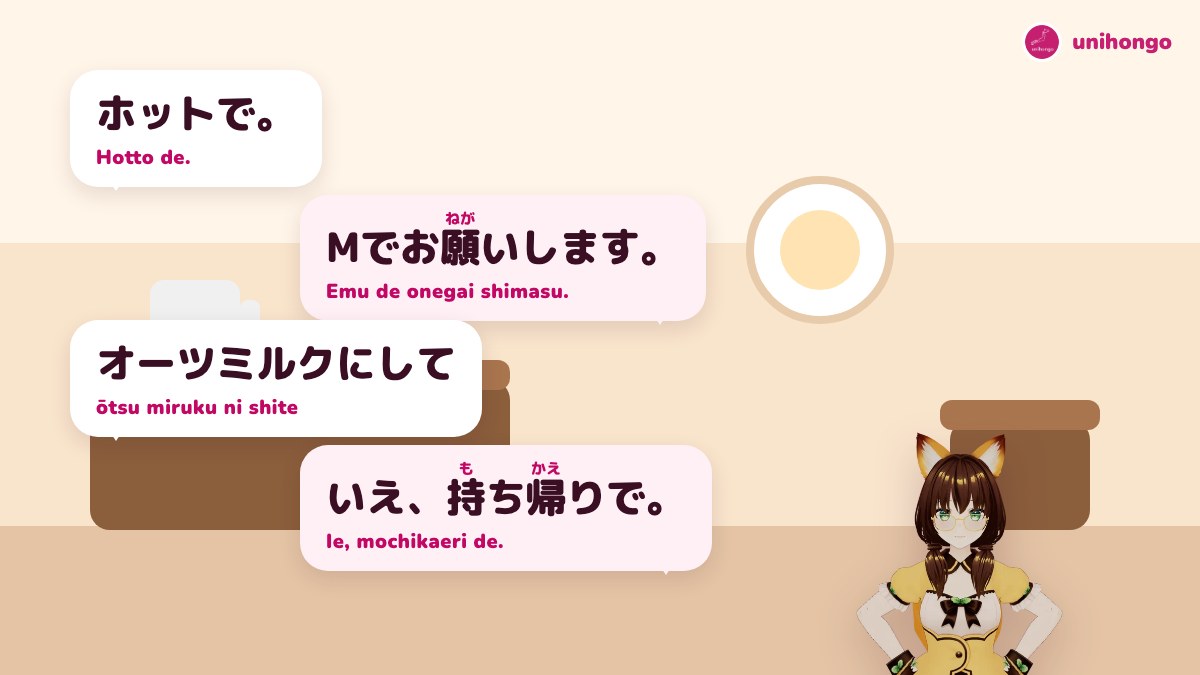
A customer orders a hot café latte with oat milk to take away. Read the Japanese line by line, then read it again without looking at the English. The staff lines are typical of chain cafés in Japan, though every shop has its own small habits.
| Japanese | Romaji | Meaning |
|---|---|---|
| いらっしゃいませ。ご注文はお決まりですか。 | Irasshaimase. Gochūmon wa okimari desu ka. | Staff: Welcome. Have you decided on your order? |
| えっと、カフェラテを一つお願いします。 | Etto, kafe rate o hitotsu onegai shimasu. | You: Um, one café latte, please. |
| ホットとアイス、どちらになさいますか。 | Hotto to aisu, dochira ni nasaimasu ka. | Staff: Hot or iced? |
| ホットで。 | Hotto de. | You: Hot. |
| サイズはいかがなさいますか。 | Saizu wa ikaga nasaimasu ka. | Staff: What size would you like? |
| Mでお願いします。 | Emu de onegai shimasu. | You: A medium, please. |
| ミルクは普通の牛乳でよろしいですか。 | Miruku wa futsū no gyūnyū de yoroshii desu ka. | Staff: Is regular milk all right? |
| 豆乳やオーツミルクにも変更できます。 | Tōnyū ya ōtsu miruku ni mo henkō dekimasu. | Staff: We can also change it to soy or oat milk. |
| じゃあ、オーツミルクにしてください。 | Jā, ōtsu miruku ni shite kudasai. | You: Then oat milk, please. |
| かしこまりました。追加料金がかかりますが、よろしいですか。 | Kashikomarimashita. Tsuika ryōkin ga kakarimasu ga, yoroshii desu ka. | Staff: Certainly. There's an extra charge, is that okay? |
| はい、大丈夫です。 | Hai, daijōbu desu. | You: Yes, that's fine. |
| 店内でお召し上がりですか。 | Tennai de omeshiagari desu ka. | Staff: Will you have it here? |
| いえ、持ち帰りで。 | Ie, mochikaeri de. | You: No, to go. |
| お会計はこちらになります。 | Okaikei wa kochira ni narimasu. | Staff: Here is your total. (pointing at the screen) |
| カードで払えますか。 | Kādo de haraemasu ka. | You: Can I pay by card? |
| はい、こちらにタッチしてください。 | Hai, kochira ni tatchi shite kudasai. | Staff: Yes, please tap here. |
| 右手のカウンターでお渡しします。少々お待ちください。 | Migite no kauntā de owatashi shimasu. Shōshō omachi kudasai. | Staff: We'll hand it over at the counter on your right. One moment, please. |
What to listen for
Service keigo looks long on paper, but each question has one key word that tells you what is being asked. Train your ear to catch that word and let the polite wrapper go past. In this script the key words are 注文 (order), ホット and アイス, サイズ, ミルク, 店内 and 持ち帰り, and 会計 (bill).
At speed, the opening いらっしゃいませ often sounds clipped, closer to a quick rasshaimase with the first i nearly gone. かしこまりました is also said fast, often run together as one long word. Do not try to hear every syllable; recognise the shape.
| Japanese | Romaji | Meaning |
|---|---|---|
| ご注文はお決まりですか。 | Gochūmon wa okimari desu ka. | Staff: Have you decided? (polite service form) |
| こちらでお召し上がりですか。 | Kochira de omeshiagari desu ka. | Staff: For here? (common alternative) |
| 店内でご利用ですか。 | Tennai de goriyō desu ka. | Staff: Will you use the shop? (another variant) |
| お持ち帰りですか。 | Omochikaeri desu ka. | Staff: To go? |
- なさいますか is the honorific of しますか. どちらになさいますか simply means which will you have.
- でよろしいですか is a confirmation: is X all right? Listen for the noun before で, then answer はい or ask for a change.
- お召し上がり is the honorific for eating or drinking. Some shops say 店内でご利用ですか instead, which means the same thing.
- 〜になります is shop language for this is. お会計はこちらになります means here is your total; it does not mean will become.
- The customer lines drop particles and verbs: ホットで and 持ち帰りで are short for longer sentences, and they are completely natural.
Common learner mistakes at the counter
- Answering お召し上がりですか with はい when you want to take away. The question is will you have it here, so はい means yes, here. Say 持ち帰りで instead.
- Saying ラテをください and stopping there. The staff will ask the rest anyway, so it is fine, but say the size and temperature together if you want to save time: ホットのMで.
- Using 牛乳 and ミルク as if they were different things. In cafés both mean ordinary milk; 牛乳 is the everyday word, ミルク appears on menus.
- Replying to every question with 大丈夫です. It means no thanks or that's fine depending on the question, which can confuse staff. With yes/no confirmations, はい or いいえ is clearer.
- Expecting the drink at the till. Many chains hand it over at a separate counter, and the staff will tell you where; listen for カウンター and the direction word.
A three-pass listening routine
If you have a recording of this dialogue, from a tutor, a friend who reads the staff lines, or a text-to-speech voice, use it in three passes with a different job each time. If you have no audio, read the staff lines aloud quickly into your phone and use that recording.
- Pass 1, gist with the text hidden: listen once and note only the choices the customer makes: drink, hot or iced, size, milk, here or to go.
- Pass 2, key words: listen again and write down one key word for each staff question, such as サイズ or 店内. Pause after each question and answer it aloud before the customer does.
- Pass 3, full detail with the text: play it with the script in front of you and underline every place where the audio sounded different from the page, such as a dropped vowel or a run-together verb.
- The next day, repeat pass 1 only. If you can follow every choice without the text, move on to the variations below.
Shadowing the customer lines
Shadowing means speaking along with the audio, a fraction of a second behind it, copying its rhythm and pitch. For a café script, shadow the customer lines first, because those are the ones you will actually say, and then the staff lines for listening practice.
Keep each customer line short and fall in pitch at the end: ホットで and 持ち帰りで end on a soft, low で. A rising で sounds like a question. In オーツミルク and カウンター, give the long vowels their full time slot, and keep the small tsu in ホット clear; katakana words are easy to rush.
| Japanese | Romaji | Meaning |
|---|---|---|
| ホットのMでお願いします。 | Hotto no emu de onegai shimasu. | You: A hot medium, please. |
| 氷少なめにできますか。 | Kōri sukuname ni dekimasu ka. | You: Can I have less ice? |
| 砂糖は大丈夫です。 | Satō wa daijōbu desu. | You: No sugar, thanks. |
- Round 1: shadow while reading the script, at a slower speed if you can.
- Round 2: shadow without the script, mumbling where you are unsure.
- Round 3: answer the staff lines yourself with your own choices, without the recording's customer line.
Variations: casual with a friend, extra polite at the counter
With a friend in the queue you will speak casually, and the friend will too. At the counter, plain polite Japanese is enough, but a few softer forms are useful if you want to sound extra careful, for example when asking for a change.
| Japanese | Romaji | Meaning |
|---|---|---|
| 何にする? | Nani ni suru? | Friend: What are you getting? (casual) |
| 私はラテにしようかな。 | Watashi wa rate ni shiyō ka na. | You: I think I'll get a latte. (casual) |
| アイスにすればよかった。 | Aisu ni sureba yokatta. | Friend: I should've got an iced one. (casual) |
| すみません、ミルクを豆乳に変えていただけますか。 | Sumimasen, miruku o tōnyū ni kaete itadakemasu ka. | You: Excuse me, could you change the milk to soy? (very polite) |
| 持ち帰りでお願いできますか。 | Mochikaeri de onegai dekimasu ka. | You: Could I have it to go? (polite) |
In a café, you do not need humble keigo yourself. お願いします and できますか are polite enough for any counter, and over-formal customer speech can sound stiff.
Rehearse the counter until it feels routine
Paste a staff line you found hard, such as 店内でお召し上がりですか, into a chat with Mocchi and type /explain. Mocchi breaks the sentence into its parts, shows the plain form behind the keigo, and remembers which service phrases you keep missing, so a later /quiz can bring them back.
Then take it to a spoken counter: in AI Sensei, start the Order at a Café roleplay mission and ask Sakura-sensei to play the barista at natural speed, then once more slowly. Change your order each time so you have to listen rather than recite.