
Four lines you will say in any clothes shop
These four customer lines cover the main moves in a clothes shop: try it on, ask for another colour, ask for another size, and say how it fits. Learn them first; the staff answers in the script will make far more sense.
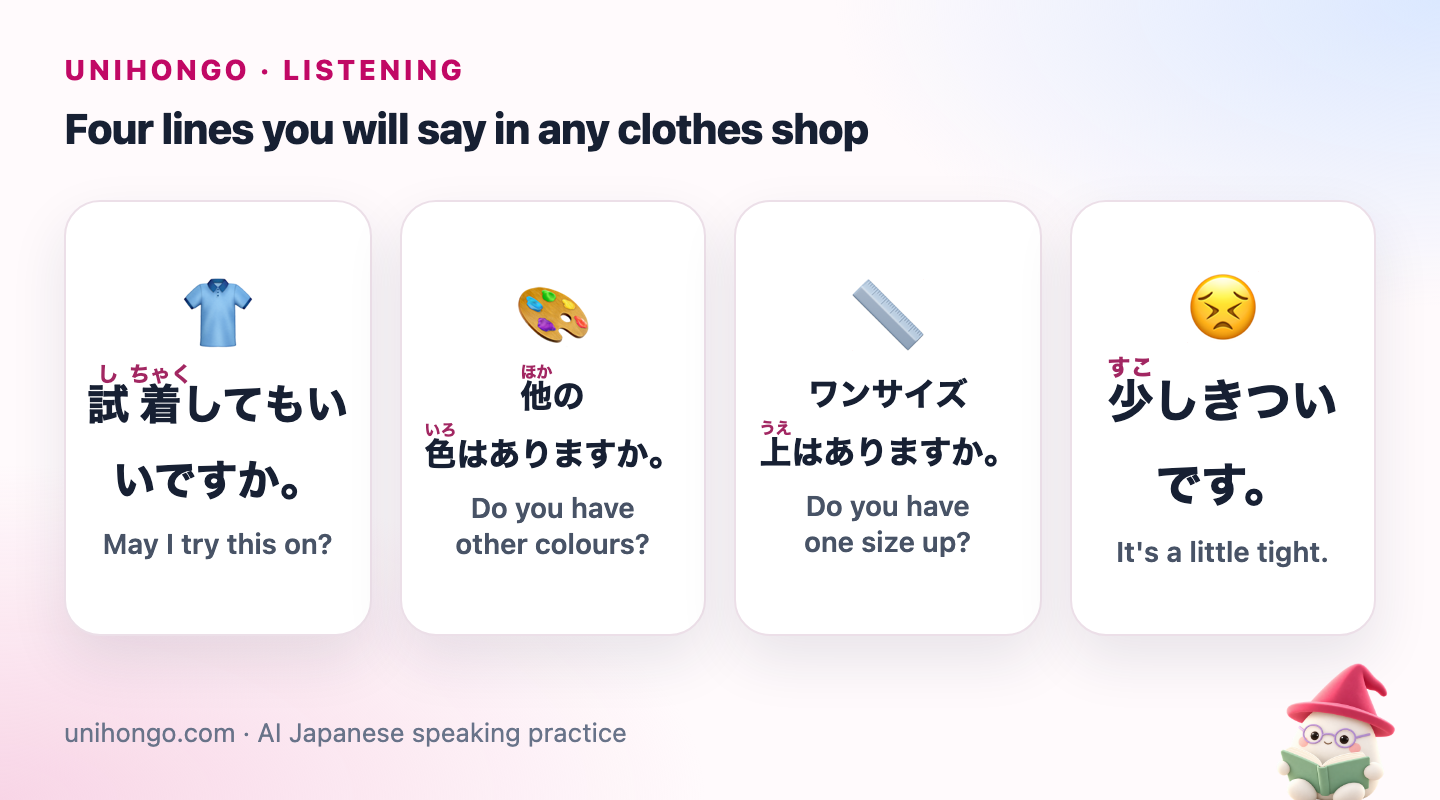
| Japanese | Romaji | Meaning |
|---|---|---|
| 試着してもいいですか。 | Shichaku shite mo ii desu ka. | May I try this on? |
| 他の色はありますか。 | Hoka no iro wa arimasu ka. | Do you have other colours? |
| ワンサイズ上はありますか。 | Wan saizu ue wa arimasu ka. | Do you have one size up? |
| 少しきついです。 | Sukoshi kitsui desu. | It's a little tight. |
The script: a jacket in navy
A customer looks at a jacket, asks about colours, tries on a medium, finds it tight in the shoulders and buys a large. The staff member uses typical shop keigo. Read the whole scene, then read only the staff lines and say what each one means in plain Japanese.
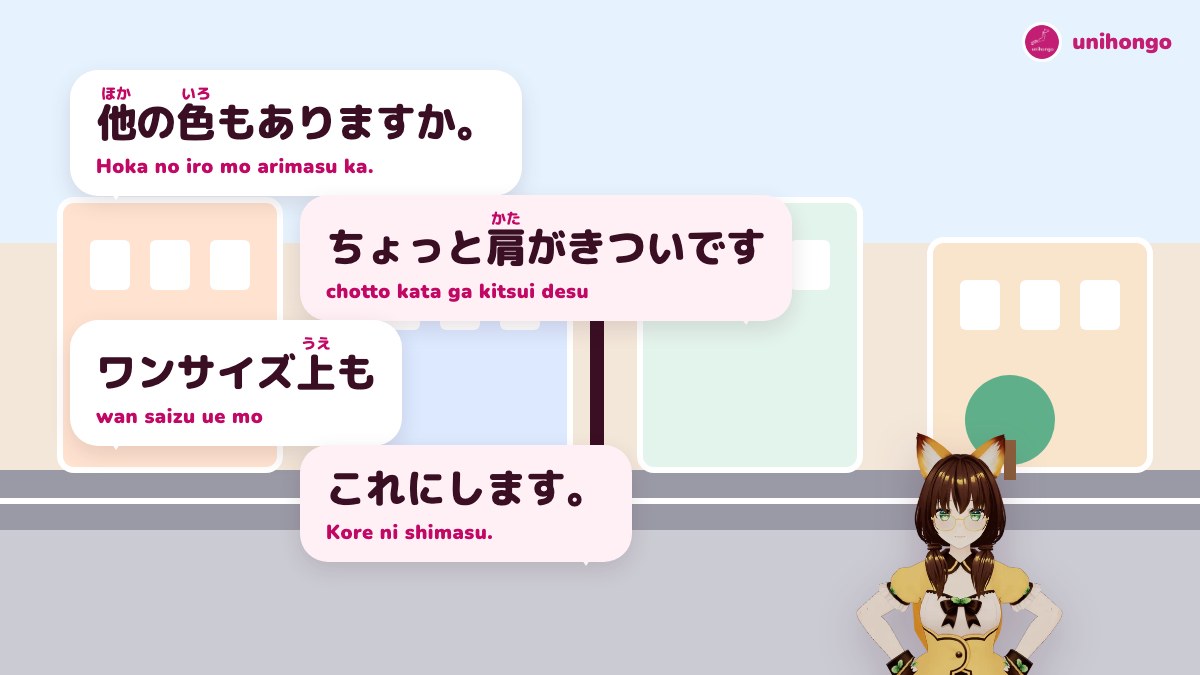
| Japanese | Romaji | Meaning |
|---|---|---|
| いらっしゃいませ。どうぞご覧ください。 | Irasshaimase. Dōzo goran kudasai. | Staff: Welcome. Please have a look. |
| そちら、今季の新作なんですよ。 | Sochira, konki no shinsaku nan desu yo. | Staff: That's new this season. |
| そうなんですか。これ、他の色もありますか。 | Sō nan desu ka. Kore, hoka no iro mo arimasu ka. | You: Oh, is it? Do you have this in other colours too? |
| はい、黒と白とネイビーがございます。 | Hai, kuro to shiro to neibī ga gozaimasu. | Staff: Yes, we have black, white and navy. |
| ネイビーのMサイズはありますか。 | Neibī no emu saizu wa arimasu ka. | You: Do you have navy in a medium? |
| 確認してまいりますので、少々お待ちください。 | Kakunin shite mairimasu node, shōshō omachi kudasai. | Staff: I'll go and check, so please wait a moment. |
| お待たせいたしました。こちらになります。 | Omatase itashimashita. Kochira ni narimasu. | Staff: Sorry to keep you waiting. Here it is. |
| 試着してもいいですか。 | Shichaku shite mo ii desu ka. | You: May I try it on? |
| はい、試着室はこちらです。どうぞ。 | Hai, shichakushitsu wa kochira desu. Dōzo. | Staff: Yes, the fitting room is this way. Go ahead. |
| いかがですか。 | Ikaga desu ka. | Staff: How is it? |
| うーん、ちょっと肩がきついです。 | Ūn, chotto kata ga kitsui desu. | You: Hmm, it's a bit tight in the shoulders. |
| でしたら、ワンサイズ上もお持ちしましょうか。 | Deshitara, wan saizu ue mo omochi shimashō ka. | Staff: In that case, shall I bring one size up as well? |
| お願いします。 | Onegai shimasu. | You: Yes, please. |
| こっちのほうがちょうどいいです。これにします。 | Kotchi no hō ga chōdo ii desu. Kore ni shimasu. | You: This one fits just right. I'll take it. |
| ありがとうございます。お会計はレジでお願いいたします。 | Arigatō gozaimasu. Okaikei wa reji de onegai itashimasu. | Staff: Thank you. Please pay at the register. |
| 袋はご利用ですか。 | Fukuro wa goriyō desu ka. | Staff: Would you like a bag? |
What to listen for
Shop staff talk about their own actions in humble Japanese and about yours in honorific Japanese. You do not need to produce these forms, but you do need to recognise them, because they hide very ordinary verbs.
| You hear | Plain meaning | Type |
|---|---|---|
| ございます | あります (we have) | Polite form of ある |
| 確認してまいります | 確認してきます (I'll go and check) | Humble |
| お待たせいたしました | 待たせました (sorry for the wait) | Humble |
| お持ちしましょうか | 持ってきましょうか (shall I bring it) | Humble |
| ご覧ください | 見てください (please look) | Honorific |
| ご利用ですか | 使いますか (will you use it) | Honorific |
- でしたら at the start of a sentence is a polite それなら, in that case. It signals that the staff member is about to offer a solution.
- In fast speech, 少々お待ちください runs together, and お待たせいたしました often sounds like one long word. Listen for the start, お待た, and you know what follows.
- Shop bags usually cost a little in Japan, so the bag question is a real question. Answer 大丈夫です if you do not need one, or お願いします if you do.
- Colour words from English, such as ネイビー and ベージュ, are pronounced in Japanese rhythm. ネイビー has a long final vowel, so listen for neibī, not navy.
Fit and size words
The words for fit are simple adjectives, and you can attach a body part with が to be precise. Sizes are usually S, M and L, but Japanese sizes often run smaller than European or American ones, so many visitors go one size up; it depends on the brand.
| Japanese | Romaji | Meaning |
|---|---|---|
| ゆるいです。 | Yurui desu. | It's loose. |
| 袖が長いです。 | Sode ga nagai desu. | The sleeves are long. |
| 丈が短いです。 | Take ga mijikai desu. | It's short in length. |
| ちょうどいいです。 | Chōdo ii desu. | It fits just right. |
| ワンサイズ下はありますか。 | Wan saizu shita wa arimasu ka. | Do you have one size down? |
| 裾上げはできますか。 | Susoage wa dekimasu ka. | Can you shorten the hem? |
A three-pass listening routine
- Pass 1, the shopping facts: listen with the text hidden and note the item, the colours offered, the size tried, the problem and the final choice.
- Pass 2, the keigo: listen again and pause after every staff line. Say its plain meaning aloud: ございます becomes あります, まいります becomes きます.
- Pass 3, the details: read along and mark the softeners in the customer lines, such as うーん and ちょっと, which make a complaint sound gentle.
- Repeat pass 1 the next day with the staff lines only. If you can predict the customer's answers, you are ready to shop.
If you have no audio, ask a friend or tutor to read the staff part quickly and with a shop voice, which is often higher and brighter than normal speech. Learners are often surprised by that voice the first time they hear it.
Keep a short list of every staff line you could not catch on the first pass. After a week, many learners find the same few lines on it again and again, usually the humble ones such as 確認してまいります and お持ちしましょうか. Those are the lines worth shadowing most, because the rest of the conversation is easy once they are clear.
Shadowing your requests
Shadow the customer lines with a relaxed, falling tone. The softeners matter: うーん、ちょっと at the start of a complaint gives the staff a second to prepare, and it sounds natural rather than hesitant. Keep the long vowel in ちょうど and the small tsu in ちょっと clear.
Then shadow the staff's long lines, especially 確認してまいりますので、少々お待ちください. You will not say it yourself, but shadowing it once or twice makes it far easier to recognise at the speed staff use.
A useful extra drill is to shadow a staff line and then answer it straight away without the script. Play いかがですか, pause, and give a real reaction about something you are wearing today: 袖がちょっと長いです, or ちょうどいいです. Doing this for every fit word on the list above turns shadowing into speaking practice, and it trains you to answer within the two or three seconds a fitting-room exchange allows.
Saying no, and other variations
Leaving a shop without buying is completely normal, and staff will not push. You just need a soft line. With a friend you will comment on clothes casually; with staff, keep the polite form.
| Japanese | Romaji | Meaning |
|---|---|---|
| ちょっと考えます。 | Chotto kangaemasu. | You: I'll think about it. (polite no) |
| また来ます。 | Mata kimasu. | You: I'll come back. (polite no) |
| 見ているだけです。 | Mite iru dake desu. | You: I'm just looking. |
| それ、似合ってるよ。 | Sore, niatteru yo. | Friend: That suits you. (casual) |
| ちょっと派手じゃない? | Chotto hade ja nai? | You: Isn't it a bit loud? (casual) |
見ているだけです is useful when staff greet you as you enter and offer help. Smile and say it, and you can browse in peace.
From fitting room to vocabulary list
- Ask Mocchi for /vocab on clothes and fit, and it gives you a short set of words with example sentences at your level, then keeps track of the ones you miss.
- Type /create-flashcards for きつい, ゆるい, 丈 and 裾上げ, picking a photo for each, and review them with /review-flashcards.
- Play Kotoba Stack on the games page with your own flashcards so the fit words come back quickly when you need them in the fitting room.