
The four lines behind most directions
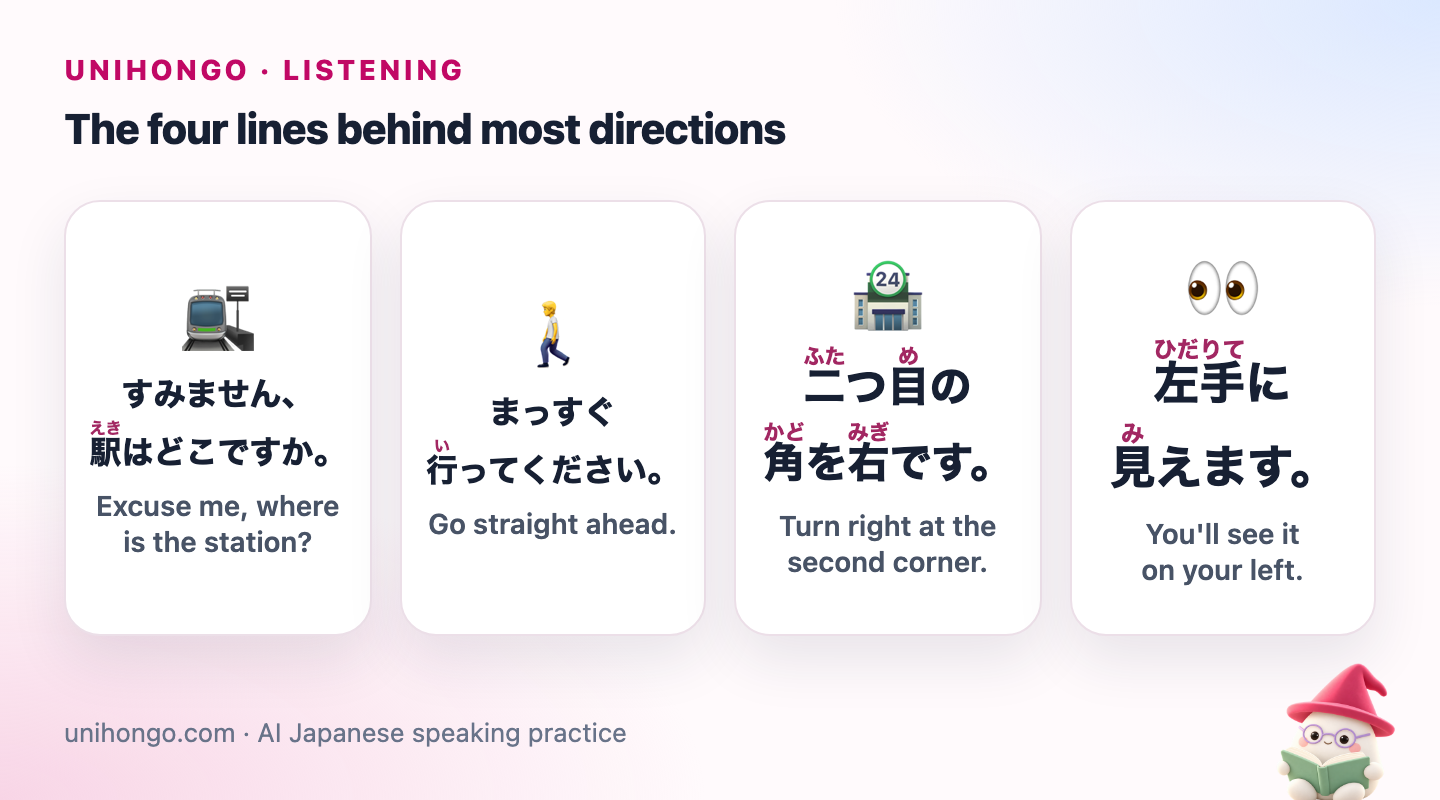
One question and three answers cover a surprising share of real directions. Learn to hear them as fixed blocks before you tackle the full dialogue.
| Japanese | Romaji | Meaning |
|---|---|---|
| すみません、駅はどこですか。 | Sumimasen, eki wa doko desu ka. | Excuse me, where is the station? |
| まっすぐ行ってください。 | Massugu itte kudasai. | Go straight ahead. |
| 二つ目の角を右です。 | Futatsume no kado o migi desu. | Turn right at the second corner. |
| 左手に見えます。 | Hidarite ni miemasu. | You'll see it on your left. |
Notice the particle を in 角を右. In directions, を marks the place you pass through or turn at, not the object of a verb you can see. The verb 曲がる is often dropped, leaving just 角を右.
The script: you're walking the wrong way
A learner is heading for Sakura Station, a fictional station, and stops an older passer-by. The passer-by starts politely, then relaxes into casual speech. Read it through, then read the passer-by's lines alone and draw the route.
| Japanese | Romaji | Meaning |
|---|---|---|
| すみません、ちょっといいですか。 | Sumimasen, chotto ii desu ka. | You: Excuse me, do you have a moment? |
| はい、どうしました? | Hai, dō shimashita? | Passer-by: Yes, what's up? |
| さくら駅に行きたいんですけど、この道で合ってますか。 | Sakura eki ni ikitai n desu kedo, kono michi de attemasu ka. | You: I want to go to Sakura Station. Is this the right way? |
| 地図ある?ちょっと見せて。 | Chizu aru? Chotto misete. | Passer-by: Do you have a map? Let me see. (casual) |
| はい、これです。 | Hai, kore desu. | You: Yes, here it is. |
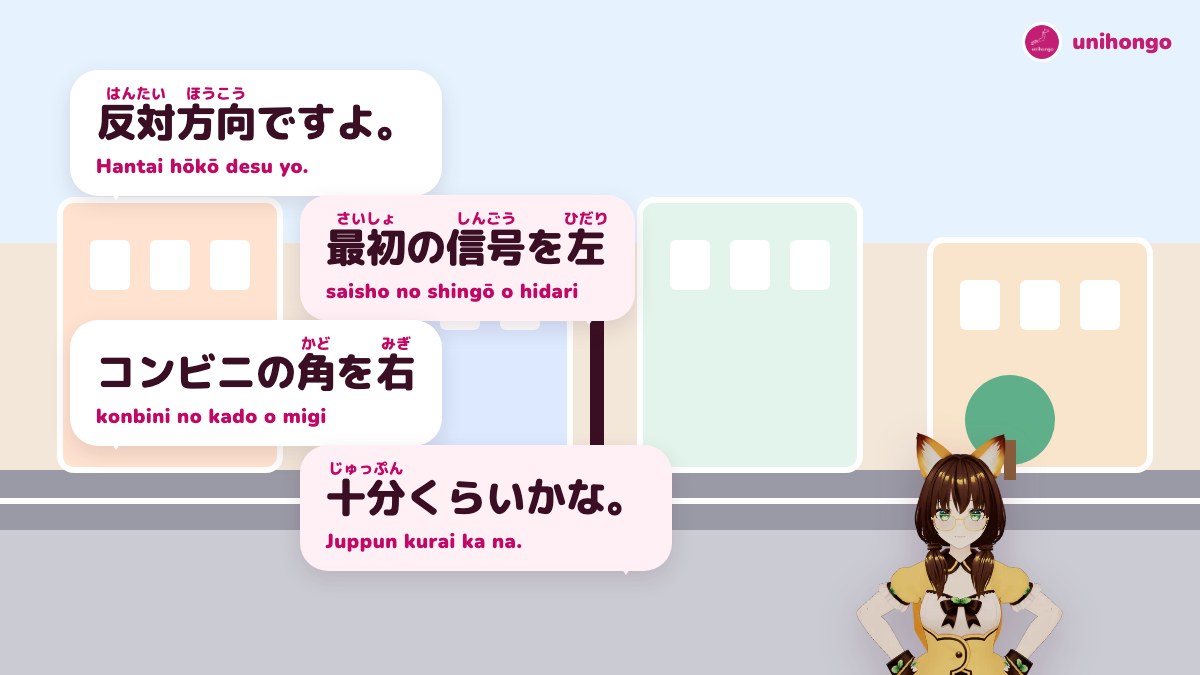
| あ、さくら駅ね。反対方向ですよ。 | A, Sakura eki ne. Hantai hōkō desu yo. | Passer-by: Ah, Sakura Station. It's the other way. |
| えっ、そうなんですか。 | E, sō nan desu ka. | You: Oh, really? |
| うん、ここを戻って、最初の信号を左に曲がってください。 | Un, koko o modotte, saisho no shingō o hidari ni magatte kudasai. | Passer-by: Yes, go back and turn left at the first traffic light. |
| 最初の信号を左ですね。 | Saisho no shingō o hidari desu ne. | You: Left at the first light, right? |
| そうそう。で、しばらくまっすぐ行くと、右側にコンビニがあるんで、 | Sō sō. De, shibaraku massugu iku to, migigawa ni konbini ga aru n de, | Passer-by: That's it. Then go straight for a while and there's a convenience store on the right, so... |
| その角をもう一回右に曲がったら、駅が見えますよ。 | Sono kado o mō ikkai migi ni magattara, eki ga miemasu yo. | Passer-by: ...turn right again at that corner and you'll see the station. |
| コンビニの角を右、ですね。 | Konbini no kado o migi, desu ne. | You: Right at the convenience store corner. |
| 歩いてどのくらいかかりますか。 | Aruite dono kurai kakarimasu ka. | You: How long does it take on foot? |
| うーん、十分くらいかな。 | Ūn, juppun kurai ka na. | Passer-by: Hmm, about ten minutes, I think. |
| わかりました。ありがとうございます。 | Wakarimashita. Arigatō gozaimasu. | You: I see. Thank you very much. |
| 気をつけてね。 | Ki o tsukete ne. | Passer-by: Take care. |
What to listen for
Directions are a chain, so listen for the links. Each link has a landmark (信号, 角, コンビニ, 突き当たり) and an action (戻る, 曲がる, まっすぐ行く). The connecting words tell you that the next link is coming: て-form verbs such as 戻って, the word で at the start of a sentence, と after a plain verb (行くと, when you go), and 〜たら (曲がったら, once you turn).
Several forms are shortened in natural speech. 合ってますか is 合っていますか with the い dropped. あるんで is a casual あるので, because there is. 一回 often sounds like ikkai with a clear pause for the small tsu. Numbers of minutes change sound too: 十分 is juppun, not jūfun.
| Japanese | Romaji | Meaning |
|---|---|---|
| 突き当たりを左です。 | Tsukiatari o hidari desu. | Turn left at the end of the road. |
| 信号を渡ってください。 | Shingō o watatte kudasai. | Cross at the traffic light. |
| 橋の手前です。 | Hashi no temae desu. | It's just before the bridge. |
| 銀行の向かいにあります。 | Ginkō no mukai ni arimasu. | It's opposite the bank. |
| You hear | Full form | What it signals |
|---|---|---|
| 戻って | 戻ってください | First action, more steps follow |
| で、 | それで | Next step in the chain |
| 行くと | 行くと (when you go) | A landmark is about to appear |
| あるんで | あるので | Reason, then the next instruction |
| 曲がったら | 曲がったら (once you turn) | The final step is coming |
| 見えますよ | 見えます + よ | The goal; the directions are over |
Repeat back to confirm
The most useful skill in this script is the learner's habit of repeating each step with ですね. It confirms what you heard, gives the speaker a natural pause, and lets them correct you before you walk off in the wrong direction. Japanese speakers do this with each other, so it never sounds odd.
Repeat only the key part: the landmark and the direction. You do not need the verb. If you missed a step, ask for just that step instead of the whole route.
| Japanese | Romaji | Meaning |
|---|---|---|
| 二つ目の信号を右ですね。 | Futatsume no shingō o migi desu ne. | You: Right at the second light, correct? |
| すみません、もう一度お願いします。 | Sumimasen, mō ichido onegai shimasu. | You: Sorry, once more, please. |
| コンビニの後は、どうしたらいいですか。 | Konbini no ato wa, dō shitara ii desu ka. | You: After the convenience store, what do I do? |
| 地図で指してもらえますか。 | Chizu de sashite moraemasu ka. | You: Could you point to it on the map? |
A three-pass listening routine
- Pass 1, draw the route: hide the text, listen once, and draw arrows and landmarks on paper. Do not write words yet.
- Pass 2, catch the links: listen again and write each landmark and direction in order: 戻る, 信号, 左, コンビニ, 右, 駅. Compare with your drawing.
- Pass 3, check the details with the text: read along and mark every shortened form you heard, such as 合ってます and あるんで, and every place where the speaker switched to casual speech.
- A day later, listen to the passer-by's lines only and give the directions back in English. If your route matches, the script has done its job.
If you have no recording, ask a Japanese-speaking friend or tutor to read the passer-by lines at their normal speed, or record yourself reading them quickly and listen back after a day, when you have forgotten the exact words.
Shadowing the confirmation lines
Shadow your own lines first: すみません, ちょっといいですか, the destination sentence and the ですね confirmations. These need a friendly, slightly falling tone. ですね used to confirm falls gently at the end; a sharp rise makes it sound like real doubt.
Then shadow the passer-by's long sentence about the convenience store. It is a good drill for keeping up with connecting words, because the sentence keeps going after あるんで. Breathe after あるんで, not before it.
- Shadow the learner lines three times while reading.
- Shadow the passer-by lines twice without reading, mumbling the parts you miss.
- Say the whole route back from memory in Japanese, using the same connecting words.
Polite and casual variations
Station staff and shop workers will answer in clear polite or service Japanese. Students and older neighbours often answer casually. Learn to understand both; as the person asking, stay polite.
| Japanese | Romaji | Meaning |
|---|---|---|
| 恐れ入りますが、駅はどちらでしょうか。 | Osoreirimasu ga, eki wa dochira deshō ka. | You: Excuse me, which way is the station? (very polite) |
| 二番出口を出て、左にお進みください。 | Niban deguchi o dete, hidari ni osusumi kudasai. | Station staff: Leave by exit 2 and go left. (service keigo) |
| あっちだよ。ついてきて。 | Atchi da yo. Tsuite kite. | Student: It's that way. Follow me. (casual) |
| 一緒に行きましょうか。 | Issho ni ikimashō ka. | Passer-by: Shall I walk you there? (polite) |
Being walked to your destination is common in Japan, especially if the route is complicated. Thank the person at the end with ありがとうございました, using the past form because the help is finished.
Turn the route into a speaking drill
Type /quiz direction words in Japanese into the Mocchi chat. Mocchi asks you one item at a time, explains the ones you miss, and keeps track of the words that keep slipping, such as 突き当たり or 手前, so they come back in later reviews.
When the words are solid, open AI Sensei and try the Ask the Way to the Station mission. Ask Haru-sensei to play a passer-by who gives the route in casual speech at normal speed, and practise confirming each step with ですね.