
Four lines of weather small talk
These four lines open most weather conversations in Japanese. Each one invites a small reaction, which is the whole point: weather talk is less about information than about sharing a moment.
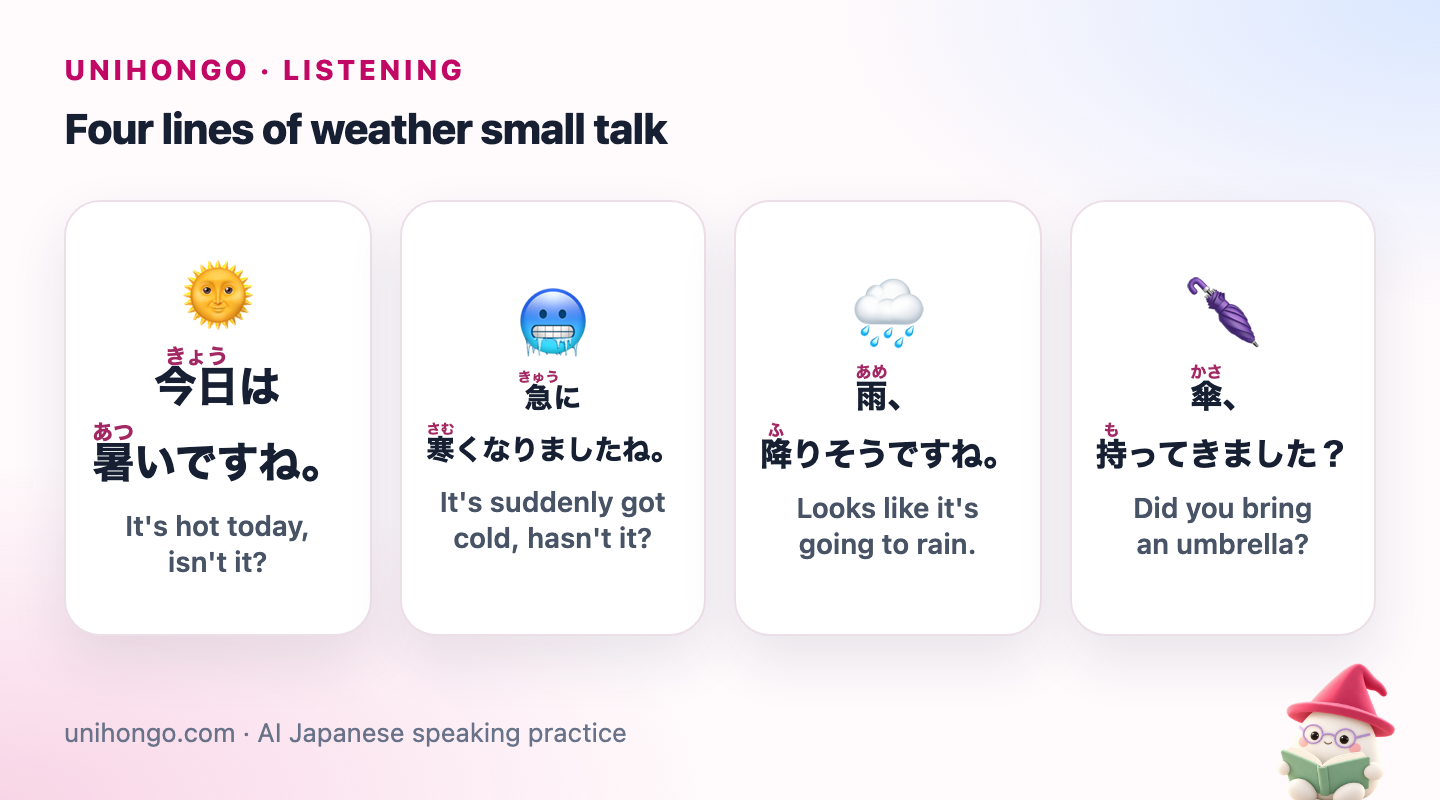
| Japanese | Romaji | Meaning |
|---|---|---|
| 今日は暑いですね。 | Kyō wa atsui desu ne. | It's hot today, isn't it? |
| 急に寒くなりましたね。 | Kyū ni samuku narimashita ne. | It's suddenly got cold, hasn't it? |
| 雨、降りそうですね。 | Ame, furisō desu ne. | Looks like it's going to rain. |
| 傘、持ってきました? | Kasa, motte kimashita? | Did you bring an umbrella? |
The script: a cold October morning
Two coworkers who know each other a little meet in the lift on a cold October morning. They speak polite Japanese with relaxed touches, which is typical between colleagues from different teams. Read it once, then read only the coworker's lines and react as yourself.
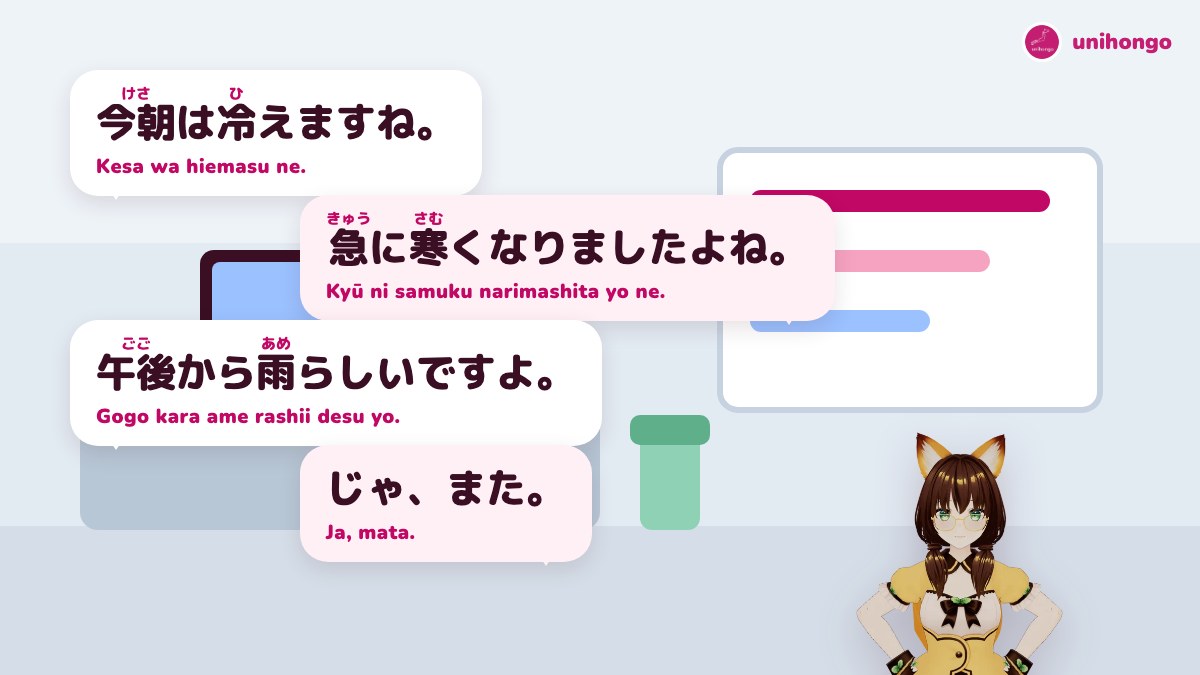
| Japanese | Romaji | Meaning |
|---|---|---|
| おはようございます。 | Ohayō gozaimasu. | Coworker: Good morning. |
| おはようございます。今朝は冷えますね。 | Ohayō gozaimasu. Kesa wa hiemasu ne. | You: Good morning. It's chilly this morning, isn't it? |
| ほんとですね。急に寒くなりましたよね。 | Honto desu ne. Kyū ni samuku narimashita yo ne. | Coworker: It really is. It's suddenly got cold, hasn't it? |
| 先週まで半袖だったのに。 | Senshū made hansode datta noni. | You: And I was in short sleeves until last week. |
| そうそう。もう冬って感じですね。 | Sō sō. Mō fuyu tte kanji desu ne. | Coworker: Exactly. It already feels like winter. |
| 午後から雨らしいですよ。 | Gogo kara ame rashii desu yo. | You: Apparently it's going to rain this afternoon. |
| え、本当ですか。傘持ってきてないや。 | E, hontō desu ka. Kasa motte kitenai ya. | Coworker: Oh, really? I didn't bring an umbrella. |
| 夕方には止むみたいですけどね。 | Yūgata ni wa yamu mitai desu kedo ne. | You: It sounds like it'll stop by the evening, though. |
| じゃあ、ちょっと残業して帰ろうかな。 | Jā, chotto zangyō shite kaerō ka na. | Coworker: Then maybe I'll work a bit late before going home. (joking) |
| それもありですね。 | Sore mo ari desu ne. | You: That's one way to do it. |
| 週末は晴れるといいですね。 | Shūmatsu wa hareru to ii desu ne. | Coworker: I hope it's sunny at the weekend. |
| ですね。紅葉、見に行きたいんですよ。 | Desu ne. Kōyō, mi ni ikitai n desu yo. | You: Me too. I want to go and see the autumn leaves. |
| いいですね。あ、着きました。じゃ、また。 | Ii desu ne. A, tsukimashita. Ja, mata. | Coworker: Sounds nice. Oh, this is my floor. See you. |
| はい、また。 | Hai, mata. | You: Yes, see you. |
What to listen for
Almost every line ends in ね, よね, よ or けどね. These sentence-final particles carry the social meaning of the conversation: ね invites agreement, よね checks shared feeling, よ offers new information, and けどね softens it. If you hear the particle, you know what kind of reply is expected.
The coworker also mixes in casual forms, typical of colleagues who are friendly but not close: ほんと for 本当, 持ってきてないや with a casual や of mild disappointment, and the short ですね on its own, which simply means I agree.
| Ending | Example | What it does |
|---|---|---|
| 〜ですね | 冷えますね | Invites agreement about something you both notice |
| 〜ですよね | 寒くなりましたよね | Checks a feeling you think is shared |
| 〜ですよ | 雨らしいですよ | Offers information the other person may not know |
| 〜けどね | 止むみたいですけどね | Adds a softening extra |
| 〜かな | 帰ろうかな | Thinking aloud, not a firm plan |
| ですね (alone) | ですね。 | Short agreement: me too, exactly |
- らしい and みたい pass on what you heard. 雨らしいですよ means I heard it's going to rain, probably from a forecast. They are softer than 雨が降ります, which sounds like a certainty.
- 〜のに at the end of 半袖だったのに expresses mild surprise or complaint: and yet I was in short sleeves.
- って感じ means it feels like. もう冬って感じ is a very common casual-polite comment on seasons.
- Listen for the exit signal: あ、着きました. In a lift, the conversation ends the moment the floor arrives, often mid-topic.
Seasonal lines you will hear
Japan's seasons give weather talk most of its material. These lines come up year after year, and recognising them makes small talk much easier. Each region has its own weather, so treat them as common examples.
| Japanese | Romaji | Meaning |
|---|---|---|
| 蒸し暑いですね。 | Mushiatsui desu ne. | It's humid, isn't it? (early summer) |
| 梅雨、明けましたね。 | Tsuyu, akemashita ne. | The rainy season's over, hasn't it? |
| 朝晩は涼しくなりましたね。 | Asaban wa suzushiku narimashita ne. | Mornings and evenings have got cooler. (autumn) |
| 花粉、つらいですよね。 | Kafun, tsurai desu yo ne. | The pollen's awful, isn't it? (spring) |
| 雪、積もるみたいですよ。 | Yuki, tsumoru mitai desu yo. | Apparently the snow will settle. (winter) |
A three-pass listening routine
- Pass 1, the topics: listen without the text and list the topics in order: cold, short sleeves, rain, umbrella, overtime joke, weekend, autumn leaves.
- Pass 2, the endings: listen again and write down the final particle of every line: ね, よね, よ, けどね, かな. Notice who uses which.
- Pass 3, tone with the text: read along and mark the joke (残業して帰ろうかな). Would you have understood it as a joke from the tone alone?
- Next day, listen to the coworker's lines only and reply with today's real weather.
Lift conversations are quiet and quick. If you record this script, speak softly and naturally, and try listening with background noise, such as a fan, to make it closer to the real thing.
After the third pass, try the script from the other side: read the coworker's lines as your own and imagine a new partner. Taking both roles helps you hear the conversation as a whole rather than as your lines and their lines.
Shadowing agreeable intonation
The sound of agreement is more important than the words here. Shadow the ね at the end of each line: in agreement it is usually short and gently falling or level, not a sharp rise. A sharp rise turns it into a real question and can sound as if you doubt the other person.
よね is a little longer and often rises slightly on よ before ね. Shadow 急に寒くなりましたよね three times, then 今朝は冷えますね three times, and feel the difference. Finally, shadow the whole script at the coworker's speed, including the quick exit.
It also helps to shadow the reactions on their own: ほんとですね, そうそう, ですね and いいですね. These short replies make up a large part of real small talk, and saying them with the right length and warmth matters more than any weather word. Record yourself saying each one and compare it with your audio; most learners find their first attempts sound flatter than they expected.
Variations: neighbour, shopkeeper, close friend
The same weather comment changes with the person. With an older neighbour it is a little more formal; with a shopkeeper it is polite and brief; with a close friend it is casual and often more complaining.
| Japanese | Romaji | Meaning |
|---|---|---|
| 今日はお寒いですね。 | Kyō wa osamui desu ne. | Neighbour: It's cold today, isn't it? (polite, a little formal) |
| 足元にお気をつけて。 | Ashimoto ni oki o tsukete. | Shopkeeper: Watch your step. (on a rainy day) |
| 寒すぎない? | Samusugi nai? | Friend: Isn't it way too cold? (casual) |
| マジで無理。 | Maji de muri. | You: Seriously, I can't take it. (very casual slang) |
お寒いですね with the polite お is common among older speakers and in shops. You do not need to use it yourself, but it is good to recognise.
Thirty seconds a day
Every morning, tell Mocchi what the weather is like in one Japanese sentence and ask for a natural ね reply with /correct. Mocchi fixes the sentence, suggests a follow-up comment a coworker might make, and remembers which particles you mix up, so it can keep coming back to them.
For the sound of agreement, the pronunciation coach has drills on sentence intonation: listen, record yourself and get a score with a tip, which is a direct way to hear whether your ね sounds friendly or like a question.